5 Questions to Vet Inverter Surge Protection Installers, South Africa
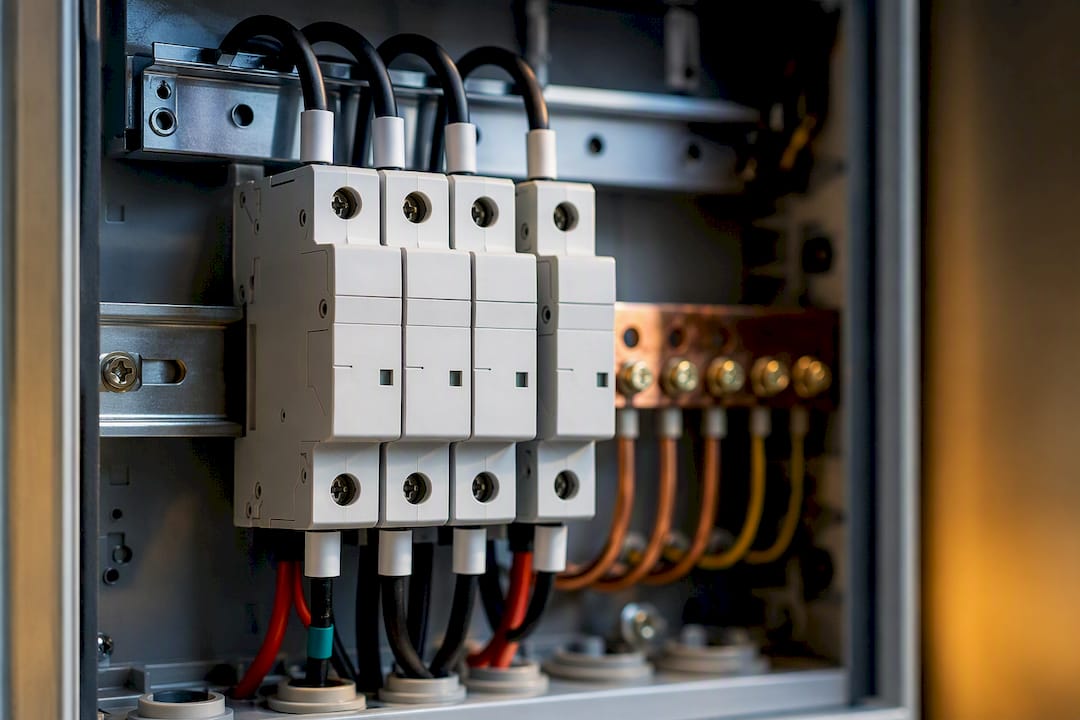
Protecting an inverter requires coordinated surge protection on both the DC and AC sides, plus proper earthing. Install DC-rated SPDs at the array or combiner box, and a Type 2 AC SPD at the inverter output or main distribution board. That combination handles most induced surges from nearby lightning strikes and switching events on the grid. It won't save your inverter from a direct strike, but it dramatically cuts your risk.
*TL;DR:>
- Proper surge protection requires DC-rated SPDs at the combiner box for string voltages and Type 2 AC SPDs at the inverter output or main distribution board.*
- The DC SPD voltage rating must match your array's actual open-circuit voltage with margin, and lead lengths should be short and straight for maximum effectiveness.
- Site conditions like coastal or high-altitude areas increase lightning risk, so choosing higher-class SPDs and thorough earthing is essential for protection.
- Verify installer compliance with standards such as SANS 10142-1, IEC 61643, and IEC 62109, and demand documented earthing tests, CoCs, and SPD specifications.
- SPDs cannot prevent direct lightning strikes but significantly reduce induced surges; regular inspection and proper earthing are critical for system reliability.
Table of Contents
- What surge protection devices does a solar inverter actually need?
- What should you check before choosing an SPD for your inverter?
- How should the earthing and bonding be set up?
- Can surge protection stop lightning damage completely?
- Which standards should your SPD installation comply with?
- Why working with a vetted installer changes the outcome
- How Solarza connects you with installers who get surge protection right
- Sources
- FAQ
What surge protection devices does a solar inverter actually need?
A solar inverter sits between two very different electrical worlds, and each one needs its own SPD. The DC side, running from your panels through the combiner box, carries string voltages that can vary depending on your array configuration. The AC side, from inverter output to your main distribution board, deals with grid-induced surges and switching transients. Treating them as one problem is the single most common mistake homeowners make when briefing an installer.
DC-rated SPDs come in two common voltage classes. A 500 VDC-class device suits smaller string voltages, typically systems under roughly 600 VDC, and tends to be the cheaper, more widely stocked option for residential combiner boxes. A 1,000 VDC-class device is built for longer strings and higher-Voc arrays, which is increasingly the norm on modern residential and small commercial installs. Fitting a standard AC-rated arrestor on a DC circuit is a real hazard: DC arcs don't self-extinguish the way AC ones do, and using the wrong-rated device can mean the SPD fails to interrupt the fault at all.On the AC side, a Type 2 SPD for single-phase 230 V systems is the standard fit for most residential grid-tied inverter outputs. It balances cost and protection, and SANS 10142-1 treats Class II devices as the baseline requirement for main distribution board protection. Larger homes or small commercial sites running three-phase supplies need a three-phase Type 2 SPD (230/400 V) instead, sized for the extra capacity and phase count.
Where lightning exposure is high, or where a lightning protection mast is already installed on the property, installers often specify combined Class I/II modules or coordinated SPD kits. These pair a higher-energy entry-point device with downstream Type 2 units, so the heavy lifting happens at the service entrance and the finer clamping happens close to the equipment.
You'll encounter these devices in a few physical formats on site. Combiner-box-mounted SPDs sit directly at the string junction where DC voltage is highest. DIN-rail SPDs inside the inverter's own distribution board handle the AC output stage. Plug-in Type 3 point-of-use protectors show up occasionally on sensitive downstream electronics, though they're not a substitute for the DC and AC devices doing the real work upstream.
What should you check before choosing an SPD for your inverter?
Get this wrong once and you'll pay for it twice: once for the failed SPD, again for whatever damage it should have stopped. A short checklist keeps the decision simple.
Run through these points before signing off on a quote:
- Confirm the SPD class matches its location: Class I / Type 1 for service entrances with lightning masts, Class II / Type 2 for the main DB and inverter DB, Type 3 only for sensitive point-of-use loads.
- Match the DC SPD's voltage rating to your array's actual open-circuit voltage (Voc), with margin, not just the inverter's rated input.
- Check that the SPD's clamping (residual) voltage sits comfortably below your inverter's stated immunity level, referenced against its technical specifications.
- Insist on short, straight lead lengths between the SPD and the busbar it protects.
- Confirm the device has a visible end-of-life indicator, and ask what the replacement procedure looks like when it trips.
- Ask for evidence of a coordinated earthing and bonding scheme, not just a single earth spike near the inverter.
Site conditions matter too. Coastal and high-altitude regions carry a higher lightning strike density than inland lowveld areas, which should influence how conservative your SPD class selection is. Long cable runs between array and inverter increase induced surge risk. Ground-mounted arrays often need a different earthing approach than roof-mounted ones, and a soil resistivity test is worth asking about if your installer hasn't mentioned it.
When you're comparing quotes, ask the installer these five questions directly:
- What exact SPD model and voltage/current rating are you specifying for the DC and AC sides?
- Where physically will each SPD be fitted, and how far from the combiner box or main DB?
- Can you show test evidence for the earthing system, not just a verbal assurance?
- Who issues the Certificate of Compliance, and is it included in the quoted price?
- What's the replacement procedure and cost when an SPD trips its end-of-life indicator?
Pro Tip: Ask to see the SPD's clamping voltage on the datasheet before installation, not after. A device that clamps too high for your inverter's immunity spec is a surge protector in name only.
Red flags are usually obvious once you know what to look for: a quote that lists a generic AC arrestor for the DC side, SPD leads longer than roughly 50 centimeters, no mention of bonding between array frames and the DB, or a Certificate of Compliance that's "available on request" rather than included as standard.
How should the earthing and bonding be set up?
Lightning protection zones, or LPZs, describe how surge energy is meant to reduce in stages as it moves from the outside world toward your sensitive equipment. Type 1 or Class I devices absorb the bulk of the energy at the service entrance or wherever an external lightning protection system connects to the building. Type 2 devices, positioned at the main DB and inverter DB, handle what gets through. Type 3 devices, where used, offer a final layer right at delicate electronics.
Lead length matters more than most homeowners expect. Every extra centimetre of cable between an SPD and the busbar it's protecting adds inductance, and that inductance raises the let-through voltage during a fast transient. Installers should route SPD leads as short and straight as physically possible, avoiding coils or unnecessary bends.
Bonding needs to tie the whole system together electrically:
- Array frames and mounting rails bonded to a common earth point.
- Inverter chassis earthed per manufacturer instructions.
- Main DB and sub-DB earth bars connected with adequately sized conductors.
- Earth electrode placement considered relative to soil conditions, not just wherever is convenient to dig.
Once installed, SPDs aren't a set-and-forget purchase. A visual indicator window changes colour, usually from green to red, when the device has absorbed enough surge energy to need replacement. Have an installer or qualified electrician check these indicators at least once a year, and immediately after any known nearby lightning event.
Can surge protection stop lightning damage completely?
No, and any installer who tells you otherwise is overselling. SPDs are designed to clamp switching surges and the induced surges that travel through cabling after a nearby strike. A typical lightning-induced surge on a power system runs around 25,000 amps, and a direct strike to the building or array can deliver current far beyond what any consumer-grade SPD is rated to absorb.
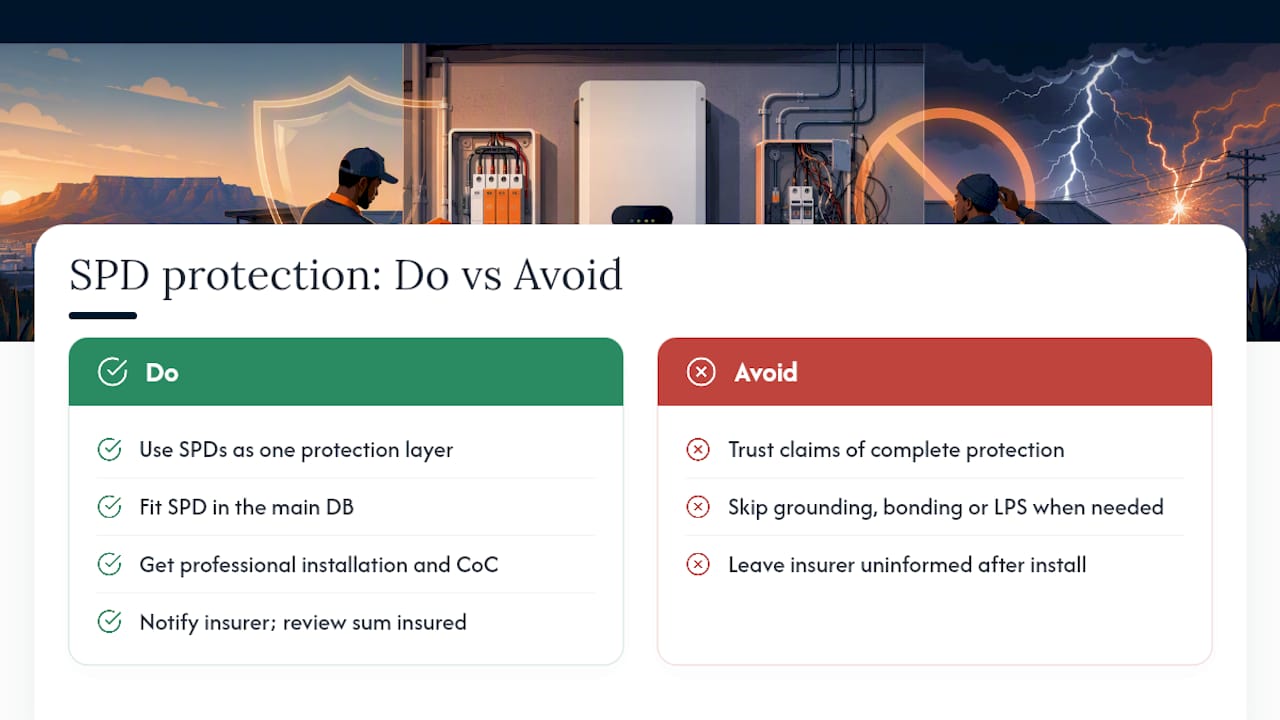
That's why SPDs work as one layer in a broader system, alongside grounding, bonding, and, where risk warrants it, a dedicated lightning protection system with masts and Class I devices.
Insurers factor this reality into how they treat claims. Reputable industry reporting notes that insurers generally respond more favourably when a homeowner can show professional installation, SPDs fitted in the main DB, and a valid Certificate of Compliance. Since permanently installed solar equipment is usually classified as a building fixture rather than contents, it's worth reviewing your sum insured and notifying your insurer once installation is complete.
Keep photographs of the finished installation, retain your invoices, and file the CoC somewhere you can find it quickly. None of that prevents a strike, but all of it speeds up a claim if one ever happens.
Which standards should your SPD installation comply with?
Three references do most of the work in South Africa. SANS 10142-1 is the wiring code that sets out where SPDs belong and requires Class II devices with replaceable cartridges in main distribution boards. IEC 61643 series standards define the international test waveforms, 10/350 for lightning current and 8/20 for surge current, that manufacturers use to rate Iimp and Isn figures on their datasheets. IEC 62109 covers inverter safety more broadly, and cross-checking your inverter against an approved technical specification list helps confirm its stated immunity level lines up with the SPD clamping voltage your installer proposes.
Ask for these standards by name on any quote. Coordinated earthing across the array, inverter and DB isn't optional; it's the thing that makes every SPD in the system actually work as designed.
Why working with a vetted installer changes the outcome
Solarza's role is matching homeowners with installers, not selling SPDs directly, and that distinction matters here. The installers listed through the platform have handled inverter protection and earthing work under SANS requirements before, which counts for more than a low quote on paper. If there's one practical step worth taking before you commit to anyone, it's requesting quotes from more than one installer and asking each to list the exact SPD models and CoC they'll provide in writing.
— Kobus Kohvik
How Solarza connects you with installers who get surge protection right
There's a real cost to guessing on this. An installer who skips a proper earthing test, or fits an AC-rated device where a DC SPD belongs, leaves you exposed in exactly the scenario you bought protection for. An alternative to cold-calling electricians is a platform that connects you directly with vetted, rated installers who document their SPD models, earthing tests, and Certificates of Compliance as standard practice.
You can search installers by service, including inverter installation work, or filter by city and province to find teams already working in your area. If you'd rather compare options side by side first, use the solar calculator to estimate your system size, then request a free quote and ask each installer to itemise their proposed SPD specification before you decide. It costs nothing to compare, and it's the fastest way to confirm the installer you choose actually understands DC versus AC surge protection before they're on your roof.
Sources
- Lightning damage to solar systems in South Africa explained
- Approved photovoltaic inverter list and technical specifications (SSEG / local reference)
FAQ
Does solar need surge protection?
Yes. Both the DC side (panels and combiner box) and the AC side (inverter output and main DB) need dedicated SPDs, since a surge can enter through either path and damage the inverter's electronics.
How can I protect my solar inverter from lightning strikes?
Fit DC-rated SPDs near the combiner box, a Type 2 AC SPD at the inverter output or main DB, keep lead lengths short, and ensure the whole system is properly earthed and bonded. Working with an installer sourced through Solarza who documents this work with a CoC gives you a verifiable record of correct installation.
What are the downsides of using a surge protector?
SPDs have a finite absorption capacity and eventually reach end-of-life after significant surge events, which means periodic inspection and occasional replacement. They also cannot stop a direct lightning strike carrying extreme current, only the induced surges that follow.
What should never be plugged into a surge protector?
This concern applies mainly to household point-of-use strips, not inverter-side SPDs. On the inverter side, the real risk is the reverse: never wire DC circuits into an AC-rated arrestor, since it isn't built to interrupt a DC arc safely.