Solar Inverter Reviews South Africa: Top Brands in 2026
 *
*
TL;DR:>
- Reliability and access to local service centers are the most important factors when choosing a solar inverter in South Africa.*
- The optimal inverter size depends on your peak load, with a safety margin of 20-25 percent, to ensure smooth operation during outages.
For South African homes and small businesses, the top-rated solar inverters in 2026 are Sunsynk, Deye, Victron Energy, Sungrow, Huawei Digital Power, GoodWe, Growatt, and the Solis S6-EH1. Each has earned its place through a combination of local service coverage, load shedding performance, and real-world reliability. Solarza's installer network also connects buyers with vetted professionals who can recommend and install the right model for your specific setup.
Here is a quick-reference shortlist of the leading options:
- Sunsynk hybrid inverters (5 kW–12 kW): Best for high-consumption homes, farms, and businesses.
- Deye hybrid inverters (3.6 kW–12 kW): Competitive pricing with solid battery integration. Well-suited for residential and small commercial setups needing scalable power.
- Victron Energy inverter range (0.5 kW–15 kW): The go-to for off-grid and specialized configurations. Trusted globally, with strong local distributor support and flexible system design.
- Sungrow hybrid inverters (3 kW–12 kW): Good efficiency, easy expandability, and local warranty fulfillment. Popular with homeowners wanting a reliable hybrid system at a fair price.
- Huawei Digital Power inverters (3 kW–10 kW): High efficiency with smart grid connectivity. Best for tech-forward buyers who want integrated monitoring and commercial-grade build quality.
- GoodWe inverter range (3 kW–10 kW): Durable, affordable, and growing its South African footprint. Strong warranty terms and dependable performance for budget-conscious buyers.
- Growatt inverter range (1 kW–10 kW): Entry-level pricing with wide availability. Adequate local support for small-scale setups where cost is the primary driver.
- Solis S6-EH1 8 kW hybrid: Silent intelligent fan cooling, 10-year swap-out warranty, and fast 190A battery charging. Installed cost is approximately R21,500. Ideal for suburban estates.
- SMA Solar Technology: A premium German brand with strong string inverter credentials. Less common in the South African residential hybrid market but respected for build quality and longevity.
- Solarza installer network: Connects you with verified local installers who supply and fit the brands above, with tailored quotes and transparent pricing across all nine provinces.
Key stat: Reliability outweighs specs or brand prestige as the top selection criterion for South African solar installers. Local service access is the deciding factor when two inverters look similar on paper.*
Table of Contents
- How do the top solar inverter brands compare in South Africa?
- How do you size and choose the right solar inverter?
- What do solar inverters cost in South Africa in 2026?
- Solar inverters versus generators for load shedding
- What do South African solar experts say about inverter reliability?
- Buyer's guide: what to check before you buy a solar inverter
- What South African homeowners say on solar forums
- Solarza connects you with the right installer for your inverter
- Key Takeaways
- FAQ
How do the top solar inverter brands compare in South Africa?
The brands below cover the full range of South African buyer needs, from entry-level backup to full off-grid independence. One lead-in worth noting: Sunsynk and Deye share comparable core electronics, so the price premium you pay for Sunsynk largely buys you better local software, a more polished app, and stronger warranty fulfillment rather than fundamentally different hardware.
| Brand | Key Models | Output (kW) | Type | Price Range (ZAR, installed) | Local Service | Battery Compatibility | Load Shedding Suitability | Best For |
|---|---|---|---|---|---|---|---|---|
| Sunsynk | SYNK-5K, SYNK-8K, SYNK-12K | 5–12 | Hybrid | R25,000–R45,000 | JHB, CPT, DBN | Li-ion, Lead-acid, User-defined | Excellent | High-consumption homes, farms, businesses |
| Deye | SUN-5K, SUN-8K, SUN-12K | 3.6–12 | Hybrid | R18,000–R38,000 | Nationwide distributors | Li-ion, Lead-acid | Excellent | Residential and small commercial |
| Victron Energy | MultiPlus-II, Quattro | 0.5–15 | Hybrid/Off-grid | R22,000–R55,000 | Nationwide distributors | All battery types | Excellent | Off-grid, specialist installs |
| Sungrow | SH5K-30, SH8K-20, SH10RT | 3–12 | Hybrid | R20,000–R40,000 | Nationwide distributors | Li-ion, Lead-acid | Very good | Homeowners wanting expandability |
| Huawei Digital Power | SUN2000-5KTL, SUN2000-10KTL | 3–10 | Hybrid | R22,000–R42,000 | Select distributors | Huawei LUNA, third-party | Very good | Tech-savvy buyers, smart grid |
| GoodWe | ES, EM, DNS series | 3–10 | Hybrid/String | R16,000–R35,000 | Growing SA network | Li-ion, Lead-acid | Good | Budget-conscious buyers |
| Growatt | SPF, MIN, MOD series | 1–10 | Hybrid/Off-grid | R12,000–R28,000 | Nationwide distributors | Li-ion, Lead-acid | Good | Entry-level, small setups |
| Solis S6-EH1 | S6-EH1-8K | 8 | Hybrid | ~R21,500 | JHB, CPT, DBN | Li-ion, Lead-acid | Excellent | Quiet suburban homes, EV charging |
| SMA Solar Technology | Sunny Boy, Sunny Tripower | 3–25 | String/Hybrid | R28,000–R60,000 | Select distributors | SMA Home Storage | Good | Premium string installs |
| Solarza | Installer network | Varies | All types | Tailored quotes | All 9 provinces | All major brands | Excellent | Buyers wanting vetted installation |
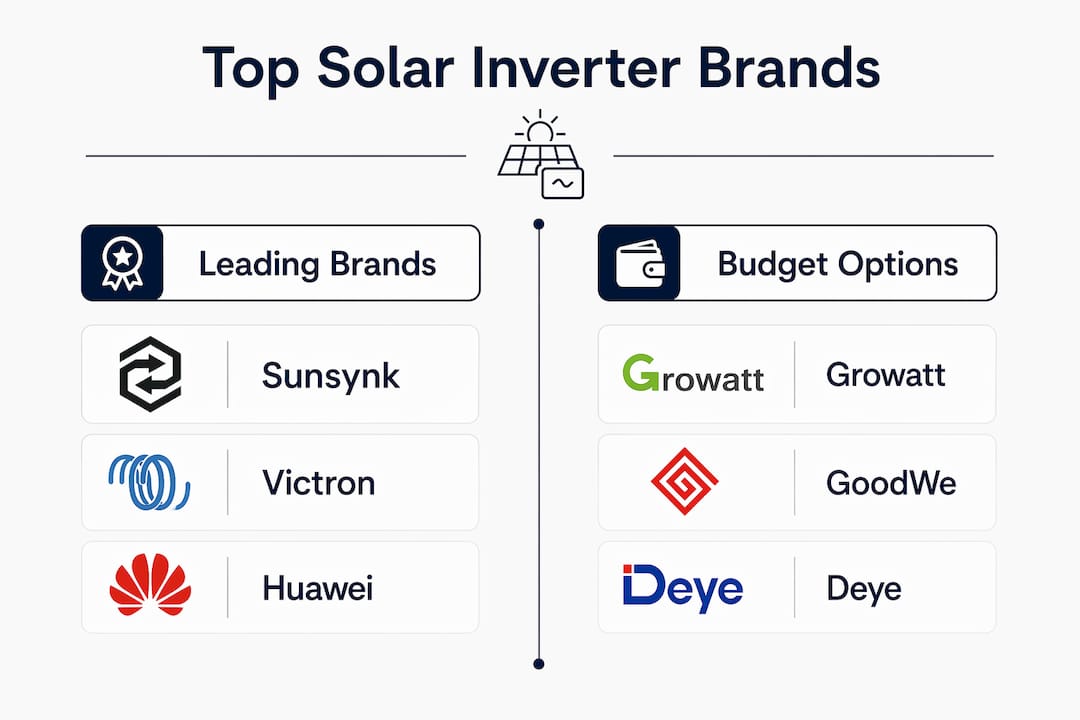 Sunsynk has sold over 50,000 units in South Africa since 2020. The 12 kW SYNK-12K-SG01LP1 switches to battery quickly during load shedding, handles geysers, pool pumps, and 3-phase appliances, with farms reporting high uptime during Stage 6. The 5-year warranty can be extended, and parts availability is strong across Johannesburg, Cape Town, and Durban.
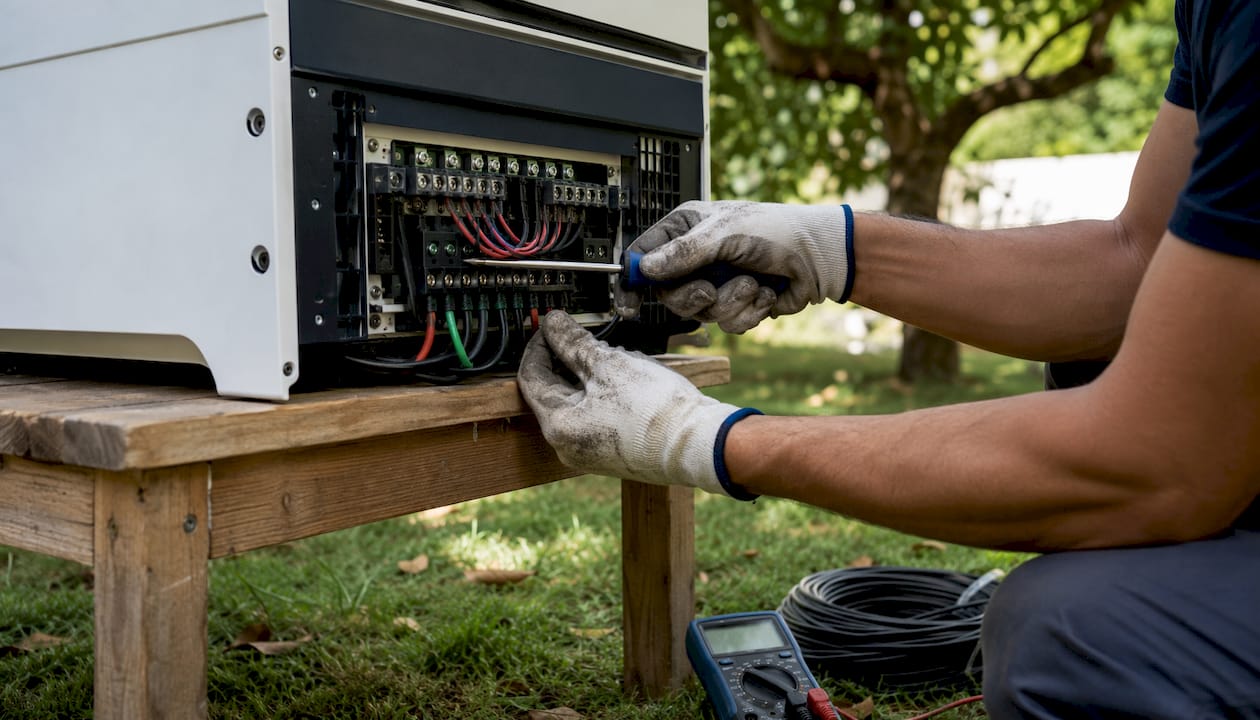 Deye delivers nearly identical inverter performance to Sunsynk at a lower price point. The trade-off is a less polished monitoring app and, in some cases, slower warranty resolution. For buyers who want hybrid performance without paying the Sunsynk premium, Deye is the most direct alternative.
Victron Energy stands apart from the Chinese-manufactured competition. Its MultiPlus-II and Quattro ranges are built for complex configurations: off-grid cabins, marine installs, and systems that need to integrate generators, multiple battery banks, and irregular loads. The VictronConnect app and Color Control GX give installers granular control that most competitors cannot match. It costs more, but for genuinely off-grid applications it is the most capable option available locally.
Sungrow hits a sweet spot for homeowners who want a reliable hybrid system with room to grow. Its SH series supports easy battery expansion and carries local warranty fulfillment, which matters when something goes wrong two years in.
Huawei Digital Power brings commercial-grade build quality to the residential market. The SUN2000 series integrates tightly with Huawei's LUNA battery system and offers some of the best monitoring interfaces available. The catch: battery compatibility is narrower than Victron or Sunsynk, and local service is concentrated in major urban centers.
GoodWe has quietly built a solid reputation in South Africa. Its ES and EM series cover most residential hybrid needs, warranty terms are competitive, and the growing local distributor network means repairs are less of a gamble than they were a few years ago.
Growatt is the entry point. The SPF and MIN series are widely available, pricing is the lowest in this comparison, and performance is adequate for small homes or businesses that need basic backup rather than full energy independence. Do not expect premium software or fast warranty turnaround.
Solis S6-EH1 8 kW is the quiet achiever. Its intelligent fan activates only under load, making it genuinely silent during light use. The 10-year swap-out warranty is the best standard warranty in this comparison, and the 190A battery charge current fills a 48V bank fast. Suburban homeowners who want to run a geyser, pool pump, and EV charger without noise complaints from neighbors consistently pick this model.
SMA Solar Technology is the premium German option. Its Sunny Boy and Sunny Tripower string inverters are respected for longevity and build quality, but SMA's hybrid and battery storage offering in South Africa is less developed than Sunsynk or Victron. Best suited for large string installations where premium build quality justifies the price.
Pro Tip: Before comparing prices, confirm that the quoted price includes installation, commissioning, and a Certificate of Compliance. A R5,000 price difference between brands can disappear entirely once you factor in installation labor and compliance costs.
*
Deye delivers nearly identical inverter performance to Sunsynk at a lower price point. The trade-off is a less polished monitoring app and, in some cases, slower warranty resolution. For buyers who want hybrid performance without paying the Sunsynk premium, Deye is the most direct alternative.
Victron Energy stands apart from the Chinese-manufactured competition. Its MultiPlus-II and Quattro ranges are built for complex configurations: off-grid cabins, marine installs, and systems that need to integrate generators, multiple battery banks, and irregular loads. The VictronConnect app and Color Control GX give installers granular control that most competitors cannot match. It costs more, but for genuinely off-grid applications it is the most capable option available locally.
Sungrow hits a sweet spot for homeowners who want a reliable hybrid system with room to grow. Its SH series supports easy battery expansion and carries local warranty fulfillment, which matters when something goes wrong two years in.
Huawei Digital Power brings commercial-grade build quality to the residential market. The SUN2000 series integrates tightly with Huawei's LUNA battery system and offers some of the best monitoring interfaces available. The catch: battery compatibility is narrower than Victron or Sunsynk, and local service is concentrated in major urban centers.
GoodWe has quietly built a solid reputation in South Africa. Its ES and EM series cover most residential hybrid needs, warranty terms are competitive, and the growing local distributor network means repairs are less of a gamble than they were a few years ago.
Growatt is the entry point. The SPF and MIN series are widely available, pricing is the lowest in this comparison, and performance is adequate for small homes or businesses that need basic backup rather than full energy independence. Do not expect premium software or fast warranty turnaround.
Solis S6-EH1 8 kW is the quiet achiever. Its intelligent fan activates only under load, making it genuinely silent during light use. The 10-year swap-out warranty is the best standard warranty in this comparison, and the 190A battery charge current fills a 48V bank fast. Suburban homeowners who want to run a geyser, pool pump, and EV charger without noise complaints from neighbors consistently pick this model.
SMA Solar Technology is the premium German option. Its Sunny Boy and Sunny Tripower string inverters are respected for longevity and build quality, but SMA's hybrid and battery storage offering in South Africa is less developed than Sunsynk or Victron. Best suited for large string installations where premium build quality justifies the price.
Pro Tip: Before comparing prices, confirm that the quoted price includes installation, commissioning, and a Certificate of Compliance. A R5,000 price difference between brands can disappear entirely once you factor in installation labor and compliance costs.
*
How do you size and choose the right solar inverter?
Getting the size wrong is the most common and most expensive mistake South African buyers make. An undersized inverter trips under load; an oversized one wastes money on capacity you never use.

Step 1: Calculate your peak load
List every appliance you want to run simultaneously during a power outage. Add up their wattages. A typical South African home running a geyser (3,000W), refrigerator (200W), lights (300W), and a TV (150W) needs at least 3,650W of continuous inverter output. Add a 20–25% safety margin, and you are looking at a 5 kW inverter as the minimum.
Step 2: Estimate your daily energy consumption
Your daily kWh figure determines how large your battery bank needs to be, which in turn affects which inverter you choose. A home consuming 20–30 kWh per day needs a battery bank large enough to cover at least one full load shedding cycle, typically 10–15 kWh of usable storage.
Step 3: Match inverter to battery bank
Hybrid inverter performance depends on a battery bank that is properly sized to handle the inverter's charge and discharge rates. A Sunsynk 12 kW charges at 240A at 48V. Running that charge current into a battery bank that is too small will damage the batteries and void your warranty. The general rule: your battery bank's amp-hour capacity should be at least 1.5 times the inverter's maximum charge current.
Step 4: Choose your inverter type
- Hybrid inverters (Sunsynk, Deye, Sungrow, GoodWe): Connect to the grid, charge batteries from solar or grid, and switch to battery during load shedding. Best for most South African homes.
- Off-grid inverters (Victron Quattro, Growatt SPF): No grid connection. Fully self-sufficient but require larger battery banks and more solar capacity. Best for farms and rural properties.
- String inverters (SMA Sunny Boy, GoodWe DNS): Grid-tied only, no battery storage. Lower cost but no backup during load shedding. Only suitable where backup power is not a priority.
Step 5: Verify local support before you buy
An inverter with no local service center is a liability. Inverters commonly fail in the first 12–24 months due to heat stress, and having a service center in Johannesburg, Cape Town, or Durban cuts repair turnaround from weeks to days.
*What do solar inverters cost in South Africa in 2026?
Prices vary by inverter size, type, and brand. The figures below reflect typical installed costs in the South African market in 2026, including basic installation but excluding batteries and panels.
| Inverter Size | Type | Typical Installed Price (ZAR) | Suitable For |
|---|---|---|---|
| 3–5 kW | Hybrid | R12,000–R22,000 | Small homes, apartments |
| 5–8 kW | Hybrid | R18,000–R30,000 | Medium homes, small offices |
| 8–12 kW | Hybrid | R25,000–R45,000 | Large homes, farms, small businesses |
| 8 kW | Hybrid (Solis S6-EH1) | ~R21,500 | Suburban homes, EV charging |
| 12 kW | Hybrid (Sunsynk) | ~R38,500 | High-consumption homes, farms |
| 5–10 kW | Off-grid | R20,000–R40,000 | Rural properties, no grid access |
| 3–10 kW | String (grid-tied) | R10,000–R25,000 | Grid-tied only, no backup |
Pricing note: A Sunsynk 12 kW system installed costs approximately R38,500 with annual savings of around R12,000, giving a payback period of roughly 3.6 years for high-consumption homes.
Several factors push prices up or down. Brand reputation and warranty length account for a meaningful portion of the premium between Sunsynk and Growatt at the same output. Features like dual MPPT, generator integration, and smart load management add cost. Installation complexity matters too: a wall-mounted single-phase unit in a Johannesburg suburb costs less to install than a 3-phase system on a farm in the Northern Cape.
Solar inverter prices in South Africa have stabilized in 2026 after the rand volatility of 2023–2024, but import duties and currency fluctuations still affect pricing on Chinese-manufactured brands. Locally assembled options like Sunsynk tend to have more predictable pricing and faster parts availability.
*Solar inverters versus generators for load shedding
Most South African households have faced the choice at some point: buy a generator or invest in solar with battery backup. The answer depends on how often you need backup, how long outages last, and what you can afford upfront.
Solar inverters with battery storage offer:- Silent, automatic switching during load shedding (10ms for Sunsynk)
- Zero fuel cost once installed
- Reduced electricity bills through solar self-consumption
- Increased property value
- No emissions or noise complaints from neighbors
- Scalability: add more batteries or panels as your needs grow
- Lower upfront cost for equivalent backup capacity
- No dependency on battery state of charge
- Effective for extended outages beyond battery capacity
- Familiar technology with widely available repair services
Hybrid solutions that combine solar inverters with a generator input are increasingly popular on farms and in small businesses. Victron's Quattro and Sunsynk's 12 kW both support automatic generator start, letting the generator kick in only when the battery drops below a set threshold. This gives you the best of both: solar handles the daily load shedding, and the generator covers extended outages or cloudy weeks.
*What do South African solar experts say about inverter reliability?
"Reliability is the most critical metric when choosing a solar inverter for South African conditions. Specs and brand prestige matter far less than whether you can get the unit serviced quickly when it fails.">
— Solar installer consensus, South African market
That view is consistent across the installer community. An inverter that fails during Stage 6 load shedding and sits in a repair queue for six weeks is worse than a slightly less efficient model that gets fixed in three days.
Inverters fail most often in the first 12–24 months due to heat stress on capacitors and fans. This is the component that works hardest in South Africa's climate, particularly in summer when ambient temperatures in Gauteng and the Northern Cape regularly exceed 35°C. Brands with local service centers in Johannesburg, Cape Town, and Durban cut repair turnaround dramatically compared to brands that require units to be shipped overseas.
Battery matching is the second most common source of system problems. Proper battery bank sizing is not optional: a hybrid inverter running into an undersized battery bank will cycle the batteries too aggressively, shortening their life and potentially triggering warranty exclusions. Installers who skip this calculation are cutting corners that cost you money later.
Solar inverters handle significant thermal and electrical stress over their lifespan. Fans and capacitors are the components most prone to failure, which is why a 10-year warranty with a local swap-out option (as offered by Solis) is worth paying for. A 5-year warranty from a brand with no local service center is worth less in practice than a 5-year warranty from Sunsynk with parts available in Johannesburg.
Pro Tip: Ask your installer for the brand's local service center address and average repair turnaround time before you sign anything. If they cannot answer both questions, that is a red flag. *Buyer's guide: what to check before you buy a solar inverter
Key criteria to evaluate
- Continuous power output (kW): Must cover your peak load with a safety margin. Never size to your average load.
- Inverter type: Hybrid for most South African homes; off-grid for rural properties; string only where backup is not needed.
- Warranty length and terms: Minimum 5 years. Confirm whether the warranty covers swap-out or repair, and where service is performed.
- Local service coverage: Service centers in your province, or at least in the nearest major city.
- Battery compatibility: Confirm the inverter works with the battery chemistry you plan to use (Li-ion, LiFePO4, lead-acid).
- Charge current: Higher charge current fills your battery faster. The Sunsynk 12 kW charges at 240A; the Solis S6-EH1 at 190A. Both are fast by residential standards.
- Load shedding switching time: 10ms or less is the standard for seamless switching. Anything slower may cause sensitive electronics to reset.
- MPPT trackers: Two independent MPPT inputs give you more flexibility in panel placement and partial shading scenarios.
- Efficiency rating: Look for 96% or above. The Sunsynk 12 kW achieves 97.6% Euro efficiency; the Solis S6-EH1 achieves 97.0%.
Questions to ask your installer
- What is the inverter's local service center address, and what is the average repair turnaround?
- Does the warranty cover parts and labor, or parts only?
- Is the quoted price all-inclusive (installation, commissioning, Certificate of Compliance)?
- What battery bank size do you recommend for this inverter, and why?
- Can this inverter be paralleled if I need more capacity later?
- Does the monitoring app work offline, or does it require a constant internet connection?
Red flags to watch for
- No local service center listed for the brand
- Warranty terms that require shipping the unit overseas for repair
- Installer who cannot explain battery sizing or charge current
- Prices that exclude installation, commissioning, or compliance certification
- Brands with no track record in the South African market
- Monitoring apps that require a paid subscription to access basic data
What South African homeowners say on solar forums
South African solar forums, particularly the MyBroadband Solar and Load Shedding boards and the Facebook group "Solar Power South Africa," consistently surface the same themes when homeowners share their experiences.
Sunsynk owners report high satisfaction with the monitoring app and the speed of warranty replacements. The most common complaint is the upfront cost, though most owners acknowledge the payback timeline justifies it. A recurring observation: the Sunsynk app gives real-time data that helps homeowners adjust their usage patterns and squeeze more value from their battery storage.
Deye owners are generally happy with performance but frequently mention that warranty claims take longer to resolve than with Sunsynk. The price advantage is real, and for homeowners who have a good local installer managing the relationship with the distributor, the experience is positive.
Victron Energy attracts a technically engaged user base. Forum threads about Victron tend to run long because the system is highly configurable, and owners spend time fine-tuning settings. Complaints are rare; the most common issue is finding an installer who knows the product well enough to set it up correctly.
Sungrow gets consistent praise for reliability and quiet operation. Homeowners in Cape Town and Johannesburg report few issues after 18–24 months of operation, which aligns with the brand's growing market share in South Africa.
GoodWe and Growatt attract budget-focused buyers. Forum sentiment is mixed: many owners are satisfied with the performance relative to the price, but warranty and service complaints appear more frequently than with Sunsynk or Victron. The advice from experienced forum members is consistent: if you go with a budget brand, make sure your installer has a direct relationship with the local distributor.
The Solis S6-EH1 has a smaller but vocal fan base. Suburban homeowners in estates and complexes specifically mention the quiet operation as a deciding factor. The 10-year swap-out warranty gets called out repeatedly as a differentiator that justifies the price over cheaper alternatives.
SMA Solar Technology appears less frequently in residential forum discussions, mostly in threads about larger string installations or commercial projects. Where it does appear, the feedback is positive on build quality and longevity.
*Solarza connects you with the right installer for your inverter
Choosing the right inverter is only half the job. A great inverter installed badly is a liability; a good inverter installed by a verified professional is an asset that pays for itself.
Solarza's nationwide network of vetted solar installers covers all nine provinces, and every installer on the platform has been verified for credentials and rated by real customers. You describe your home or business, select your preferred inverter brand, and receive tailored quotes from local professionals who know the South African market. No cold calls, no guesswork on pricing.
For buyers in Gauteng, the platform lists verified Johannesburg installers who specialize in Sunsynk, Deye, Victron, and Sungrow installations. Cape Town buyers can compare Western Cape specialists with transparent pricing and customer ratings. The same coverage extends to KwaZulu-Natal, the Eastern Cape, and beyond.
The Solarza solar calculator helps you estimate your system size and savings before you speak to anyone. Once you know what you need, request a free quote and compare offers from multiple verified installers in your area. That comparison is what protects you from overpaying or getting undersized equipment.
*Key Takeaways
Reliability and local service access are the two factors that separate a good solar inverter investment from an expensive mistake in South Africa.
| Point | Details |
|---|---|
| Reliability beats specs | Local service center access matters more than efficiency ratings when choosing a South African inverter. |
| Size to peak load | Calculate your maximum simultaneous wattage and add 20–25% before selecting an inverter output rating. |
| Match battery to inverter | Battery bank capacity must be sized to the inverter's charge current to avoid premature battery failure. |
| Warranty terms vary widely | A 10-year swap-out warranty (Solis) or a 5-year extendable warranty (Sunsynk) with local parts is worth more than a longer paper warranty with no local service. |
| Solarza simplifies the process | Solarza's vetted installer network covers all nine provinces, providing tailored quotes and verified professionals for your inverter installation. |
FAQ
Which brand is best for solar inverters in South Africa?
Sunsynk leads for high-consumption homes and businesses, with local assembly, a 5-year warranty, and service centers in Johannesburg, Cape Town, and Durban. For off-grid and specialist configurations, Victron Energy is the most capable option available locally.
Which is better, Sunsynk or Victron?
Sunsynk is better for grid-tied hybrid systems with load shedding backup, particularly for larger homes and farms. Victron is better for off-grid systems, complex configurations, and buyers who need maximum flexibility in battery and generator integration.
What is the most reliable solar inverter for South African conditions?
Reliability depends on local service access more than brand alone. Sunsynk and Solis consistently receive strong reliability feedback in South Africa, partly because both have local service centers and fast parts availability in major cities.
How much does a solar inverter cost in South Africa in 2026?
Installed prices range from around R12,000 for a 3–5 kW entry-level hybrid to R45,000 or more for a 12 kW premium hybrid like the Sunsynk SYNK-12K. The Solis S6-EH1 8 kW installs for approximately R21,500, and the Sunsynk 12 kW for approximately R38,500.
What size solar inverter do I need for a typical South African home?
Most South African homes need a 5–8 kW hybrid inverter for standard load shedding backup. Larger homes running geysers, pool pumps, and air conditioners simultaneously should look at 8–12 kW models. Use Solarza's solar cost calculator to get a figure based on your actual consumption.