Protect warranties: Solar installer checklist for SA homeowners

Get three detailed quotes that name the exact brands, models, and the registered electrician who will sign your Certificate of Compliance. Confirm in writing who manages your municipal SSEG registration and whether local warranty support actually exists for the equipment quoted. Then hold back final payment until you have that signed CoC, a PV GreenCard as-built report where applicable, and full handover documentation in hand.
*TL;DR:>
- Ensure every quote explicitly states the specific brand, model, and local warranty agent for panels, inverters, and batteries to compare value accurately.*
- Confirm the electrician signing the Certificate of Compliance is registered and named in the contract, not just employed by the installer, to ensure legal responsibility.
- Avoid full upfront payment; instead, negotiate a staged payment schedule tied to milestones and verified before releasing final funds.
- Request all essential documents before signing, including the signed CoC, PV GreenCard report, manufacturer warranties, and a detailed commissioning and maintenance report.
- Verify all credentials through PV GreenCard's list and municipal approval lists, and keep a paper trail of communication to support future disputes or warranty claims.
Table of Contents
- How to compare quotes quickly: the comparison grid homeowners should use
- Pre-signing checklist: documents and questions to insist on before you commit
- Handover: documents you must receive and why they matter
- Verify credentials and spot red flags: practical checks and escalation paths
- How SolarZA helps: matching, verification, and simplifying document collection
- Next step: request a free quote or get matched via Solarza
- Official pages to check for compliance, inverter lists, and PV GreenCard verification
- Why the industry's biggest complaint list traces back to one skipped step
- Sources
- FAQ
How to compare quotes quickly: the comparison grid homeowners should use
Three quotes that look wildly different in price usually aren't comparing the same thing. One installer's number might include SSEG registration fees and a five-year workmanship warranty. Another's "cheaper" quote might exclude both and quietly assume you already own a distribution board upgrade. Before you can judge value, you need every quote translated into the same columns.
Put each proposal side by side using these categories:
| Comparison point | What to check |
|---|---|
| Total price | Confirm whether municipal/SSEG fees, VAT, and cabling are included or extra |
| Named electrician | IE or MIE registration number stated in writing |
| Component brand and model | Panels, inverter, battery, with local warranty agent named |
| Workmanship warranty | Length and exactly what it covers beyond the manufacturer warranty |
| Monitoring and aftercare | Remote monitoring included, and stated response time for faults |
| Payment terms | Deposit size, progress payments, and what triggers final payment |
Watch for these red flags on your comparison grid:
- Vague equipment specs ("quality panels," no model number)
- A demand for 100% payment upfront before any work begins
- No written commitment to a Certificate of Compliance
- No named, registered electrician anywhere in the proposal
Homeowners are generally advised to collect at least three quotes and weigh brand, warranty length, and whether the CoC is contractually guaranteed, not just the bottom-line price.
Pre-signing checklist: documents and questions to insist on before you commit
Before you sign anything, the paperwork should already answer most of your questions. If an installer can't produce these documents on request, that's information in itself.
- A written quote listing brands and model numbers for panels, inverter, and batteries, plus the local warranty agent's contact details for each.
- A contract naming the specific IE or MIE who will sign your Certificate of Compliance, and stating clearly who handles SSEG or municipal registration.
- Proof of PV GreenCard or SAPVIA affiliation, at least two past client references, and proof of public liability insurance.
- A staged payment schedule in writing: deposit, progress payments tied to visible milestones, and final payment released only once the CoC is issued.
- A minimum workmanship warranty, separate from the manufacturer warranty, stated as a specific duration in the contract itself.
An installer who won't name the electrician on the contract is one of the clearest warning signs in the entire hiring process. Their registration number belongs in your paperwork, not just on their website. Pro Tip: Photograph every panel, inverter, and battery serial number on installation day, before the installer packs up. It speeds up warranty claims later and helps you catch a substituted component before it becomes your problem.
Handover: documents you must receive and why they matter
The day your system switches on isn't the finish line. What lands in your inbox afterward is what protects the money you just spent.
Insist on receiving all of the following before you consider the job complete:
- The original signed Certificate of Compliance, naming the registered electrician and describing the scope of work covered.
- A PV GreenCard as-built report, if one was issued, plus full manufacturer warranty documents with local agent contact details.
- A commissioning report, monitoring app login, wiring diagrams, and a maintenance schedule.
- A final invoice that matches every line item in your original contract, with no unexplained additions.
- A written workmanship warranty with a direct contact for aftercare, not just a general support email.
Insurers typically want an invoice with full component specifications alongside the CoC before they'll cover a claim involving your solar system. A PV GreenCard as-built report exists specifically to give you and your insurer that paper trail, and only certified installation companies can issue one. Keep every document together, ideally scanned, because a lost CoC can hold up a future home sale.
Verify credentials and spot red flags: practical checks and escalation paths
Trust is easy to promise and expensive to fake. Before work starts, confirm the specific person signing your CoC is actually registered, not just employed by a company that sounds legitimate.
- Check the named electrician's registration through the relevant electrical trade body, and cross-reference the installer against PV GreenCard's certified installer listing.
- Ask for proof of a previous municipal SSEG approval on a comparable job, and confirm the inverter model appears on your municipality's approved list.
- Treat these as hard stops: a demand for full payment upfront, refusal to name an electrician, no written CoC guarantee, or a quote suspiciously below every other bid you received.
An unusually cheap quote often means corners are being cut somewhere you can't see yet, sometimes because commission structures push reps toward volume over thorough site work. If something feels off after signing, escalate to SAPVIA, your municipal electricity department, or your insurer directly. Pro Tip: Keep a paper trail of every email exchange about registration numbers and warranty terms. If you ever need to escalate a dispute, dated correspondence carries far more weight than a phone call you remember differently.
How SolarZA helps: matching, verification, and simplifying document collection
Chasing three quotes on your own means three site visits, three phone calls chasing paperwork, and three separate attempts to verify an electrician's registration. Solarza simplifies that process by connecting homeowners directly with installers who have been vetted and rated across South Africa.
You still ask every question on this checklist. The difference is Solarza's solar calculator gives you a realistic starting estimate before installers even walk your roof, and tailored quotes arrive with installer details attached, so comparing named electricians and warranty terms takes minutes instead of days. It doesn't replace your due diligence. It removes the friction that makes people skip it.
Next step: request a free quote or get matched via Solarza
Solarza exists to shortcut the exhausting part: hunting down three separate installers, chasing each one for paperwork, and hoping you're comparing like for like. Get matched with vetted installers already rated by other homeowners, and you'll receive multiple tailored quotes with the named electrician and warranty details laid out clearly, not buried in a PDF appendix.

You'll still run every quote through the checklist above. That's the point. But instead of starting from zero, you start with installers who've already cleared a screening step most homeowners have no way to run themselves. Get matched with a vetted installer or request a free solar quote to see what a properly documented proposal actually looks like, then browse installers by city if you want to compare local options directly.
Official pages to check for compliance, inverter lists, and PV GreenCard verification
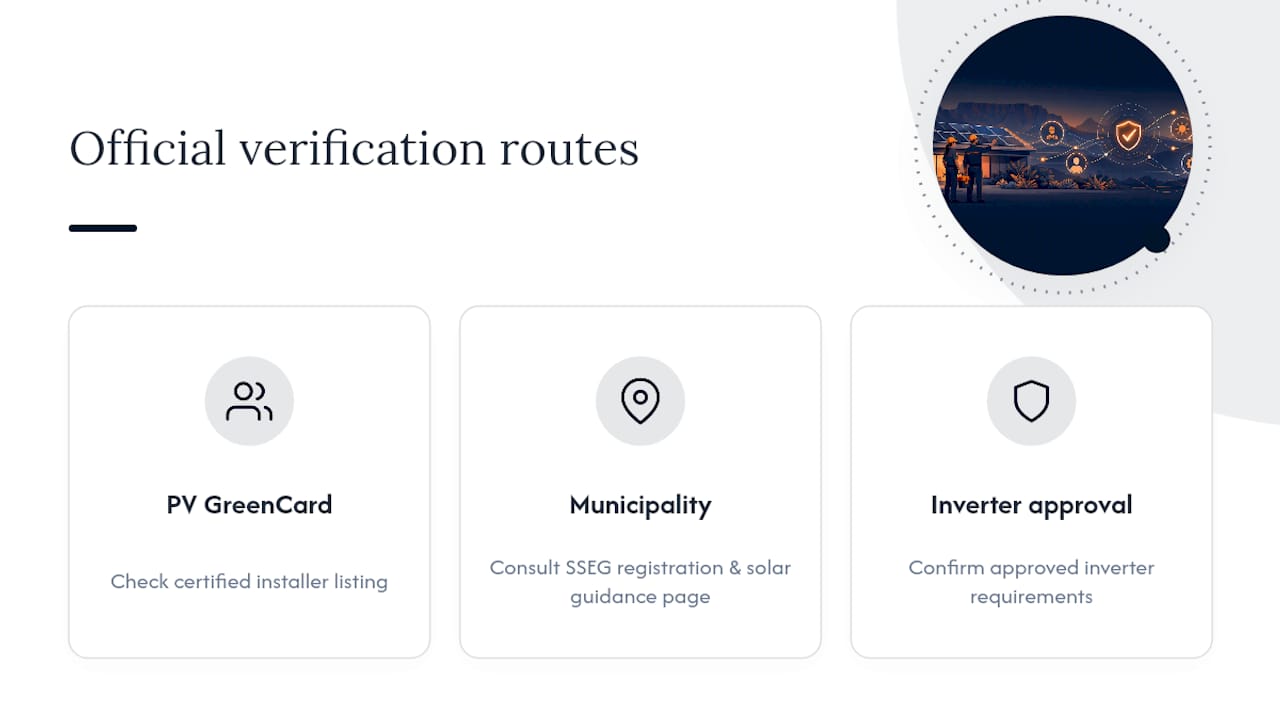
For CoC and installer verification, check PV GreenCard's certified installer listing. For SSEG registration and inverter approval requirements, consult your municipality's solar guidance page, similar to Cape Town's published checklist.
Why the industry's biggest complaint list traces back to one skipped step
Most solar disputes I've seen written about don't start with bad panels. They start with someone skipping the boring part: confirming who, specifically, was legally responsible for signing off the work. Homeowners get seduced by a low number on a quote and forget to ask who the electrician actually is.
Here's what the conventional advice gets wrong: it tells people to "get multiple quotes," as if quantity solves the problem. Three vague quotes are worse than one detailed one, because now you're comparing three different sets of missing information instead of one. The real fix isn't more quotes. It's insisting every quote answers the same five or six questions before you even start comparing numbers.
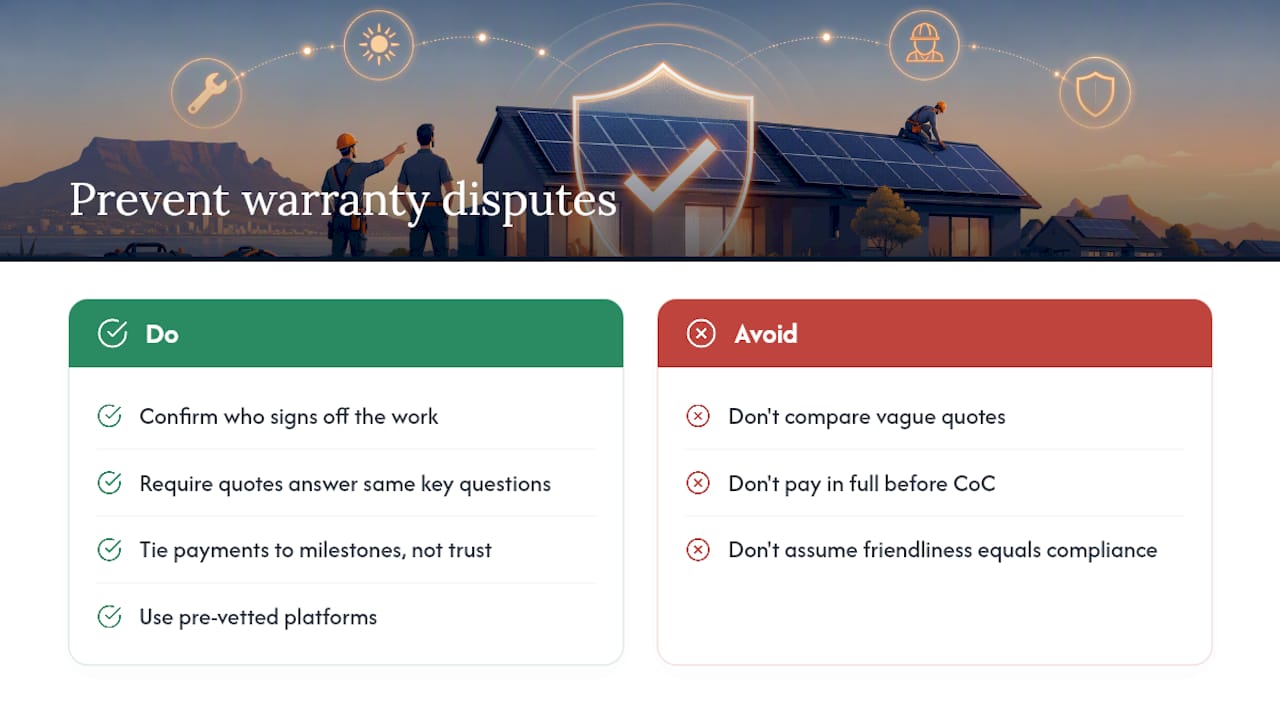
The other thing nobody says loudly enough: your leverage disappears the moment you pay in full. Before that final payment, you can withhold money until the CoC lands in your inbox. After it, you're just another person waiting on a callback. Structure the payment schedule around milestones, not trust, and you'll never need to find out how responsive an installer becomes once the invoice is settled.
Platforms built to match homeowners with pre-vetted installers exist precisely because this verification step is tedious enough that most people quietly skip it. That's not a knock on homeowners. It's just what happens when compliance paperwork competes with load shedding fatigue and a contractor who seems friendly enough.
— Kobus Kohvik
Sources
FAQ
What should be on a solar installer checklist before signing?
A solid solar installer checklist covers three quotes with named brands and models, a contract naming the registered electrician who signs the CoC, proof of insurance, and a milestone-based payment schedule.
How do I verify a solar installer is legitimate?
Check the named electrician's registration status, confirm the company appears on the PV GreenCard certified installer list, and ask for references from at least two previous jobs.
Who is responsible for SSEG registration on a solar installation?
Your installer should handle SSEG registration for grid-tied systems, and this responsibility should be stated explicitly in your contract rather than assumed.
What documents should I receive after solar panel installation?
You should receive a signed Certificate of Compliance, a PV GreenCard as-built report if applicable, manufacturer warranty documents, a commissioning report, and a final invoice matching your contract.
Is it normal to pay a solar installer 100% upfront?
No. A staged payment schedule tied to visible progress and final payment released only after the CoC is issued is the safer, more common industry practice.