Save about 270kWh per month with solar pool pumps in South Africa
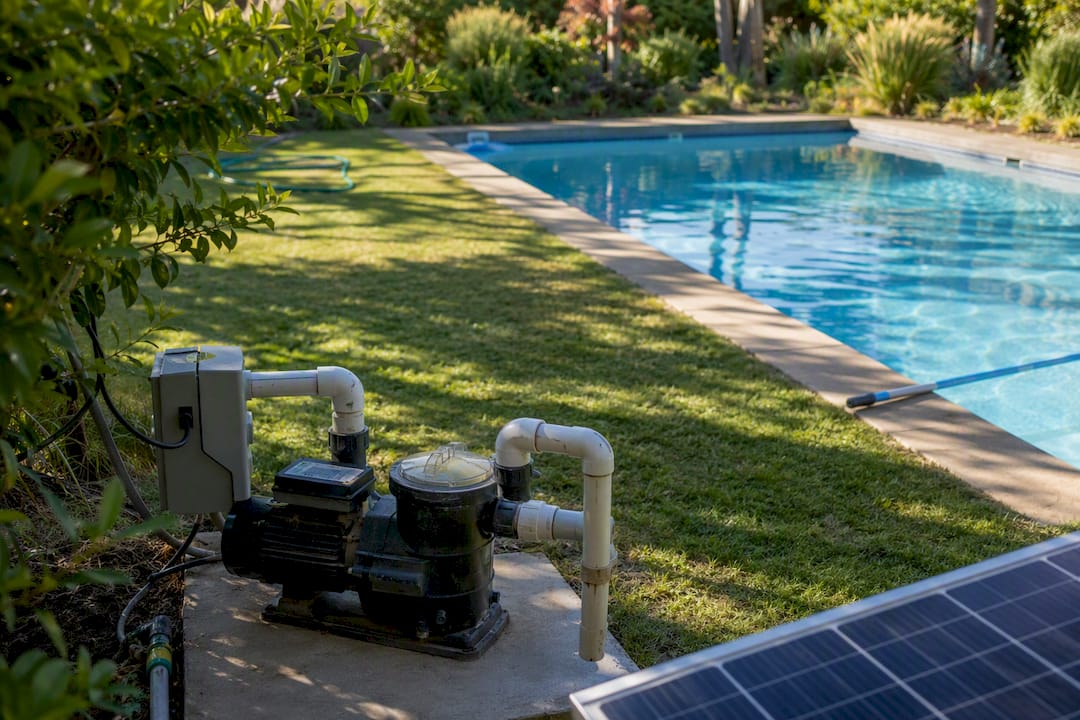
Yes, you can run a pool pump on solar. Most owners choose between a dedicated DC solar pump powered entirely by its own panels, or running the existing pump from a larger household solar setup timed to midday sun. The dedicated route suits daytime-only filtration and simpler wiring; a household or hybrid system suits anyone who wants overnight flexibility. Either way, expect a payback period measured in years, not months, once you factor in installed costs.
*TL;DR:>
- Converting an existing pump to solar is easiest if your household system has spare capacity; a dedicated off-grid pump requires replacement with purpose-built DC or hybrid units.*
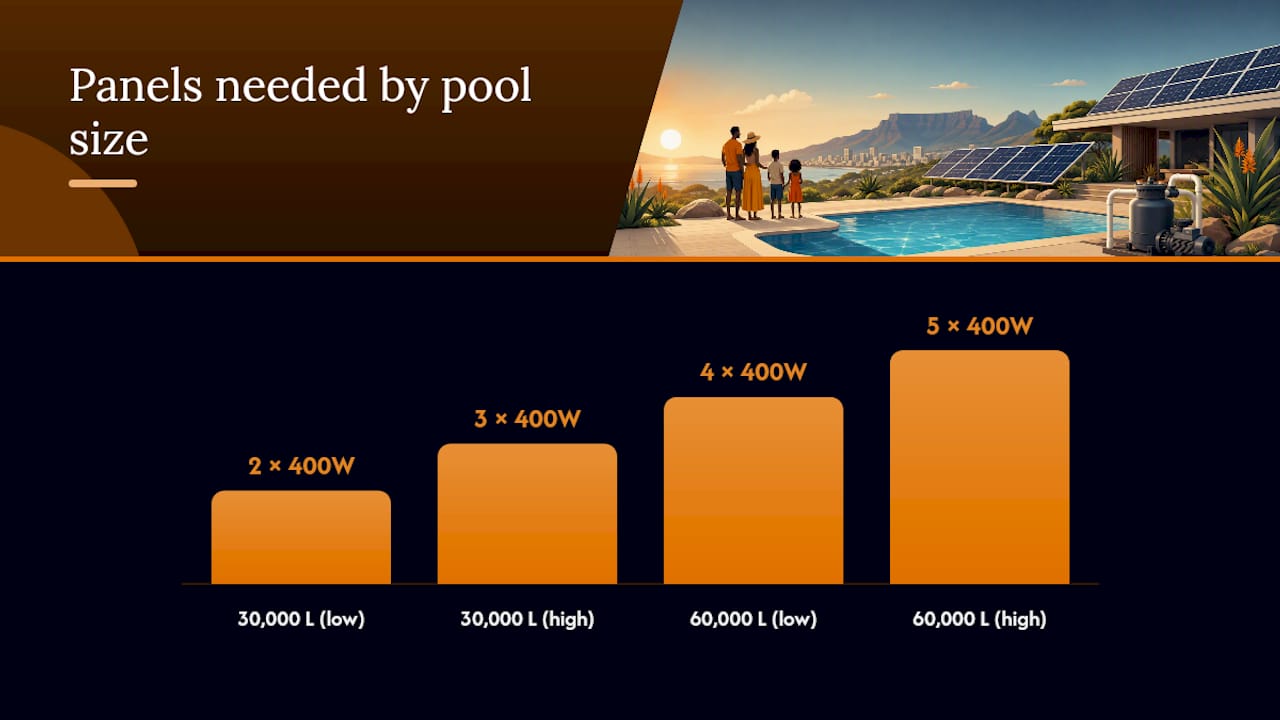
- About two to three 400W panels suffice for a 30,000-liter pool, while a larger 60,000-liter pool typically needs four to five panels, assuming six peak sun hours daily.
- A mid-sized solar pool system can eliminate nearly all daytime electricity use for the pump, but payback usually takes several years depending on local tariffs and usage patterns.
- Proper installation and sizing, including correct pipe diameter and wiring, are critical, and vetted local installers reduce the risk of mismatched components or undersized systems.
- Regular maintenance like panel cleaning and smart scheduling can improve efficiency and expedite return on investment, especially when paired with a hybrid or variable-speed setup.
Table of Contents
- How does a solar pool pump actually work?
- Can you convert an existing pump to solar, or do you need a new one?
- How many solar panels do you need for a pool pump?
- What does a solar pool pump system cost, and how fast does it pay back?
- What should you check before installation day?
- How do you keep a solar pool pump running efficiently?
- Why installer vetting matters more than the panels themselves
- Get matched with a solar pool pump installer
- Sources
- FAQ
How does a solar pool pump actually work?
A solar pool pump system runs on three core parts: PV panels, an MPPT controller, and a DC brushless motor. The controller manages the voltage coming off the panels and feeds the motor a clean, variable current, which is why pump speed naturally rises and falls with sunlight rather than staying fixed like a mains pump. Hybrid units add an AC input, so they draw from your inverter or the grid once the sun drops, giving you continuous filtration instead of a hard stop at dusk.
The trade-offs come down to a short list:
- Pure DC systems run silently, avoid the inrush current spikes that stress old wiring, and need no grid approval since they're technically off-grid for the pump.
- Hybrid systems cost more upfront but keep water moving after sunset or during overcast stretches.
- Both configurations connect through an MPPT controller. This is what lets the pump throttle output instead of tripping off in low light.
The main limitation is obvious once you say it out loud: a pure DC pump does nothing at night. For most recreational pools that's rarely a problem, since filtration during daylight hours covers the job.
Can you convert an existing pump to solar, or do you need a new one?
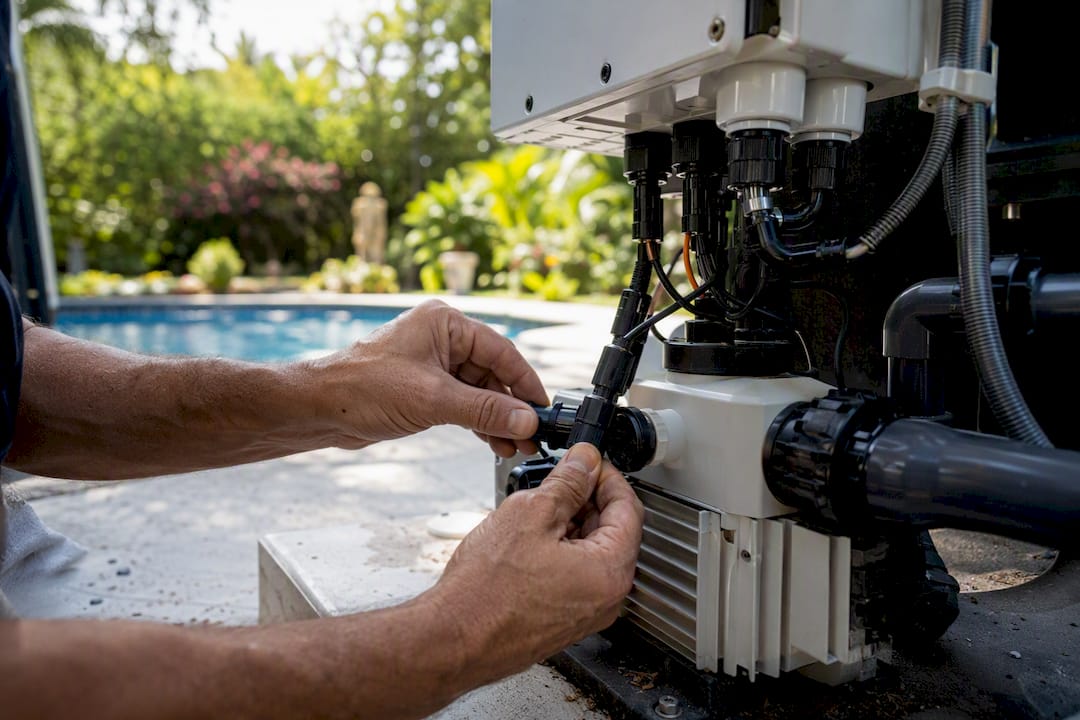
It depends on what you're starting with. If your household solar array and inverter already have spare capacity, running your existing mains pump off that system during midday hours is often the simplest fix. No new pump, no rewiring. If you want a pump-only setup independent of the house system, you'll need to replace it with a purpose-built DC or hybrid unit, since standard AC pumps can't run on raw DC solar input.
Compatibility is rarely the sticking point people expect:
- Solar pool pumps are generally drop-in replacements that work with existing sand filters, suction cleaners, and chlorinators.
- Robotic cleaners that need constant pressure may need a hybrid pump rather than a pure DC one, since flow can dip on cloudy days.
- Any conversion involving mains wiring or an inverter tie-in needs a qualified electrician to fit isolator switches and confirm earthing.
Pro Tip: Ask your installer to check your existing pipe diameter before quoting. A pump upgrade paired with undersized old plumbing will underperform no matter how good the panels are.
How many solar panels do you need for a pool pump?
Sizing starts with a turnover target. Installers typically design toward roughly two full water turnovers a day, using an assumption of around six hours of strong midday sun to get there. Pump wattage needs to match your pool's flow requirement, and panel wattage needs to comfortably exceed the pump's running draw to account for cloud cover and panel degradation.
Two worked examples show how this plays out in practice:
- 30,000 litre pool: a 900W to 1,100W DC pump typically handles two turnovers within the daylight window. Paired with around six peak sun hours, that usually means two to three 400W panels, sized generously so the pump still runs at partial output on hazy days.
- 60,000 litre pool: you'll likely need a 1,500W to 1,800W pump, which pushes the array up to four or five 400W panels to keep turnover on target.
These numbers shift with plumbing head and pipe run length. A pump fighting a long return line or a raised pool pad needs more wattage to hit the same flow rate, and panels mounted far from the pump lose some efficiency to cable resistance. Mounting panels close to the pad, as most local installers recommend, keeps the math closer to these baseline figures. A solar calculator built for your specific pool volume and roof orientation will tighten these estimates further than any rule of thumb can.
What does a solar pool pump system cost, and how fast does it pay back?
Local pricing spans a wide range depending on how much of the system you're buying. Pump-only units start in the low thousands of rand, while a complete installed system with panels, mounting, and an MPPT controller runs considerably higher, driven mostly by panel count and labour.
Cost snapshot: A mid-sized pool replacing a 1.1kW mains pump with a solar-only setup can cut that specific circuit's electricity draw close to zero during daylight hours, since the pump no longer pulls from the grid at all when the sun is up.
A simple payback estimate looks like this: if your mains pump currently runs 8 hours a day and draws around 1.1kW, that's close to 9kWh daily, or roughly 270kWh a month, entirely on the pool circuit. Removing that load from your electricity bill, even at conservative tariff assumptions, adds up over a few years against the installed cost of the solar system.
A few things shorten or stretch that timeline:
- Load shedding stage and grid tariff, since higher electricity costs shrink payback faster.
- Pump runtime habits, since a pump running longer than necessary inflates the baseline you're comparing against.
- System sizing, since an undersized array that forces partial mains backup slows the return on investment.
What should you check before installation day?
A proper site survey covers the pool's volume, existing pipe sizes, the condition of the pump pad, and where panels can realistically be mounted without shading. Distance between the panels and the pump matters too, since longer cable runs lose efficiency.
- Confirm electrical readiness: isolator switches, correct earthing, and a sensible mounting spot for the MPPT controller out of direct weather.
- Decide upfront whether you want inverter or battery integration for overnight operation, since retrofitting that later costs more than planning for it now.
- Ask about approvals. Dedicated off-grid DC systems typically need none, but any tie-in to your household inverter should go through your installer's standard sign-off process.
Most straightforward installations take a day, sometimes two if plumbing needs adjusting or panel mounts require custom brackets; using PU panels for smart insulation can also streamline mounting and improve efficiency near pool builds. Budget extra for labour, conduit, and any minor pipework beyond the pump swap itself, since these line items are where quotes tend to diverge most.
How do you keep a solar pool pump running efficiently?
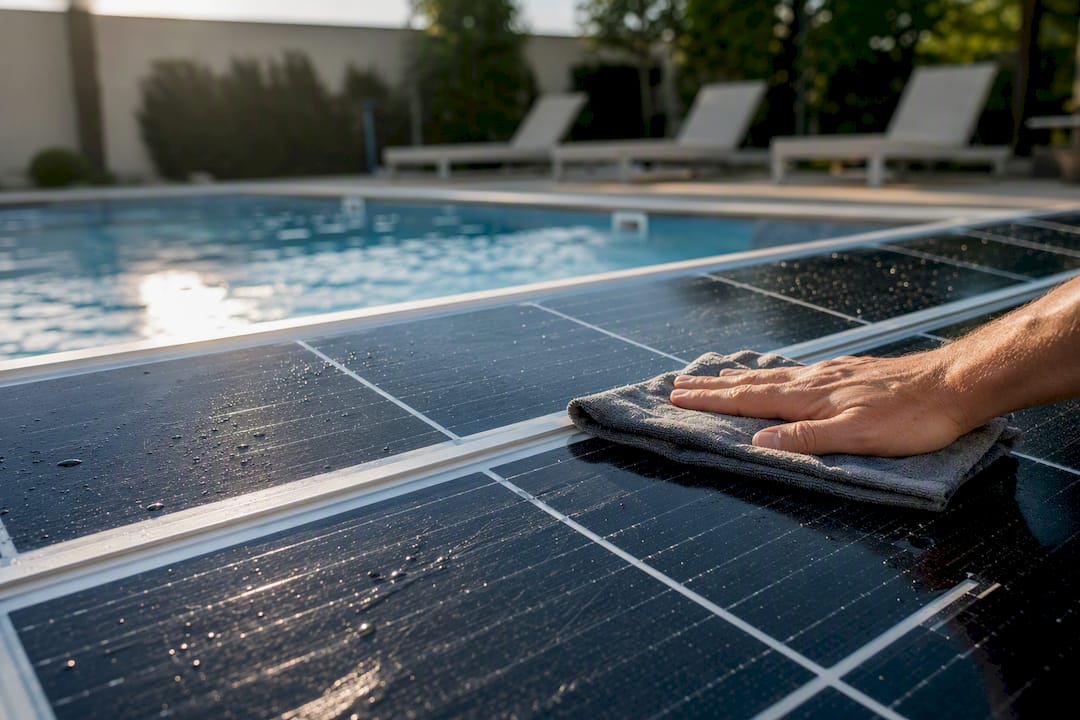
Dust on panels cuts output more than most owners expect, so a monthly wipe down during dry months keeps the array performing near its rated wattage. Check pump unions for leaks and clear the pre-filter basket on the same schedule you'd use for a mains pump.
A few habits stretch your savings further:
- Time pump runs to coincide with peak sun hours rather than spreading them across the day.
- A pool cover reduces evaporation and heat loss, which shortens the filtration hours you actually need and speeds up payback.
- Consider a hybrid or battery-backed setup if you're in a cloudier region or running a koi pond that needs continuous circulation rather than daytime-only flow.
Pro Tip: Pair a variable-speed timer with your solar controller so the pump automatically throttles down as the sun weakens in late afternoon, instead of running at a fixed speed until it stalls.
Why installer vetting matters more than the panels themselves
Solar pool pump performance depends as much on correct sizing and wiring as on the hardware itself, which is exactly where unvetted suppliers tend to cut corners. Solarza lists installers by city with verified ratings, and its solar calculator gives you a sizing baseline before you ever speak to a quote. Working from a vetted shortlist rather than a cold call cuts the risk of an undersized array or a pump mismatched to your pool's turnover needs, and it gets a working system installed faster.
— Kobus Kohvik
Get matched with a solar pool pump installer
Solarza connects you directly with installers who've already been vetted and rated across all nine provinces, so you're not gambling on a random quote from someone who's never sized a pool pump array before.

If you've worked through the sizing math above and want numbers specific to your pool, run them through the solar calculator first. From there, request a free quote and Solarza will match you with local installers who can confirm panel count, pump wattage, and total installed cost for your exact setup. It's a faster path to an accurate number than piecing together rules of thumb on your own.
Sources
- Run Your Pool Pump On Solar | The Best Pool Co In JHB
- Solar Pool Pumps & Koi Pond Pumps | Bundu Power
- How much is a solar pool pump in South Africa? - Baracuda
FAQ
Can I run a pool pump on solar power?
Yes. You can either install a dedicated DC solar pump powered directly by panels, or run your existing pump from a household solar system large enough to cover its draw during daylight hours.
How many solar panels do I need for a pool pump?
For a 30,000 litre pool, two to three 400W panels typically cover a 900W to 1,100W pump; a 60,000 litre pool usually needs four to five 400W panels for a 1,500W to 1,800W pump, assuming around six peak sun hours a day.
Can I convert my pool pump to solar power?
If your household solar array has spare capacity, you can run your existing mains pump from it without buying a new pump. A standalone, off-grid setup requires a purpose-built DC or hybrid solar pump instead.
How much does it cost to run a pool pump for 24 hours?
Most pools don't need overnight circulation. A typical mains pump running 8 hours a day at around 1.1kW draws roughly 9kWh daily, which is the load a solar pool pump setup can largely offset during daylight hours.