Homeowners: Commissioning and Warranties Decide Solar Battery Lifespan
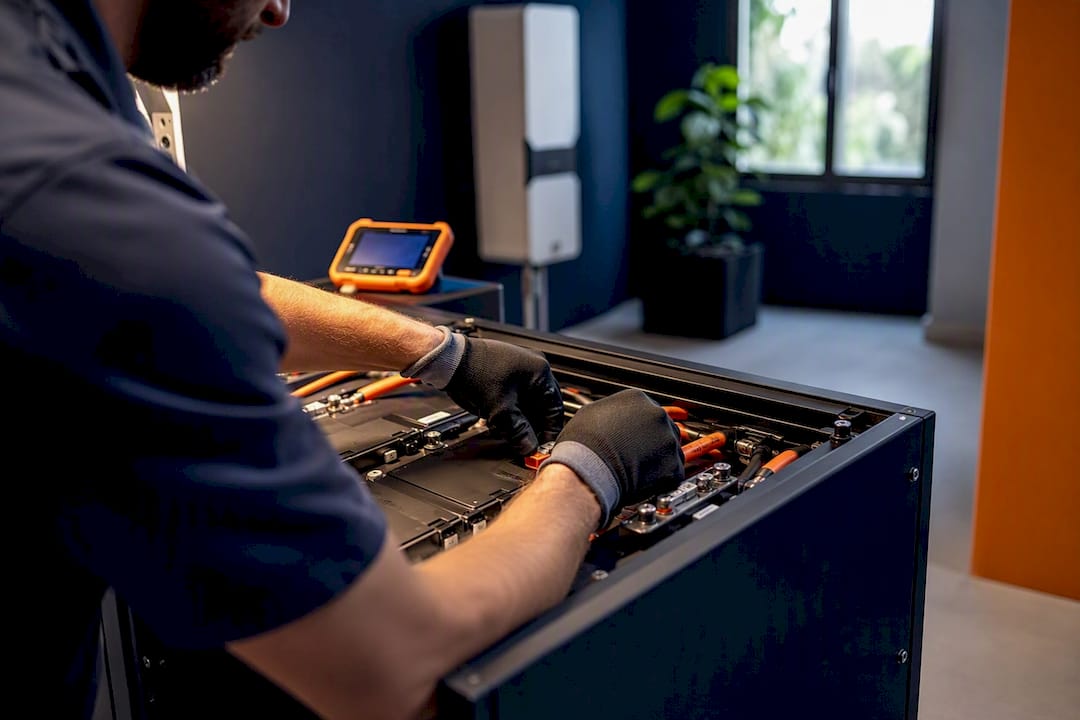
Most modern home storage batteries last roughly 8 to 15 years, depending on chemistry and how they're used. That range comes with an asterisk, though: a warranty term is not the same as a death sentence. The number on the spec sheet often describes when capacity drops to a set floor, not when the battery quits.
*TL;DR:>
- Lithium iron phosphate batteries typically last 10 to 15 years, handling 3,000 to 6,000 cycles before capacity drops below usable levels.*
- Proper system installation, including thermal management and BMS configuration, can significantly extend battery lifespan beyond the raw chemistry expectations.
- Warranties mainly cover capacity loss to a specified threshold, usually 80%, not a guaranteed expiration date, making actual usable life potentially longer.
- Heat, high depth of discharge, fast charge rates, and poor installation practices are the primary factors that shorten battery longevity.
- Correct sizing, maintaining within a 20 to 80 percent state of charge, and regular system checks are key habits for homeowners to maximize battery lifespan.
Table of Contents
- How long do solar batteries last by chemistry?
- What does "battery lifespan" actually measure?
- What factors shorten or extend battery lifespan?
- Do battery warranties reflect real-world lifespan?
- How can homeowners extend solar battery life?
- What are the signs a solar battery needs replacing?
- What Solarza's tools tell you about battery planning
- The real problem isn't the battery, it's the commissioning
- Get a battery sized and installed to last
- Sources
- FAQ
How long do solar batteries last by chemistry?
The chemistry inside your battery does more to determine its working life than almost any other single factor. Here's what the different types actually deliver in real installations.
LiFePO4 (lithium iron phosphate) dominates residential solar right now, and for good reason. These batteries typically run 10 to 15 years and handle 3,000 to 6,000 cycles before hitting their end-of-life capacity threshold.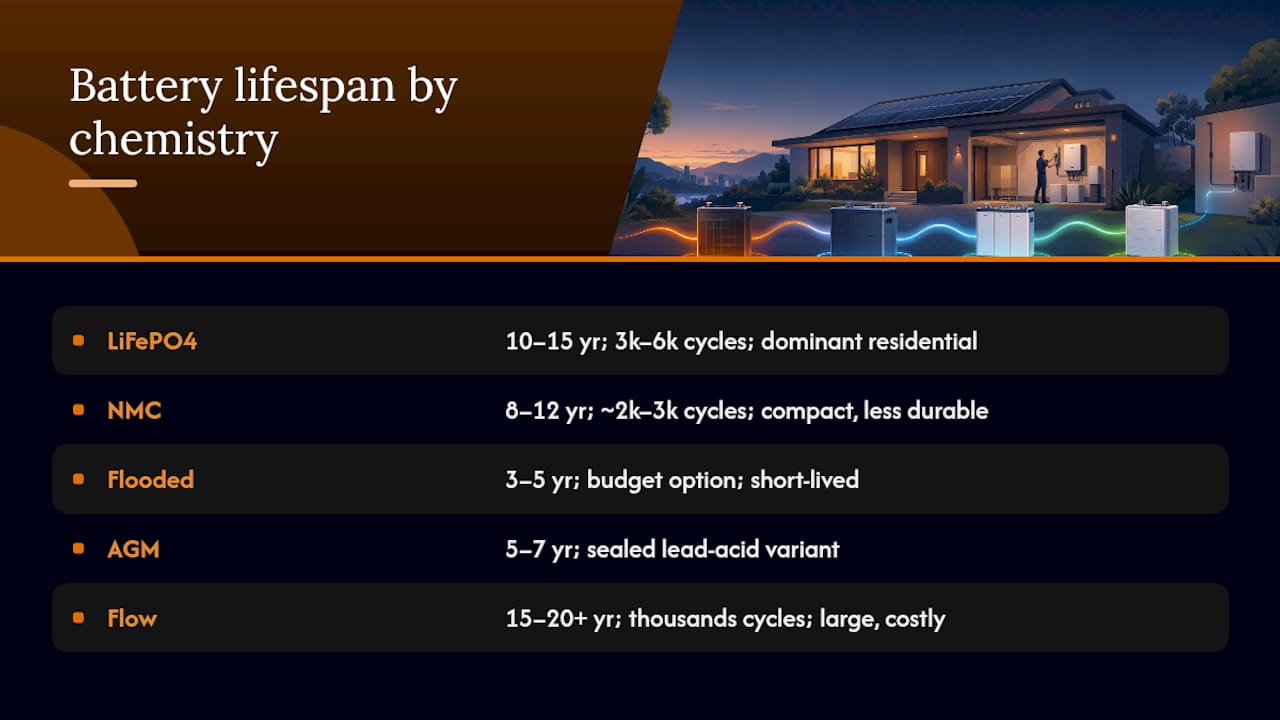 NMC (nickel manganese cobalt) batteries pack more energy into a smaller footprint but trade away some longevity. Expect 8 to 12 years and roughly 2,000 to 3,000 cycles. They're common in electric vehicles and some early home battery products, though LiFePO4 has largely overtaken them for stationary storage because of the durability gap.
Lead-acid (flooded or AGM) is the budget option, and it shows. Flooded lead-acid batteries often need replacing within 3 to 5 years; AGM stretches that to maybe 5 to 7 years with careful charging. A peer-reviewed lifecycle comparison found lithium-ion systems modeled at roughly 11 years of service against about 4 years for lead-acid in equivalent PV battery storage scenarios, which explains why lead-acid keeps losing ground despite its lower sticker price.
Flow batteries are a niche but growing option for larger residential or small commercial setups, with some systems rated for 15 to 20+ years thanks to minimal capacity fade over thousands of cycles. They cost more upfront and take up more space, so they mostly make sense when you need serious storage capacity and plan to stay in the property for decades.
NMC (nickel manganese cobalt) batteries pack more energy into a smaller footprint but trade away some longevity. Expect 8 to 12 years and roughly 2,000 to 3,000 cycles. They're common in electric vehicles and some early home battery products, though LiFePO4 has largely overtaken them for stationary storage because of the durability gap.
Lead-acid (flooded or AGM) is the budget option, and it shows. Flooded lead-acid batteries often need replacing within 3 to 5 years; AGM stretches that to maybe 5 to 7 years with careful charging. A peer-reviewed lifecycle comparison found lithium-ion systems modeled at roughly 11 years of service against about 4 years for lead-acid in equivalent PV battery storage scenarios, which explains why lead-acid keeps losing ground despite its lower sticker price.
Flow batteries are a niche but growing option for larger residential or small commercial setups, with some systems rated for 15 to 20+ years thanks to minimal capacity fade over thousands of cycles. They cost more upfront and take up more space, so they mostly make sense when you need serious storage capacity and plan to stay in the property for decades.
For most homes, LiFePO4 wins on total cost of ownership even though it isn't always the cheapest to install. You can compare current battery prices and chemistries to see how the numbers shake out for a typical household setup.
What does "battery lifespan" actually measure?
Manufacturers, installers, and reviewers throw around "lifespan" like it means one thing. It doesn't. Three separate measurements hide behind that word, and mixing them up is how homeowners end up disappointed.
- Cycle life counts full charge-discharge cycles until capacity drops to a defined threshold, usually 80%. A battery rated for 4,000 cycles to 80% doesn't fail at cycle 4,001; it just keeps declining past that point.
- Calendar life tracks aging that happens regardless of use. Heat, storage conditions, and simple chemistry drift erode capacity even in a battery that barely gets cycled.
- End-of-life capacity is the threshold itself, commonly set at 70% or 80% of original rated capacity. Standards documents typically specify that end-of-life capacity should not fall below 80% of the C5 rating under stated conditions, which gives you a concrete number to check against.
Here's a worked example. A 10kWh LiFePO4 battery rated for 6,000 cycles to 80% capacity, cycled once daily, hits that cycle count in about 16.4 years. But if the same household runs it through two partial cycles a day, or lives somewhere hot enough to accelerate calendar aging, the real-world number often lands closer to 10 to 12 years. The cycle rating is a lab number. Your actual timeline depends on how hard and how often you use the battery.
What factors shorten or extend battery lifespan?
Four system-level factors do more damage to a battery's working life than anything else, and most of them are entirely within an installer's or homeowner's control.
- Temperature. Heat is the single biggest accelerant of calendar aging in lithium batteries. Installers working in hot climates increasingly treat thermal planning as a core design decision rather than an afterthought, because ambient heat and poor airflow around the battery enclosure can shave years off projected capacity retention.
- Depth of discharge (DoD). Draining a battery further on each cycle wears it down faster than shallow, frequent cycling. A battery run at 90% DoD daily will generally age faster than one run at 50% DoD, even with the same total energy throughput.
- Charge and discharge rates. Pulling high current repeatedly, especially from undersized inverters pushed to their limits, generates heat and stress inside the cells.
- BMS configuration and commissioning. The battery management system controls charge cutoffs, float voltage, and cell balancing. A poorly configured BMS, outdated firmware, or skipped balancing checks at installation can quietly shorten a battery's working life long before the warranty period ends.
- Environment and installation quality. Dust ingress, moisture, and batteries mounted in direct sun or unventilated enclosures all accelerate wear, as do basic installation mistakes like undersized cabling.
Pro Tip: Ask your installer for the BMS and inverter configuration report at handover. It should show charge cutoff points, float voltage settings, and cell balancing logs. If they can't produce one, that's a red flag about commissioning quality, not just paperwork.
Do battery warranties reflect real-world lifespan?
Warranties are useful, but they answer a narrower question than most homeowners assume. That's a capacity floor, not an expiration date. A battery can keep functioning well past its warranty period; it just delivers less usable energy per cycle.
Read the fine print before treating any warranty number as gospel:
- Most warranties cap the number of cycles per year, and exceeding that cap can void coverage.
- Extreme temperature exposure outside a specified range is a common exclusion.
- Capacity guarantees are usually prorated, meaning a battery failing early gets a partial replacement credit, not a full new unit.
As a rule of thumb, start budgeting for eventual replacement around year 8 to 10 for most lithium systems, even with a 15-year warranty on paper. That gives you time to shop current battery pricing before a failure forces a rushed decision.
How can homeowners extend solar battery life?
Longevity comes down to a handful of habits and installation choices, most of which cost nothing beyond a bit of attention.
- Keep daily cycling within a 20% to 80% state-of-charge window rather than routinely draining to empty or holding at 100%. Local maintenance guidance on LiFePO4 systems consistently points to this range as the sweet spot for balancing runtime against long-term wear.
- Confirm commissioning basics at installation: correct BMS settings, current firmware, verified cell balancing, and properly sized cabling. These are one-time checks that prevent years of accelerated degradation.
- Site the battery for thermal stability. A shaded, ventilated spot beats a sealed cupboard or direct sun exposure every time.
- Size the system with a small buffer. A battery specified slightly larger than your minimum need reduces average DoD per cycle, which stretches service life and lowers total cost of ownership even though the upfront price is higher.
- Log health data monthly. Track state of health (SoH), voltage behavior, and any fault codes so a slow decline shows up early instead of as a sudden failure.
Pro Tip: Run your target battery size through a solar calculator before you buy. Oversizing by even 10 to 15% often pays for itself through reduced cycling stress over a decade.
What are the signs a solar battery needs replacing?
A handful of warning signs tend to show up together when a battery is approaching the end of its useful life. Alongside that, watch for noticeably shorter runtime during outages, voltage sag under normal household load, unusual heat from the enclosure, and repeated fault codes from the inverter or BMS.
A technician diagnosing a suspect battery will typically run a capacity test, measure internal resistance, and review the discharge curve for irregularities. From there, you've got three real paths: repair if the issue is isolated to a module or connection, replace if degradation is pack-wide, or repurpose the battery for lower-stakes second-life stationary storage before it goes to certified recycling.
What Solarza's tools tell you about battery planning
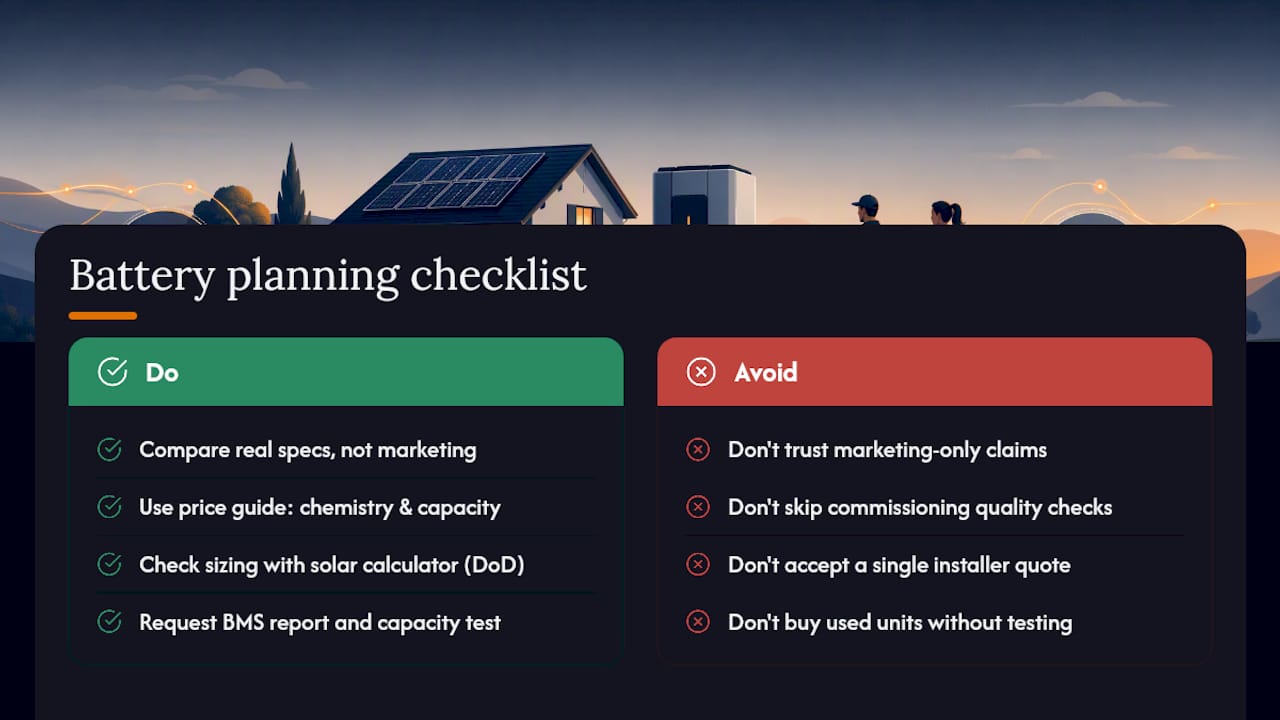
Getting a straight answer on projected lifespan means comparing real specs, not marketing copy. Solarza's battery price guide breaks down chemistry and capacity options so you can weigh upfront cost against expected service years, and the solar calculator shows how sizing choices affect your daily DoD.
Every installer in Solarza's network is vetted and rated, because commissioning quality is one of the biggest levers on how long your battery actually lasts. Before signing anything, ask for a BMS and inverter settings report, request a capacity test on any pre-owned or refurbished unit, and get more than one quote through Solarza's installer matching so you can compare commissioning practices, not just price.
The real problem isn't the battery, it's the commissioning
Homeowners obsess over cycle counts and chemistry comparisons, and those numbers matter. But the biggest gap between a battery that hits 15 years and one that limps out at 7 usually has nothing to do with the cell chemistry on the spec sheet. It comes down to whether the BMS was configured correctly on day one.
Conventional advice leans heavily on "buy the best chemistry you can afford," which isn't wrong, but it skips the part that actually determines outcomes: who installed the system and whether they bothered to document the settings. A LiFePO4 battery with sloppy commissioning can underperform a well-configured system using the same cells from a different installer. That's an uncomfortable truth for an industry that likes to sell on specs.
If you're planning a purchase or a replacement, prioritize the installer's commissioning process before you compare warranty years between brands. Ask for the configuration report. Ask how balancing gets verified. A 15-year warranty means little if nobody checks whether the system was set up to actually reach it.
— Kobus Kohvik
Get a battery sized and installed to last
Correct sizing and proper commissioning protect your battery's lifespan more than any brand name on the label, and both come down to who installs your system. Solarza connects you directly with verified, rated installers across South Africa, so you're not gambling on commissioning quality with an unknown contractor.

Before you commit to a chemistry or capacity, check current battery pricing to see what fits your budget and usage pattern. Then request a free quote through Solarza to get matched with installers in your area who can walk you through BMS configuration, thermal planning, and sizing before a single panel goes on your roof.
Sources
- Comparative battery lifecycle study — MDPI Energies (2022)
- LiFePO4 battery maintenance: Extend unit life (EveZone / Evetech)
- How temperature, cycling and system configuration affect lithium battery longevity (Huanyu Energy)
FAQ
How much does it cost to replace a solar battery?
Replacement cost depends heavily on chemistry and capacity, with LiFePO4 units generally commanding a higher upfront price than lead-acid but lasting far longer. Check current battery price ranges for an up-to-date comparison across capacities.
Do solar batteries stop charging when full?
Yes. A properly configured battery management system cuts charging once the battery reaches its set upper voltage or state-of-charge limit, protecting the cells from overcharge stress regardless of how much solar power the panels are generating.