PV GreenCard in 3–6 Weeks for South African Installers
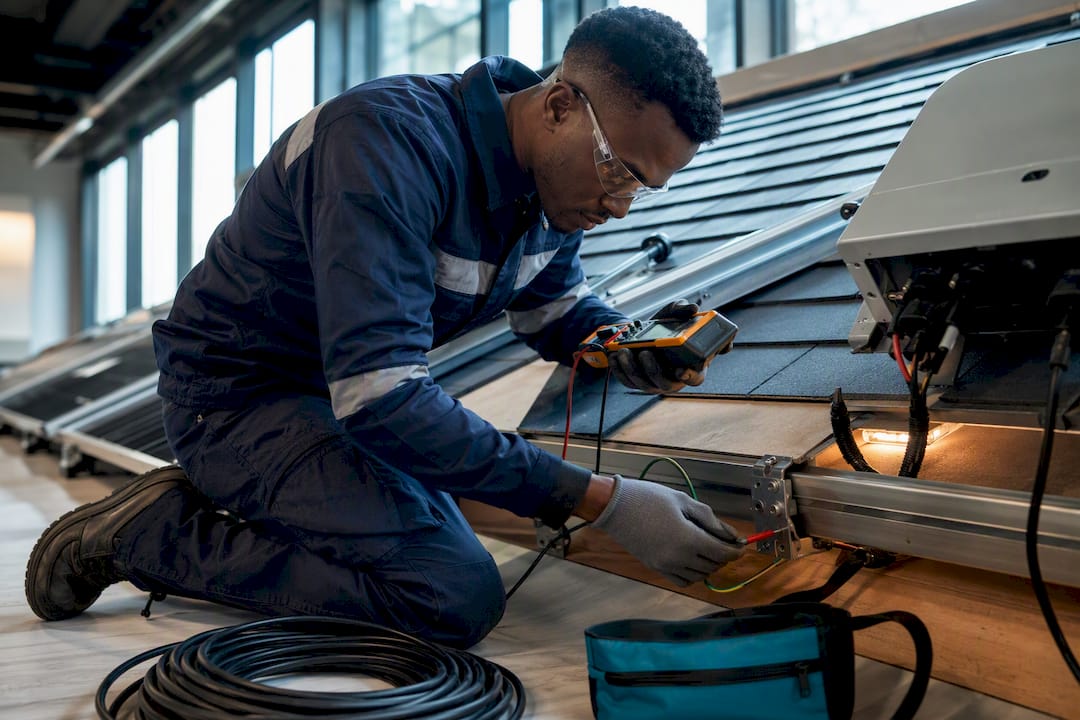
The PV GreenCard is South Africa's industry as-built quality assurance report and installer assessment programme, run through SAPVIA and its accredited training partners. If you install solar for a living, the immediate move is simple: book a 5-day preparatory course, then sit the 2-day SAPVIA assessment. Your company also needs a Department of Employment and Labour (DoEL) registered electrician on staff before it can register and start issuing GreenCard reports.
*TL;DR:>
- A PV GreenCard confirms the proper installation of solar systems and is increasingly required by insurers, lenders, and municipalities for credibility and compliance.*
- Passing the SAPVIA assessment involves a five-day training course and a two-day exam, with costs totaling roughly R12,500 to R15,500 excluding VAT per candidate.
- Company registration requires at least one assessed staff member and DoEL registration, with verification and listing taking about three to six weeks.
- Maintaining the GreenCard involves ongoing fees, compliance with administrative requirements, and ensuring active staff and DoEL status; lapses can lead to suspension or delisting.
- Obtaining a GreenCard can significantly boost lead generation through verified installer directories, with some platforms like Solarza actively connecting qualified installers with homeowner inquiries.
Table of Contents
- What is a PV GreenCard, and how does it relate to the CoC?
- Who actually needs a PV GreenCard, and what's in it for your business?
- How do you get PV GreenCard assessed and register your company?
- What should you look for in a training provider before you enrol?
- What does PV GreenCard training and assessment actually cost?
- How do you keep your PV GreenCard certification valid?
- How PV GreenCard reports are issued and how to find listed installers
- Why PV GreenCard matters more than most installers realise
- Get more leads once you're PV GreenCard registered
- Official PV GreenCard and SAPVIA resources
- Sources
- FAQ
What is a PV GreenCard, and how does it relate to the CoC?
A PV GreenCard is not a substitute for your Electrical Certificate of Compliance. It sits alongside it. The GreenCard functions as an as-built commissioning report, industry documentation confirming exactly how a system was installed, what equipment went in, and whether it matches the design that was signed off. The CoC remains the legal document confirming the installation meets SANS wiring regulations. You need both.
Why does this second layer exist at all? Because a CoC tells an insurer or bank that the wiring is safe. It does not tell them the panels are correctly angled, the DC cabling is protected from UV degradation, or the earthing matches manufacturer spec for that specific inverter brand. SAPVIA built the GreenCard to close that gap and protect the industry's reputation after years of botched rooftop jobs eroding public trust in solar generally.
That is why three groups increasingly ask for it before they'll do business with an installer:
- Insurers, who use the GreenCard as evidence of quality workmanship when underwriting solar-related claims.
- Finance houses, who want documented proof before releasing funds on asset-backed solar loans.
- Municipalities, several of which now reference GreenCard or equivalent QA documentation during grid-tie applications.
Who actually needs a PV GreenCard, and what's in it for your business?
There's a distinction that trips up a lot of installers early on: passing the individual assessment and registering a company are two separate steps. An electrician can sit the SAPVIA assessment and become "PV GreenCard assessed" as an individual. That credential alone does not let a company issue GreenCard reports to clients. The company itself must register separately, and that registration requires at least one assessed individual on payroll plus a DoEL-registered electrical contractor status for the business.
So who should pursue this? Any installer doing grid-tied or hybrid residential and commercial work, particularly those chasing tender work, insurance-referral business, or finance-backed installs where documentation gets scrutinized. The commercial upside is concrete:
- Tender documents for municipal and corporate solar projects increasingly list GreenCard registration as a prerequisite.
- Homeowners comparing quotes treat GreenCard status as a credibility signal against unregistered competitors.
- Smaller installation businesses gain a documented quality pathway that larger, established players already use to win institutional work.
How do you get PV GreenCard assessed and register your company?
The process runs in two distinct tracks: getting yourself individually assessed, then registering the business. Skipping straight to company registration without an assessed staff member on hand is the single most common stumbling block installers report.
- Confirm your prerequisites. You need a solid electrical background, and if your company issues CoCs, it must already carry DoEL registration as an electrical contractor. Sort this before booking anything.
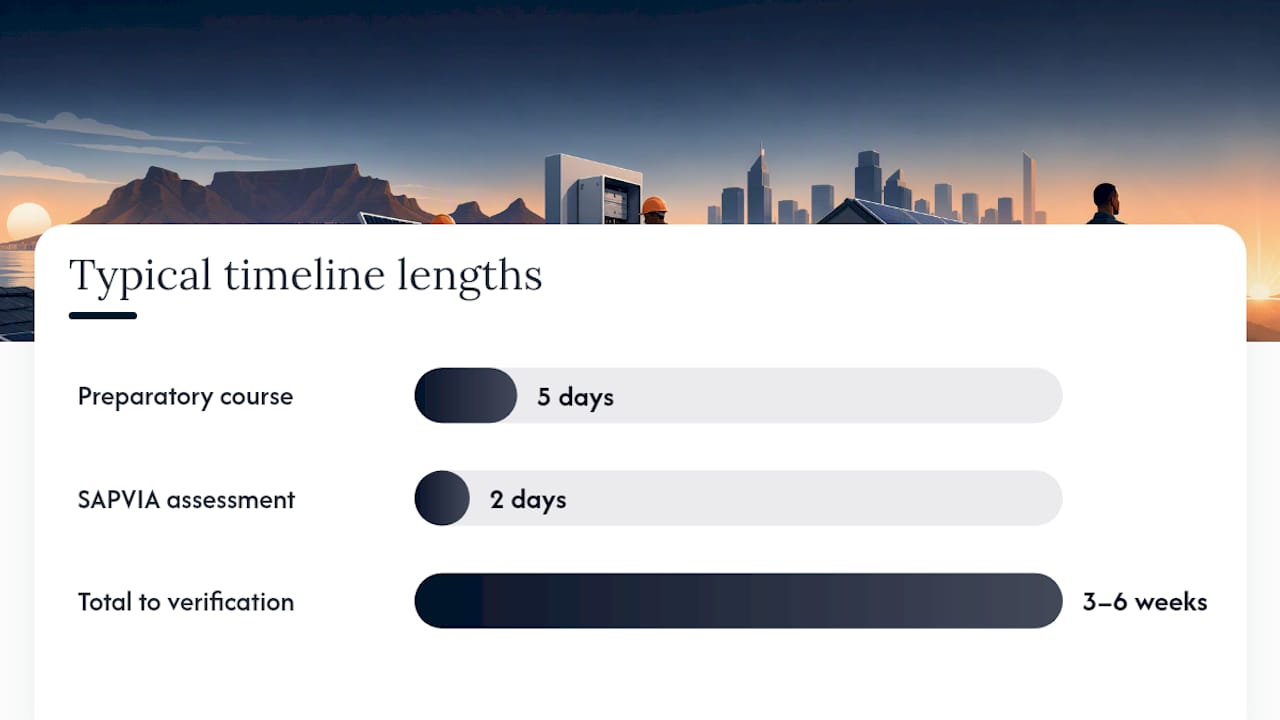
- Enrol in a 5-day preparatory course. These run at SAPVIA-affiliated training centres and cover system design, protection, and hands-on installation practice.
- Sit the 2-day SAPVIA assessment. Day one is a theory exam covering sizing, earthing, and protection calculations, typically running 8:00 to 15:00. Day two is practical, hands-on mock-roof installation from roughly 8:00 to 13:00, judged against the official assessment datasheet.
- Submit company registration documents. Once you have at least one assessed individual, register the business through Pvgreencard, supplying DoEL registration proof, company registration papers, and the assessed staff member's credentials for verification.
- Wait for verification. Administrators cross-check your DoEL status and assessed individual before activating your listing.
Realistically, expect somewhere between three and six weeks from starting your 5-day course to having your company verified and live on the installer directory, assuming no documentation hiccups. Pro Tip: Book your practical mock-roof day with a provider that gives you extra supervised hands-on hours before the actual assessment. Candidates who rush straight from theory to the SAPVIA practical test with no extra roof time tend to fumble earthing and cable management steps under exam pressure.
What should you look for in a training provider before you enrol?
Not every course calling itself "PV GreenCard prep" is accredited, and a cheap shortcut course that skips practical hours can leave you underprepared for the actual SAPVIA practical day. A handful of checks before you pay a deposit will save you a failed attempt and a repeat assessment fee.
- Confirm the provider appears on SAPVIA's own list of recognised training partners, not just a claim on their marketing page.
- Ask how many supervised hours you'll actually spend on a mock roof, since hands-on practice time correlates directly with first-time pass rates.
- Check the assessor's own credentials. Someone teaching sizing calculations should be able to show their own GreenCard or equivalent qualification.
- Get the full syllabus in writing before enrolling, not just a course outline on a landing page.
Providers like SARETEC publish detailed course schedules and contact details, which gives you a benchmark for what a properly structured course should look like.
What does PV GreenCard training and assessment actually cost?
Budget realistically, because this is a two-part spend. The 5-day preparatory course typically runs between R8,500 and R10,500 excluding VAT depending on the provider, and the independent 2-day SAPVIA assessment adds another R4,000 to R5,000 excluding VAT on top of that.
The real cost picture: training plus assessment lands somewhere between roughly R12,500 and R15,500 excluding VAT for one individual, before any company registration fees.
Subsidy programmes have surfaced periodically, including SAPVIA-backed schemes offering partial or full subsidies for qualifying candidates in the past. Availability shifts from region to region and year to year, so check current eligibility directly with SAPVIA rather than assuming an old subsidy still stands. Once training and assessment are done and company documents check out, expect roughly three to six weeks before your business appears on the public directory.
How do you keep your PV GreenCard certification valid?
Certification isn't a one-time badge. PV GreenCard membership carries ongoing fees, periodic verification checks, and an enforced code of conduct, and falling out of compliance can get you suspended or delisted without much warning.
The pitfalls that trip up otherwise competent installers are usually administrative, not technical:
- Letting DoEL registration lapse while assuming GreenCard status carries on regardless. It doesn't; administrators verify DoEL status during renewals.
- Losing your only assessed staff member to another company and forgetting that company registration depends on having one on the books.
- Confusing individual assessment with company registration, then wondering why the business listing never went live.
- Submitting incomplete as-built reports missing equipment serials or CoC reference numbers.
Pro Tip: If your only assessed electrician resigns, treat that as an emergency, not an admin task for next month. Get a replacement staff member booked into an assessment course immediately. Your company registration is only as valid as its weakest staffing link.
How PV GreenCard reports are issued and how to find listed installers
The as-built report itself documents equipment serials, system design specifics, and critically, the CoC reference number tied to the job. Reports issued without a valid, DoEL-signed CoC risk audit failure and invalidation of that GreenCard entry, so the two documents have to line up.
Before issuing a GreenCard to a client, installers typically need to submit:
- The signed CoC with its reference number
- Equipment datasheets and serial numbers for panels, inverters, and batteries installed
- Photographic evidence of the completed, as-built installation
Homeowners and procurement teams can search the public PV GreenCard installer directory to confirm a company's registration status before signing a contract, which is exactly the kind of due diligence more clients now expect.
Why PV GreenCard matters more than most installers realise
Most installers treat certification as a compliance box, something to tick once and forget. That's the wrong lens. A GreenCard listing is a documented answer to the question every serious client eventually asks: "how do I know this was done properly?" Tender committees and insurers ask that question in writing. Homeowners ask it with hesitation before signing a deposit cheque.
The installers who get ahead use their assessed status actively in bids and marketing, not as a quiet footnote. Treat the training spend as an investment in the conversations you'll have for years, not a one-off cost to survive.
— Kobus Kohvik
Get more leads once you're PV GreenCard registered
Passing the SAPVIA assessment and registering your company solves the credibility problem. It doesn't automatically solve the lead problem. Solarza connects homeowners across all nine provinces with verified solar installers, and a GreenCard-registered business has exactly the kind of documented credibility that stands out on a comparison page.
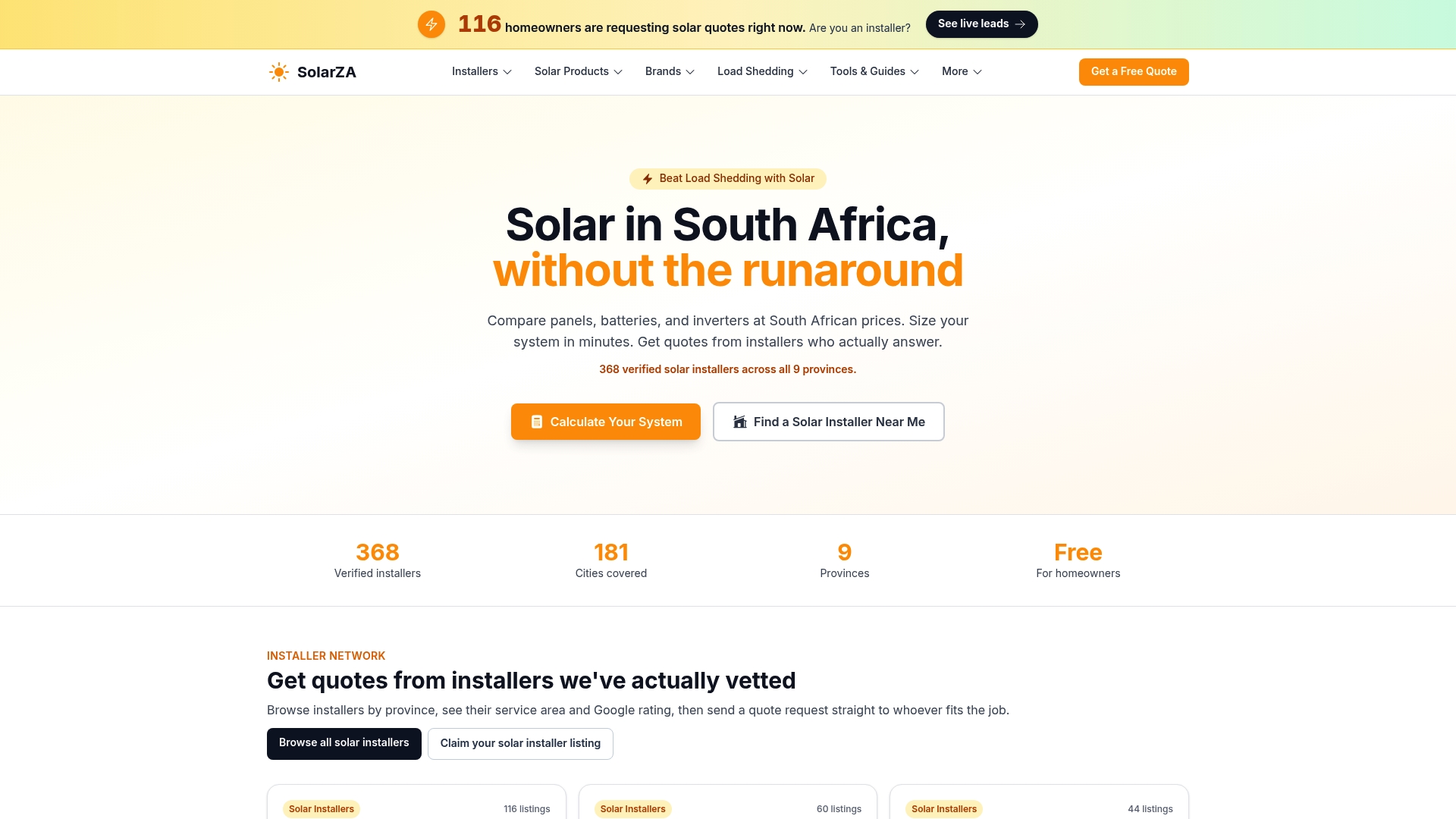
Once your company is listed with Solarza, homeowners requesting quotes through the solar calculator and quote tools get matched with installers by location, service type, and brand experience rather than digging through generic search results. Your GreenCard status, DoEL registration, and any provincial coverage become part of your profile, giving homeowners the reassurance they're after before they even pick up the phone. If you're ready to start receiving qualified enquiries in your area, list your business through Solarza's installer directory and get in front of homeowners who are actively comparing quotes right now.
Official PV GreenCard and SAPVIA resources
- PV GreenCard portal and company registration
- PV GreenCard membership terms and conditions
- SAPVIA programme overview
- PV GreenCard assessment datasheet
- Industry perspective on trades development: Trade Intel blog
Sources
FAQ
How do you get a PV GreenCard?
Complete a 5-day preparatory training course, then pass the 2-day SAPVIA assessment covering theory and practical mock-roof installation. Your company then registers separately once you have DoEL registration and an assessed staff member.
How much does it cost to get a PV GreenCard?
Training typically costs several thousand rand excluding VAT, and the SAPVIA assessment adds an additional fee excluding VAT, putting the combined cost at a moderate expense per candidate.
How do you get a green card in South Africa?
If you mean permanent residency, that's handled through South Africa's Department of Home Affairs immigration process, entirely separate from the PV GreenCard, which is an industry solar quality assurance credential and has no connection to immigration or residency status.
Do you have to pay Eskom if you have solar?
Yes, unless you've gone fully off-grid. Most grid-tied solar homes remain connected to Eskom or their municipal supplier for backup power and, in some areas, for feeding excess generation back to the grid, so the connection and its fees typically continue.
What's the difference between individual assessment and company registration?
Individual assessment certifies one electrician's competence through the SAPVIA exam. Company registration is a separate step requiring DoEL contractor status plus at least one assessed individual on staff before the business can issue GreenCard reports to clients.