Home inverter calculator: size your system right in 2026

How to calculate the right home inverter size for your South African home
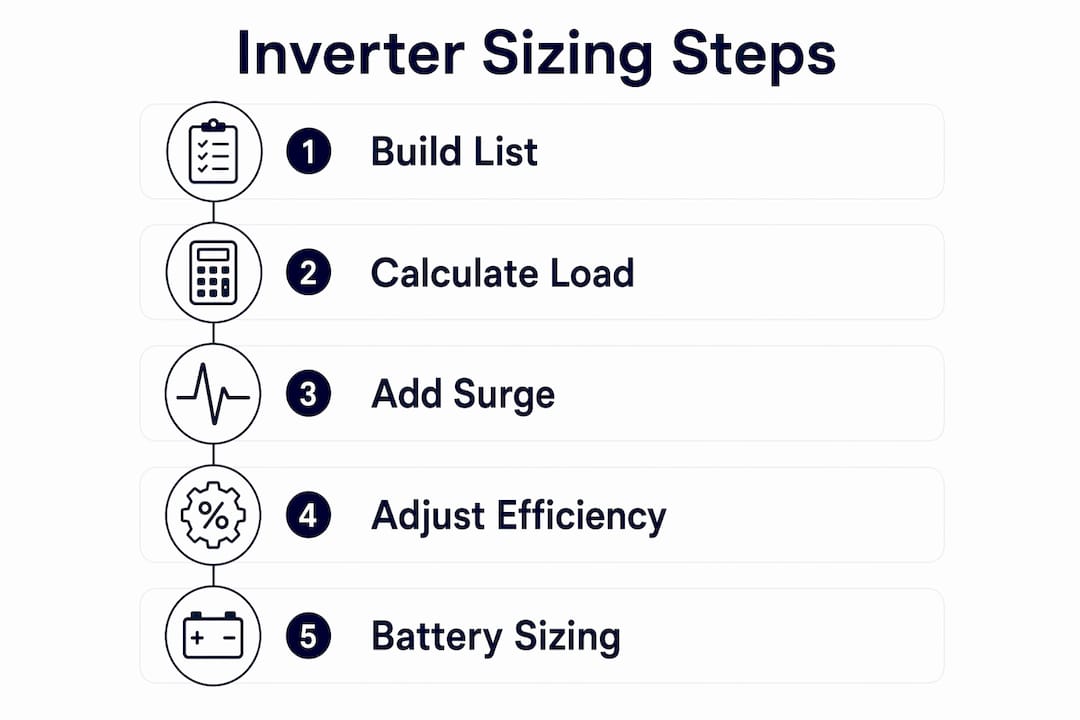
The right inverter size comes down to one core calculation: add up the wattage of every appliance you plan to run at the same time, then multiply that total by 1.25 to cover surge and startup loads. That 25% buffer is what stops your inverter from tripping the moment your fridge compressor kicks in while the TV and Wi-Fi router are already running.
Here is the process, step by step:
- List your essential simultaneous appliances. Think lights, fridge, Wi-Fi router, TV, laptop chargers, and any security system. These are the loads that must stay on during load shedding.
- Find the wattage of each. Check the label on the appliance or its manual. LED lights run low wattage each; a fridge continuously uses moderate power but surges on startup; microwaves and kettles draw significant wattage during operation.
- Add them up. That sum is your continuous load in watts.
- Multiply by 1.25. This gives you your minimum inverter rating in watts. Divide by 1,000 to convert to kilowatts.
- Account for inverter efficiency. Most inverters operate at 90–95% efficiency, so divide your adjusted load by 0.92 (a midpoint) to find the true inverter capacity you need.
- Check the surge rating separately. Your inverter's surge rating must exceed the highest single startup load in your system, typically the fridge or a pump.
Typical sizing examples for South African homes:
- A flat or small home running lights, Wi-Fi, TV, and a fridge needs roughly a 3 kW inverter.
- A medium family home adding a microwave, washing machine (cold cycle), and small kitchen appliances needs a 5 kW inverter.
- A larger home with multiple fridges, a pool pump, borehole pump, or a small air conditioner should look at an 8 kW inverter or higher.
Adding a kettle or toaster to any of these setups immediately pushes the requirement up. A kettle alone draws 1,—, which can tip a 3 kW system into overload territory if the fridge surges at the same moment. *
Table of Contents
- Why correct inverter sizing matters more in South Africa than anywhere else
- Understanding kW, kVA, and power factor when reading inverter specs
- A practical guide to calculating your home's power requirements
- Common inverter sizing mistakes South African homeowners make
- How Solarza helps you size and install the right inverter safely
- Key takeaways
- FAQ
Why correct inverter sizing matters more in South Africa than anywhere else
South Africa's grid is not stable. Voltage fluctuations, frequent load shedding, and the abrupt switching between grid and battery power put inverters under stress that homeowners in countries with reliable grids simply do not face. Incorrect sizing increases the risk of inverter tripping and system failure precisely during the moments you need backup power most.
The consequences of getting the size wrong cut both ways:
- Undersizing causes the inverter to trip under surge loads, leaving you without power during load shedding. Repeated overloading shortens the inverter's lifespan and can damage connected appliances.
- Oversizing wastes money. A system with far more capacity than your home needs can cost R15,000 to R40,000 more than a correctly sized one, with no practical benefit.
- Battery mismatch is a knock-on effect. An oversized inverter paired with an undersized battery bank drains batteries too fast, reducing backup time and degrading battery health faster.
- Solar panel underperformance follows when the inverter cannot efficiently convert the DC output your panels produce.
- Safety and compliance failures are the most serious risk. South Africa's SANS 10142 standard governs all electrical installations, including solar and inverter systems. A non-compliant installation can void your home insurance and create genuine fire or electrocution hazards.
SANS 10142 compliance is not optional. Professional installer assessment is critical beyond any online calculator estimate to ensure safe integration with the local grid and to meet the legal requirements for residential electrical installations in South Africa.
The combination of grid instability and strict local standards makes accurate sizing a practical necessity, not just a financial one.
*Understanding kW, kVA, and power factor when reading inverter specs
Inverter labels in South Africa almost always show two ratings: one in kW and one in kVA. They are not the same number, and confusing them is one of the most common sizing errors homeowners make.
kW is real power, the actual work done to run your appliances. kVA is apparent power, which includes both real power and the reactive power that inductive loads (motors, compressors, transformers) require to operate. The ratio between the two is called the power factor.South African appliances typically carry a power factor of around 0.8, which means:
kW = kVA × power factorThis distinction matters when you are comparing inverter quotes. A supplier quoting a "5 kVA inverter" and another quoting a "4 kW inverter" may be describing the same machine, or they may not. Always confirm both figures. How power factor affects your sizing:
A 5 kVA inverter delivers approximately 4 kW of real power. If your calculated load is 4 kW, a 5 kVA inverter is the minimum you should specify, not a 4 kVA unit.
- Motor-driven appliances (fridges, washing machines, pumps) have lower power factors, meaning they draw more apparent power than their watt rating suggests.
- Resistive loads (kettles, toasters, incandescent bulbs) have a power factor close to 1.0, so their kW and kVA ratings are nearly identical.
- Mixing both types in your load list means your overall system power factor will sit somewhere between 0.8 and 1.0.
For a practical overview of inverter options and ratings available in South Africa, Solarza's inverter guide covers current 5 kW, 10 kW, and hybrid models with their real-world specs.
*A practical guide to calculating your home's power requirements
Working through a real calculation makes the process concrete. Use this as your home inverter load calculator framework.
Step 1: Build your appliance list
Start with essential loads only. Non-essential appliances like geysers, ovens, and air conditioners should be handled separately, if at all.
| Appliance | Typical running wattage | Startup surge wattage |
|---|---|---|
| LED light (per bulb) | 10–15 W | None |
| Wi-Fi router | 10 W | None |
| LED TV | 80–120 W | None |
| Laptop charger | 45 W | None |
| Fridge/freezer | 100 W | Up to 1,000 W |
| Microwave (1,000 W model) | 1,000 W | — |
| Washing machine (cold cycle) | — | 1,— |
| Kettle | 1,— | 1,— |
| Security system | 50 W | None |
Step 2: Calculate your total simultaneous load
Here is a worked example for a medium South African family home:
- 10 × LED lights = 150 W
- Wi-Fi router = 15 W
- TV = 100 W
- 2 × laptop chargers = 120 W
- Fridge = 150 W (running)
- Microwave = 1,000 W
- Security system = 80 W
Total continuous load = 1,615 W
Step 3: Add the surge margin
1,615 W × 1.25 = 2,019 W (approximately 2 kW)
The fridge startup surge of 1,000 W is the largest single surge event. The inverter's surge rating must comfortably exceed 1,000 W above the running load, so a 3 kW inverter with a surge rating of around 5,400 W handles this setup with headroom to spare.
Step 4: Adjust for inverter efficiency
2,019 W ÷ 0.92 = 2,195 W effective inverter requirement. A 3 kW unit is the right call here.
Step 5: Factor in battery capacity and backup time
Battery sizing follows a separate formula. Energy required = load (kW) × backup hours ÷ 0.8, where 0.8 accounts for the 80% depth of discharge recommended for lithium batteries to preserve their lifespan.
For the example above: a 1.6 kW continuous load running for 4 hours needs 1.6 × 4 ÷ 0.8 = 8 kWh of battery capacity. For a full battery sizing guide matched to your inverter, Solarza's battery resource walks through lithium and deep-cycle options available in South Africa.
Pro Tip: Run your kettle and microwave from the grid or a dedicated circuit where possible. Both are resistive loads that consume enormous wattage for short periods, and including them in your inverter load calculation forces you into a significantly larger and more expensive system. *Common inverter sizing mistakes South African homeowners make
Most sizing errors are predictable, and knowing them in advance saves real money.
Ignoring startup surge wattage. A fridge compressor starting up while a washing machine motor is also spinning can spike demand by 2,500–3,000 W above the running load. An inverter sized only for continuous load will trip immediately. Always check the surge rating on the spec sheet, not just the continuous kW figure. Sizing for every appliance in the house. The goal of a home inverter battery calculator is to identify what you genuinely need during an outage, not to replicate your full grid connection. Sizing for the oven, geyser, and air conditioner simultaneously produces a system that costs far more than necessary and still cannot run all three at once without tripping. Neglecting battery autonomy in the inverter calculation. A 5 kW inverter paired with a 5 kWh battery bank will exhaust its batteries in under an hour at full load. The inverter and battery capacity must be planned together, not separately. Choosing a modified sine wave inverter for a modern home. Pure sine wave inverters provide clean, stable power suitable for all household appliances. Modified sine wave units are cheaper but can damage sensitive electronics, variable-speed motors, and medical equipment. In a home with modern appliances, the cost saving is not worth the risk. Skipping professional assessment for SANS compliance. An online home inverter wattage calculator gives you a starting point, not a compliant installation. South Africa's SANS 10142 requires that all electrical work be carried out or certified by a registered electrician. An uncertified installation can invalidate your home insurance and create legal liability if something goes wrong. Failing to separate essential from non-essential circuits. Experts consistently recommend building your inverter system around a dedicated essential-loads circuit rather than trying to back up the whole house. This approach cuts system cost significantly and produces a more reliable result. Pro Tip: Before you run any numbers, walk through your home and physically list the appliances you cannot live without for 4–8 hours during load shedding. That list, not your Eskom bill total, is the correct starting point for your inverter sizing calculation. *How Solarza helps you size and install the right inverter safely
Getting the calculation right on paper is step one. Getting it installed correctly, compliantly, and with the right equipment is where most homeowners need support.
Solarza connects South African homeowners with vetted, rated solar installers across all nine provinces. The platform is built specifically around the realities of load shedding and South Africa's regulatory environment, which means the installers in its network understand SANS 10142 compliance, local grid characteristics, and the practical sizing decisions that online calculators cannot fully capture.
Here is what Solarza brings to the process:
- Solar and inverter sizing tools. Solarza's solar cost calculator gives you a starting estimate for system size and cost before you speak to anyone.
- Verified installer connections. Every installer in the Solarza network is vetted and rated by previous customers. You can find installers by city or by the inverter brand they work with, so you get someone who knows the specific equipment you are considering.
- Professional load assessments. A verified installer will conduct a proper site assessment, check your DB board, measure your actual consumption patterns, and size your system for your real load, not a theoretical one.
- Compliance guidance. Solarza's installer network ensures that sizing and installation meet SANS 10142 requirements, protecting your home insurance and your family's safety.
- Load shedding expertise. The platform is built around South Africa's load shedding reality. Installers connected through Solarza understand how to configure systems that switch seamlessly between grid, solar, and battery without damaging sensitive appliances.
Hybrid inverters are worth a specific mention here. Battery-ready hybrid models do more than provide backup during outages. South Africa is actively developing virtual power plant infrastructure, where coordinated residential batteries could collectively support grid stability. Choosing a hybrid inverter now positions your home to participate in these programmes as they mature, adding long-term value beyond basic backup.
For a broader look at home backup system options, including how inverters fit into complete solar generator setups, this practical guide covers the full picture.
Solarza makes it straightforward to move from calculation to installation. Use the complete solar systems guide to understand how inverter sizing fits into a full system, then connect with a verified installer in your area to get a tailored quote.
*Key takeaways
Accurate inverter sizing in South Africa requires calculating your simultaneous essential load, adding a 25% surge margin, adjusting for inverter efficiency, and verifying compliance with SANS 10142 through a registered electrician.
| Point | Details |
|---|---|
| Core sizing formula | Total simultaneous wattage × 1.25 for surge, then divide by inverter efficiency (around 0.92). |
| kW vs kVA distinction | A 5 kVA inverter delivers roughly 4 kW of real power at a 0.8 power factor — always confirm both figures. |
| Battery capacity formula | Energy needed = load (kW) × backup hours ÷ 0.8 to account for 80% depth of discharge in lithium batteries. |
| Avoid oversizing costs | Oversizing can add unnecessary costs without practical benefit; size for essential circuits, not the whole house. |
| Compliance is mandatory | SANS 10142 requires certified electrical work; an uncertified installation can void home insurance. |
FAQ
How do I calculate what size inverter I need?
Add the running wattage of all appliances you plan to use simultaneously, then multiply by 1.25 to cover startup surges. Divide the result by your inverter's efficiency rating (typically 0.92) to get the minimum inverter capacity in watts.
How many watts of inverter do I need for a typical South African home?
A home running lights, a fridge, Wi-Fi, and a TV needs roughly a 3 kW inverter. Adding a microwave and washing machine pushes that to 5 kW. High-draw appliances like kettles or pumps require 8 kW or more.
What size inverter do I need to run my whole house?
Running an entire house including geysers, air conditioning, and cooking appliances simultaneously is rarely practical or cost-effective. Most South African homeowners size for essential circuits only, which typically lands between 3 kW and 8 kW depending on household size.
How many kW inverter do I need for a 4-hour load shedding backup?
Calculate your continuous load in kW, then use the battery formula: load × backup hours ÷ 0.8. A 1.6 kW load for 4 hours requires 8 kWh of battery capacity. The inverter itself should be sized to your peak simultaneous load, not the backup duration.
Do I need a pure sine wave inverter for my home appliances?
Yes, for any modern home with variable-speed motors, sensitive electronics, or medical equipment. Modified sine wave inverters are cheaper but can damage these devices over time. Pure sine wave inverters provide clean, stable power compatible with all standard household appliances.