4–5 Year Payback: Charge Your EV on Solar, Get Vetted Installers
You can charge an electric vehicle from home solar, and the practical route for most South African homeowners is a solar-aware Level 2 charger paired with a hybrid inverter and, where load-shedding is a concern, battery storage. Before buying anything, get a licensed electrician to run a load calculation. That single step determines whether your panel and wiring can handle the extra circuit, and it shapes every quote you'll receive.
*TL;DR:>
- When setting up solar EV charging, ensure your inverter is compatible with your charger and supports bidirectional flow if vehicle-to-home capability is desired.*
- A typical 8 to 12 kW solar array, coupled with a hybrid inverter and 10 to 15 kWh battery, can offset most EV charging needs within 4 to 5 years of operation.
- Smaller households or daily commuters with lower driving distances can rely on a 3 to 4 kWp system and a 5 kWh battery, while larger or heavier drivers need 6 to 12 kWp and larger storage.
- Load calculations and proper wiring, including dedicated circuits and surge protections, are essential steps verified by licensed electricians to ensure system safety and performance.
- Weather variations, like cloud cover and seasonal changes, significantly impact solar output, making battery storage and scheduled grid top-ups crucial for reliable EV charging.
Table of Contents
- How solar, inverters, batteries and your EV charger work together
- What a solar EV charging system costs, and what you get back
- How much solar do you actually need for your driving pattern?
- Installation checklist: what to verify before and during the job
- Choosing a charger that actually fits a solar setup
- How Solarza gets you from research to a working system
- Does weather change how well solar EV charging works?
- Net metering, feed-in tariffs and how the grid fits in
- Keeping a solar EV charging system running smoothly
- A pragmatic take on getting started
- Get matched with vetted installers for your solar EV setup
- Sources
- FAQ
How solar, inverters, batteries and your EV charger work together
Solar power doesn't flow straight from your roof into your car. It moves through a chain of conversions, and understanding that chain tells you why component choice matters so much.
Your panels generate direct current (DC) electricity. A hybrid inverter converts that DC into usable AC power, sends surplus to your distribution board, and, if you have one, tops up your battery. From there, power reaches a dedicated circuit wired specifically for your EV charger, ideally with its own breaker sized to the charger's draw. Batteries sit in the loop as a buffer, storing whatever the house doesn't use during the day so you can draw on it after sunset or during an outage.
There are two main ways to run this setup:
- Surplus (solar-first) charging: the charger only draws power once your home's other loads are covered, so you're using electricity that would otherwise go unused or get exported.
- Scheduled charging: you set the car to charge during a fixed window, typically the middle of the day, when solar production peaks.
Smart chargers make surplus charging work by constantly measuring how much solar power is available and adjusting their draw accordingly. Charging between roughly 10:00 and 15:00 maximises direct solar use and keeps your battery reserve intact for the evening.
Inverter compatibility is the detail people skip, and it bites them later. Not every inverter talks to every EV charger's solar-tracking feature, and if you're eyeing vehicle-to-home (V2H) capability down the line, you'll need a charger and inverter explicitly rated for bidirectional flow. That's a niche feature today, but it's worth asking about before you commit to hardware that can't be upgraded.
What a solar EV charging system costs, and what you get back
A home solar EV charging setup has five core components, and each one earns its place.
Solar array (usually 8–12 kW for a household running an EV): converts sunlight into the raw power supply everything else depends on. Monocrystalline panels remain the standard recommendation for efficiency per square metre of roof. Hybrid inverter: the traffic controller, splitting power between household use, battery charging, and the grid. Get one rated to handle your array's peak output plus room to grow. Battery (10 to 15 kWh is the range most installers recommend for homes wanting both EV support and outage backup): LiFePO4 chemistry dominates local installs because of its cycle life and thermal stability. Level 2 charger (7.4 to 9.6 kW): the piece that actually feeds your car, and the one with the "smart" features worth paying for. Protections: breakers, surge protection, and isolation switches sized to the new circuit.Here's roughly what each component costs, based on current market data:
These figures come from Africa-focused installation guides aggregating regional pricing, and your final quote will shift depending on roof condition, wiring distance, and installer labour rates.
The number that actually matters to your wallet is payback. Local analysis using a R3.50/kWh tariff and 270 kWh of avoided grid consumption per month found a payback period of approximately 4 to 5 years, with monthly savings around several hundred rands once the system is sized correctly for the household's driving habits. That's a meaningfully faster return than solar-only installations without EV charging, because you're offsetting a bigger, more predictable chunk of consumption.
If you want a starting estimate before calling installers, run your numbers through a solar calculator first. It gives you a ballpark on array size and savings before you request quotes, so you walk into those conversations with realistic expectations instead of guessing.
How much solar do you actually need for your driving pattern?
Sizing a system starts with one number: how many kWh does your car use per day, and does your roof and battery combination cover that.
The math is straightforward. Take your car's consumption rate (most EVs sit between 15 and 20 kWh per 100km), multiply by your average daily distance, and you've got your daily charging need. A car using 17 kWh/100km driven 40km a day needs about 6.8 kWh of charge daily. Compare that against your array's realistic daily output (roughly 4 to 4.5 usable hours of peak sun for most South African regions) and you can work backward to the array size required.
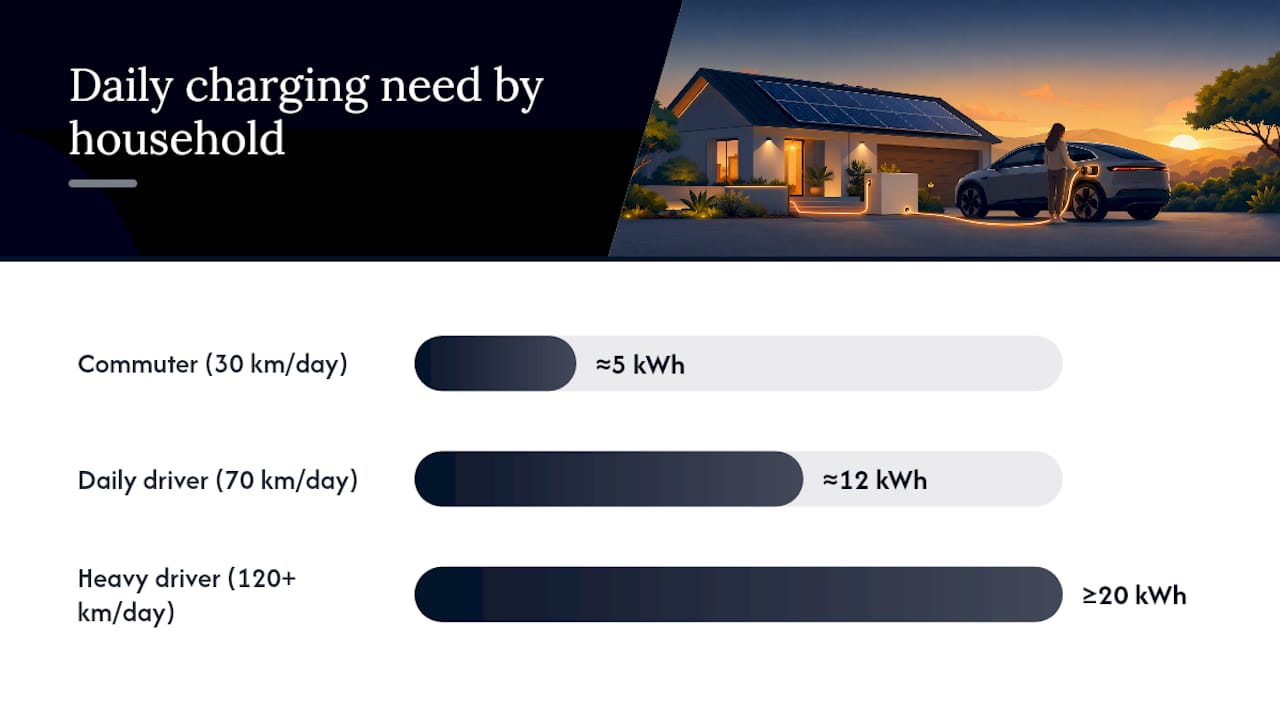
Here's how that plays out across three household types:
- The commuter (30km/day, small hatchback EV): needs around 5 kWh daily. A 3 to 4 kWp array with a small 5 kWh battery can comfortably cover this, similar to the setup that added roughly 6.4 kWh to a car battery in one sunny day by limiting charge current to 6 to 10A.
- The daily driver (70km/day, mid-size sedan): needs roughly 12 kWh daily. This calls for a 6 to 8 kWp array and a 10 kWh battery if you want backup coverage as well.
- The heavy driver (120km+/day, or a household with two EVs): needs 20 kWh or more daily. Expect to need the full 8 to 12 kWp array range and a 10 to 15 kWh battery to avoid grid draw on cloudy days.
One wiring detail catches people off guard: single-phase household connections cap your practical charging speed lower than three-phase setups, regardless of what your charger is rated for. If you're on single-phase power (the norm for most residential properties), a 7.4 kW charger is usually your ceiling. Three-phase unlocks the higher end of Level 2 charging, but check with your electrician whether your property has it before you shop for a charger based on its maximum rated output.
The smaller the system, the more you'll rely on scheduling and current limiting rather than pure surplus charging, and charge speeds will run slower as a trade-off for staying off the grid entirely.
Installation checklist: what to verify before and during the job
A solar EV charging install touches your home's electrical system directly, so the paperwork matters as much as the hardware.
- Confirm the installer is a licensed electrician registered to issue a Certificate of Compliance (CoC) on completion. No CoC means no proof the work meets electrical code, and it can complicate insurance claims later.
- Request a written load calculation showing your panel's existing capacity and headroom for the new circuit.
- Ask for a wiring diagram specifying breaker size, conduit routing, and where the dedicated EV circuit terminates.
- Verify surge protection and AC/DC disconnects are included, particularly around the inverter and battery.
- Check where the inverter and battery will sit. They need ventilation and protection from direct sun and moisture, not a sealed cupboard.
- During commissioning, insist on a full test cycle and monitoring app setup so you can see production, consumption, and charger draw in real time.
- Agree on a maintenance schedule upfront, including panel cleaning frequency and battery health checks.
For homes dealing with frequent load-shedding, ask specifically how the system handles a grid outage mid-charge. A properly configured hybrid inverter should isolate from the grid automatically and keep charging from battery or solar without you touching a switch. Pro Tip: Ask your installer to show you the load calculation on paper, not just describe it verbally. If they can't produce one, get a second quote.
Choosing a charger that actually fits a solar setup
Not every Level 2 charger plays well with solar, and the difference shows up in your electricity bill within the first month.
Prioritise these features when comparing options:
- Solar-priority or "charge on solar" mode: the charger throttles its draw to match available surplus rather than pulling a fixed rate regardless of production.
- Dynamic load balancing: prevents the charger from overloading your panel when other appliances kick in simultaneously, a feature increasingly standard in installer-supplied setups.
- Scheduling and app monitoring: lets you set charging windows around peak sun hours without manual intervention.
- Connector compatibility: check it matches your vehicle's inlet type (Type 2 is the regional standard).
- Certification and warranty terms: look for a minimum two-year warranty and clear language on what's covered.
Match the charger's kW rating to what your car can actually accept. A 22 kW charger is wasted money on a vehicle that only accepts 7.4 kW onboard, and it adds cost to your panel upgrade for no real benefit.
Red flags on a quote: no load calculation attached, vague or verbal-only warranty promises, and any installer unwilling to commit to issuing a CoC. Walk away from all three.
How Solarza gets you from research to a working system
Working out array size and battery capacity on your own is useful groundwork, but turning that into an installed system means comparing real quotes from real installers. That's where a directory built specifically for this matters.
There are directories and platforms that connect you with vetted, rated solar installers matched to your location and system type. Start with the solar calculator to get a rough sizing estimate, then use Get Your Solar Match to receive tailored quotes from installers who already understand EV charging integration. Compare those quotes against the checklist above: load calculation, CoC, warranty terms, and charger specification. That comparison is where you catch the difference between a rushed quote and a properly engineered one.
Does weather change how well solar EV charging works?
Cloud cover cuts panel output significantly, and that has a direct, practical effect on how much charge your EV gets on a given day. A fully overcast day can drop production to a fraction of clear-sky output, which matters most for smaller systems relying on surplus-only charging.
Seasonal variation compounds this. Winter months bring shorter days and a lower sun angle, both of which reduce total daily production even on clear days. A system sized generously for summer charging can fall noticeably short in June and July.
This is where battery storage earns its keep beyond outage protection. A battery charged during a strong solar day can carry reserve capacity into a weaker one, smoothing out the day-to-day unpredictability that pure grid-tie surplus charging can't handle on its own.
The practical response isn't to over-build your array to cover worst-case winter days, which wastes money most of the year. Instead, plan for scheduled grid top-ups during extended low-production stretches, and treat solar as your primary source rather than your only source.
Dust and pollen buildup on panels also chips away at output gradually, which is a maintenance issue as much as a weather one, and it's easy to underestimate how much a dirty panel surface costs you over a season.
Net metering, feed-in tariffs and how the grid fits in
Grid interaction policy in South Africa is inconsistent by municipality, and that inconsistency directly affects whether exporting surplus solar power makes financial sense for your EV charging setup.
Some municipalities offer net billing or feed-in arrangements that credit you for exported power, while others offer little to no compensation, or require specific metering equipment and approval processes before you're allowed to export at all. Before assuming you'll get paid for surplus solar, check your specific municipality's current policy and metering requirements directly. This varies enough between areas that a blanket answer would mislead you.
For most homeowners running an EV charging setup, the more reliable financial logic is self-consumption rather than export. Every kWh you use to charge your car is a kWh you didn't buy from the grid at retail rates, and that offset is usually worth more than whatever a municipality credits you for exporting the same power. This is part of why sizing your array to your household plus EV load, rather than oversizing for export income, tends to produce a better return.
Grid-tie systems without battery backup also have a practical limitation worth flagging: most are required to shut down during a grid outage for safety reasons, meaning they won't charge your car during load-shedding unless paired with a hybrid inverter and battery configured for off-grid operation. If outage-proof charging matters to you, that battery isn't optional. It's the component that makes the difference between "solar EV charging" and "solar EV charging that also survives load-shedding."
Keeping a solar EV charging system running smoothly
Most problems with solar EV charging setups trace back to three things: dirty panels, software glitches, and loose connections, none of which require an electrician to catch early.
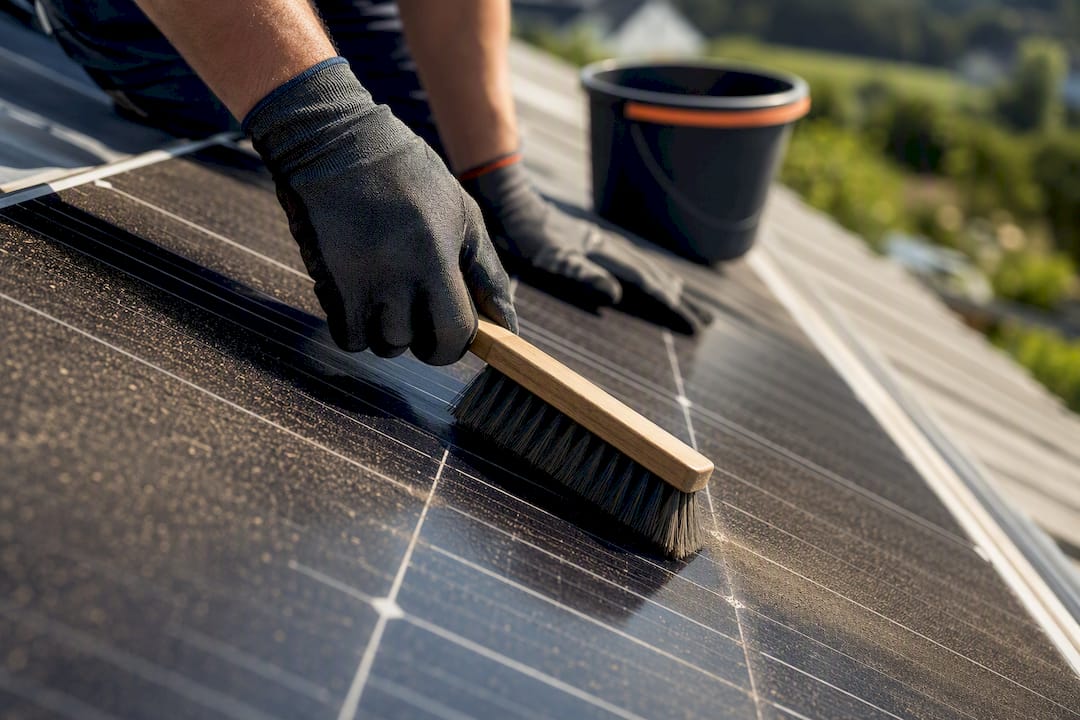
Panel cleaning should happen every few months, more often if you're near dust, agricultural land, or heavy pollen seasons. A visible drop in your monitoring app's production numbers on an otherwise clear day is usually the first sign it's time.
Battery health is the next thing to watch. LiFePO4 batteries are built for long cycle life, but check your monitoring app periodically for warnings about cell balancing or capacity fade. A battery that's noticeably underperforming its rated capacity within the first year or two is worth flagging to your installer under warranty rather than waiting it out.
Charger issues tend to show up as either a failure to start charging or an inconsistent draw rate. Before assuming hardware failure, check the basics: is the charger's firmware updated, is the scheduling app actually syncing, and has anything changed in your home's load that might be triggering the load-balancing feature to throttle output. A surprising number of "broken charger" calls turn out to be a Wi-Fi connectivity issue between the charger and its app, not an electrical fault at all.
Set a maintenance check twice a year covering panel condition, inverter fan and vents, battery terminals, and a full system test cycle. That rhythm catches small issues before they become an expensive callout.
A pragmatic take on getting started
Start with a solar-aware Level 2 charger and an array sized to your actual driving pattern, not an aspirational one. Add battery storage only once you've confirmed you need outage-proof charging, since it's the most expensive line item and not everyone needs it on day one. Get at least two vetted quotes with proper load calculations before signing anything.
— Kobus Kohvik
Get matched with vetted installers for your solar EV setup
Instead of cold-calling installers one by one and hoping you land on someone qualified, consider using platforms that match you with vetted, rated installers who understand how to integrate a Level 2 charger with a hybrid inverter and battery.

The process starts with the solar calculator to establish a realistic system size for your home and driving pattern. From there, request a free quote and you'll be matched with installers who can put together side-by-side proposals covering array size, inverter model, battery capacity, and charger specification, so you're comparing apples to apples instead of guessing which quote is actually complete. If you'd rather browse by location first, the directory of installers by city lets you see who's active near you before committing to anything.
Sources
- Ev24
- How to charge an electric car on a small solar power system — without accidentally using Eskom - MyBroadband
- Solar Electric Vehicle(EV) Charging in South Africa: 4.4-Year Payback | Smart Tech Distributors
- EV Home Charger South Africa: Complete 2026 Guide to Installation, Costs & Best Options – ChargePoint SA
FAQ
Is it possible to charge an EV with solar?
Yes. A solar array feeding a hybrid inverter, with or without battery storage, can charge an EV directly, either through surplus charging during daylight hours or scheduled charging timed to peak production.
Is there a solar powered EV charger?
Smart Level 2 chargers with a "charge on solar" or solar-priority mode are widely available and designed specifically to draw only from available solar surplus, throttling output as production changes throughout the day.
Can an EV charging station be powered by solar?
Yes, provided the charger is wired through a hybrid inverter with sufficient array capacity behind it. Sizing matters here: a 7.4 to 9.6 kW charger typically needs an 8 to 12 kW array to run reliably on solar alone.
Can I charge my electric car using solar panels?
Yes, and even a modest system can help. One documented setup with a 3.3 kWp array and a 5.12 kWh battery added roughly 6.4 kWh of charge in a single day by limiting charge current and timing it to peak sun hours.