Will Eskom's time of use tariffs raise your bill in 2026?
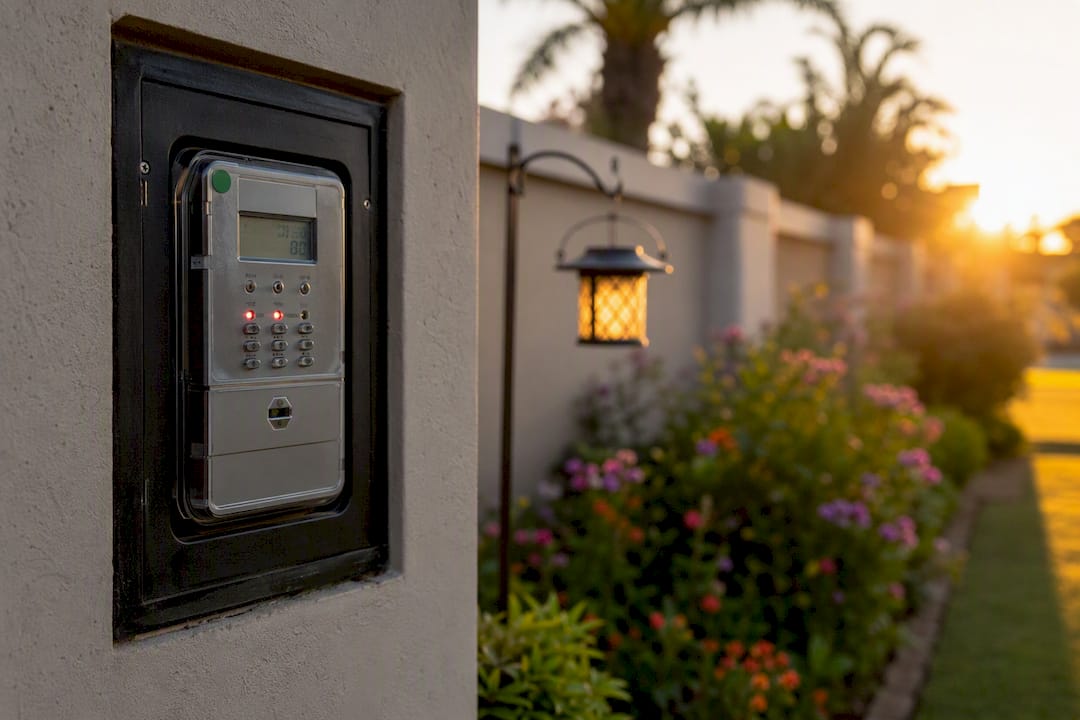
Whether Eskom's time of use structure raises or lowers your bill depends almost entirely on two things: how much of your household load happens during peak hours, and whether you can shift it. If you run your geyser, pool pump, and laundry in the evening between 5pm and 9pm, you'll likely pay more under the FY2026 rules. If you can move that load to the morning or late at night, or you're running grid-tied solar with a battery, you stand to save.
Three facts matter most right now. The evening peak window has grown to 3 hours, the morning peak has shrunk to 2 hours, and the peak to off-peak price ratio dropped from 8:1 to 6:1. Grid-tied solar customers on Homeflex are required to use time of use metering, no exceptions.
- Evening peak: now 3 hours (was 2)
- Morning peak: now 2 hours (was 3)
- Peak to off-peak ratio: 6:1 (was 8:1)
Your first move this month: find your tariff name on your latest bill, confirm your meter type, and run your consumption through a tariff comparison tool before assuming anything about your new bill.
Key Takeaways
Eskom's FY2026 time of use pricing rewards households that can shift load away from the 3-hour evening peak and raises costs for those whose usage stays fixed to that window regardless of the compressed 6:1 ratio.
| Point | Details |
|---|---|
| Check your tariff name first | Confirm whether you're on Homeflex, Homepower, Homelight, or Ruraflex before estimating any bill change |
| Evening peak grew, morning peak shrank | The 3 hour evening window now carries more of your exposure than the reduced 2 hour morning peak |
| Model before spending | Use Eskom's tariff tools or appliance-level estimates to project your bill change before buying anything |
| Cheap fixes often work first | Geyser timers and shifted laundry cycles can solve much of the gap without capital outlay |
| Solarza models the solar option | Use Solarza's calculator and vetted installer network to size a system specifically for your evening peak load |
Table of Contents
- What changed under Eskom's time of use pricing structure
- How your Eskom bill is actually built: the four charge types
- Which tariff are you actually on: Homeflex, Homepower, Homelight, or Ruraflex
- How to estimate your own bill change under the new tariffs
- Practical ways to cut your bill under the new peak hours
- Tools that help you model your bill and when to call a professional
- Why Eskom introduced time of use pricing in the first place
- How South Africa's peak pricing compares internationally
- The genuine concerns households have about Eskom's TOU tariffs
- Who regulates Eskom's tariffs and how oversight works
- Who wins and who loses under the new tariff structure
- When time of use pricing actually calls for solar and a battery
- Get a real quote before you guess what solar will save you
- Sources
- FAQ
What changed under Eskom's time of use pricing structure
Eskom's time of use tariffs charge different rates depending on the hour of day and the season, and for FY2026 the underlying logic shifted in ways that actually change household behaviour incentives. The core change is the peak to off-peak ratio moving from 8:1 to 6:1, which compresses the price gap between the most expensive and cheapest hours. Peak electricity is still far pricier than off-peak, just less dramatically so than a year ago.
The clock itself moved too. Evening peak now runs longer while morning peak hours were reduced. Eskom also added a new standard rate window on Sunday evenings, a period that used to sit at off-peak or standard pricing depending on the season.
- Evening peak extended to 3 hours
- Morning peak reduced to 2 hours
- New 2-hour Sunday evening standard block
- High-demand season: 1 June to 31 August
- Low-demand season: 1 September to 31 May
- Public holidays follow separate, generally lower-cost rules
The ratio compression from 8:1 to 6:1 is the number that matters most for your budget. It means peak hours cost relatively less than before compared to off-peak, but off-peak and standard hours have risen to compensate. Eskom frames this as aligning prices more closely with actual system costs, and the changes were built into the NERSA-approved FY2026 tariffs that took effect on 1 April 2025. The stated goal was removing unintended subsidies between customer categories, but the practical effect for many households is a bill that behaves differently across the day than it did last year, even if total usage stays flat.
How your Eskom bill is actually built: the four charge types
Your monthly bill under time of use pricing isn't one number multiplied by kWh anymore. It's a stack of separate charges, and understanding which ones move with the clock and which don't is the difference between a useful mental model and a guess.
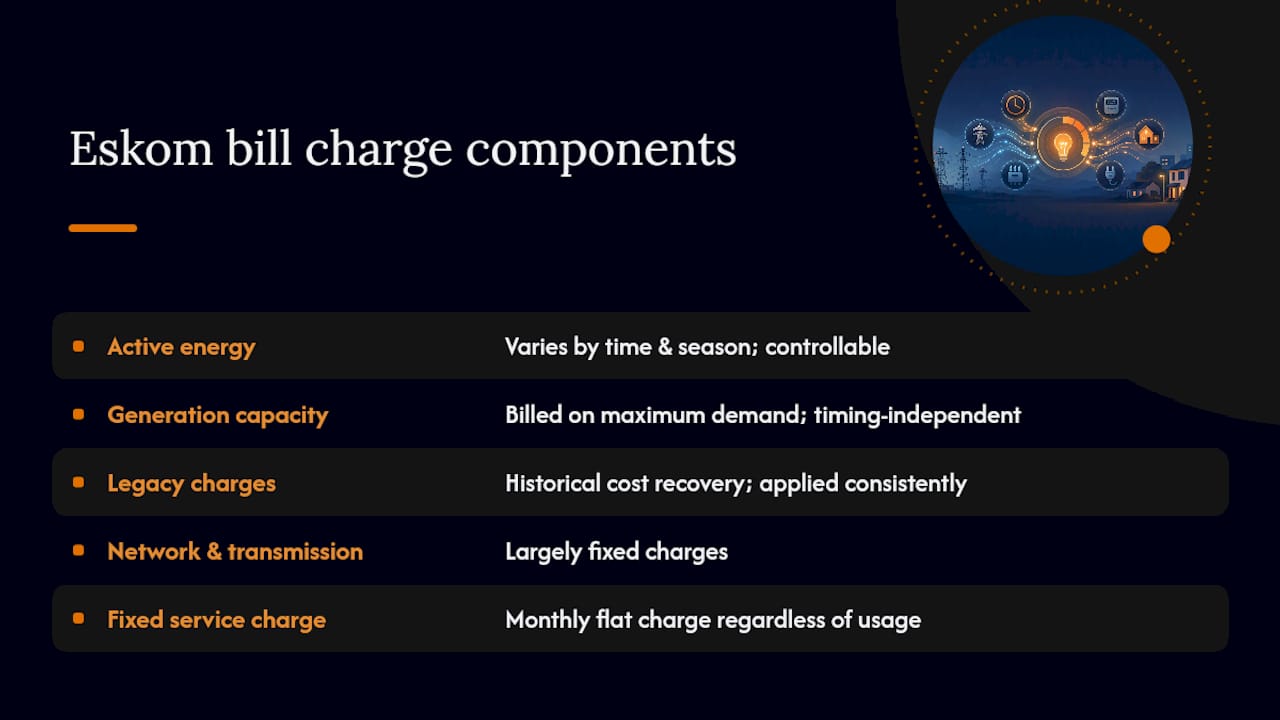
Active energy charges vary by time of day and season and can be controlled by shifting usage.
Generation capacity charges are billed based on maximum demand and apply regardless of timing.
Legacy charges cover historical cost recovery applied consistently.
Network and transmission charges are largely fixed.
A fixed service charge applies monthly regardless of usage.
Homelight remains the one exception. Eskom kept it as a non-unbundled tariff, meaning it still bills on a simpler blended rate structure rather than splitting into these separate line items, as confirmed in the official schedule of standard prices. Everything else on time of use requires a smart meter capable of recording import and export by period, which is mandatory for Homeflex customers with grid-tied solar.
Which tariff are you actually on: Homeflex, Homepower, Homelight, or Ruraflex
Most homeowners have never checked which residential tariff their account sits on, and that single line on your bill determines whether any of this applies to you at all.
- Homeflex covers households with grid-tied solar installations or those who've opted into time of use billing. It's built for customers who can shift load or export surplus power, and Eskom requires it for any grid-tied PV system, even a small one. If you install solar and connect to the grid, you don't get a choice: you move to Homeflex and get a smart meter.
- Homepower is the standard residential tariff for households without solar, generally without time of use splitting in the same way Homeflex applies it, aimed at middle-income urban and suburban customers.
- Homelight serves smaller consumption households, typically lower-usage properties, and stays on the simpler non-unbundled billing model rather than the full time of use structure.
- Ruraflex applies to farms and rural properties with different load patterns and infrastructure costs, and it carries its own time of use logic tailored to agricultural and rural demand curves rather than the urban evening peak.
Check your tariff name on the summary page of your latest bill, then check your meter box for a digital smart meter display versus an older mechanical dial. If you've installed grid-tied solar and you're still on Homepower, that's worth a call to Eskom or your municipal distributor, because grid-tied systems require TOU registration under NERSA rules.
How to estimate your own bill change under the new tariffs
Working out whether you'll pay more or less takes five steps, and you can do this on a spreadsheet in under an hour if you have a recent bill in front of you.
- Pull your hourly or daily consumption profile, ideally a full month, from your smart meter portal or your municipal supplier's app.
- Map each hour of usage to the correct seasonal TOU period: high-demand season runs June through August, low-demand covers September through May, and the periods shift again on Sundays.
- Multiply consumption in each period by that period's active energy rate in c/kWh.
- Add the fixed service charge, the generation capacity charge based on your kVA demand, and the legacy charge.
- If you have grid-tied solar, subtract the value of exported units at the applicable feed-in rate, and account for when your battery charges relative to peak hours.
A full month of hourly data gives the most accurate modelling result, but if you don't have that, appliance-level time estimates paired with the known TOU blocks get you close enough to plan around. Worked example A: a household without solar. A typical suburban home using around 900 kWh a month, with a geyser and cooking load concentrated between 6pm and 8pm, sees a heavier share of consumption fall inside the now-longer 3-hour evening peak. Under the old 8:1 ratio, that peak exposure cost less proportionally than it does now relative to standard hours, even though the ratio itself compressed. Worked example B: a household with grid-tied solar and a battery on Homeflex. This home generates during the day, charges its battery off cheap off-peak and standard rates overnight or midday, and discharges through the evening peak instead of drawing from the grid. Because the battery absorbs the 3-hour evening window entirely, this household barely touches peak-rate grid electricity at all, and any daytime export earns credit at the feed-in rate. The net bill often falls compared to the previous tariff year, even with the ratio compression, because the household simply isn't buying grid power during the expensive hours.
| Input needed | Where to get it |
|---|---|
| Hourly or daily kWh profile | Smart meter portal or municipal usage app |
| Current tariff name and kVA capacity | Latest Eskom or municipal bill |
| Battery charge/discharge schedule | Inverter app or installer settings |
| Export/feed-in rate | Municipal or Eskom tariff schedule |
Practical ways to cut your bill under the new peak hours
Not every household needs a capital outlay to respond to the longer evening peak. Some of the cheapest wins cost less than a takeaway dinner.
- Fit a geyser timer so heating happens in off-peak hours, not during the 3-hour evening window when rates are highest.
- Shift washing machine and dishwasher cycles to late night or mid-morning, outside both peak windows.
- Move pool pump run-time to off-peak hours entirely; most pumps don't need to run during daylight or evening peak at all.
- Use smart plugs or a home energy controller to automate heavy appliances so you don't have to remember to flip a switch every evening.
- Consider thermal storage, like an insulated geyser blanket, as a near-zero-cost way to hold heat through peak hours without running the element.
Automation tends to outperform good intentions. A smart controller that schedules your geyser and pool pump against the TOU calendar removes the human error factor, since most people forget to manually shift loads within the first two weeks of trying.
Solar and battery investment makes the strongest financial sense when your household has a pronounced, consistent evening peak load and enough roof space and budget for a system sized to cover that 3-hour window specifically, not just daytime usage. The ratio compression to 6:1 actually makes standard and off-peak grid power slightly less cheap by comparison, which shifts the return-on-investment math in favour of battery storage for households with heavy evening draws. If a full system isn't affordable right now, manual timers and thermal storage buy you real savings while you save toward a bigger upgrade.
 Pro Tip: Run your geyser and pool pump changes for one full billing cycle before deciding whether you need to spend on batteries. You might find the simple fix covers most of the gap.
Tools that help you model your bill and when to call a professional
Eskom publishes the official tariff booklet and schedule of standard prices with Appendix A laying out every defined TOU period, season, and rule, and it's worth bookmarking as your primary reference. Eskom also recommends customers use its own tariff comparison tools to model individual usage patterns, since bills are no longer a single blended rate.
Beyond the official tools, a solar calculator built for South African conditions can estimate what a solar and battery system would actually do to your bill under current TOU hours, factoring in your province's sun hours and your evening load.
Call in a professional when:
- Your bill jumps sharply with no matching change in your usage habits
- You suspect your meter isn't correctly registered for your tariff type
- You've added grid-tied solar but haven't been switched to Homeflex
| Point | Details |
|---|---|
| Check your tariff first | Confirm Homeflex, Homepower, Homelight, or Ruraflex before assuming your bill will change |
| Model before you spend | Use Eskom's comparison tools or a solar calculator before buying a battery |
| Book an audit for anomalies | A sharp, unexplained bill jump often means a meter or tariff registration error |
Why Eskom introduced time of use pricing in the first place
Time of use pricing isn't a new invention Eskom dreamed up for FY2026. Utilities worldwide have used it for decades to manage the basic problem of electricity generation: capacity built to meet the highest demand hour sits idle most of the day, and someone has to pay for that idle capacity.
Eskom's version has existed in some form for large industrial and commercial customers for years, priced to discourage factories and mines from running heavy machinery during the evening residential peak. Extending a meaningful time of use structure to households is more recent, largely enabled by the rollout of smart metering that can actually measure consumption by hour rather than just a monthly total.
The stated rationale behind the FY2026 changes centres on removing what Eskom calls unintended subsidies. For years, some customer categories effectively paid less than their share of system costs while others paid more, and the ratio and hour adjustments approved by NERSA were designed to correct that imbalance. Eskom argues this reflects a user-pays principle: households that draw heavily during expensive, high-demand hours should pay closer to what that demand actually costs the grid, rather than having that cost spread evenly across everyone regardless of when they use power.
The practical consequence is that time of use tariffs reward flexible households and, by design, apply more financial pressure on households whose load is fixed to the evening hours by necessity rather than choice.
How South Africa's peak pricing compares internationally
South Africa isn't inventing anything unusual here. Time of use billing is standard practice across most developed electricity markets, and Eskom's structure sits broadly in line with how utilities in the United Kingdom, Australia, and parts of the United States price residential power.
The general international pattern splits days into two or three price bands, peak, standard or shoulder, and off-peak, timed around when the grid is under the most strain. Most markets set their peak windows around the same early evening hours South Africa uses, because human behaviour around cooking, heating, and appliance use is fairly consistent across climates once you adjust for local timing habits.
Where South Africa's approach differs slightly is in the size of the price gap. A 6:1 peak to off-peak ratio is a meaningful spread; many mature markets run closer to 2:1 or 3:1 once the more extreme early tariffs settled over time as smart metering became universal and utilities had more data to price accurately. Eskom's still-wide gap partly reflects the severity of its capacity constraints during load shedding years, when peak demand genuinely threatened grid stability in a way it doesn't in most comparable economies right now.
International best practice also tends to pair time of use pricing with strong consumer-facing tools: real-time usage apps, in-home displays, and automated demand response that shifts appliances without the homeowner lifting a finger. South Africa is still catching up on that consumer tooling side, which is part of why manually checking your tariff and modelling your bill matters more here than it might in a market with mature smart-home integration already built into the utility relationship.
The genuine concerns households have about Eskom's TOU tariffs
Not everyone benefits from time of use pricing, and pretending otherwise would be dishonest. The core complaint, echoed across independent analysis of the FY2026 changes, is that Homeflex rewards households that already have the means to shift load or invest in solar and batteries, while households without that flexibility simply absorb the higher evening rates.
A shift worker who's home only during peak hours can't move their cooking and washing to 2pm on a Tuesday. A family renting a flat with a shared, non-negotiable geyser schedule has no control over when hot water gets heated. For these households, the longer 3-hour evening peak isn't a pricing signal they can respond to, it's just a cost increase.
There's also confusion baked into the bill structure itself. Splitting charges into active energy, capacity, legacy, and network components makes bills harder to read at a glance, and Eskom's own guidance acknowledges customers need to actively model their usage rather than eyeball a single rate. That's a real barrier for anyone without internet access, a smartphone, or the time to sit down with a spreadsheet.
The equity question runs deeper than convenience. Analysts have pointed out that removing cross-subsidies is presented as fairness, charging people closer to actual cost, but the practical effect can widen the gap between households that can adapt and those that can't, since the ability to shift load correlates fairly strongly with income and housing type.
Who regulates Eskom's tariffs and how oversight works
Eskom doesn't set its own prices unilaterally. Every tariff structure, including the FY2026 time of use changes, requires approval from the National Energy Regulator of South Africa, NERSA, before it can take effect.
NERSA's role is to review Eskom's proposed tariffs against cost-of-supply studies, public comment periods, and the broader regulatory framework governing the electricity sector. The FY2026 structure, including the shift from an 8:1 to a 6:1 peak ratio and the revised peak hour windows, went through this approval process and is described by Eskom as NERSA-approved rather than a rate Eskom simply imposed.
That approval process includes public participation windows where consumer groups, municipalities, and industry bodies can raise objections before tariffs are finalised. In practice, most residential customers never engage with this process directly, which means the tariff structure they eventually pay reflects negotiations between Eskom, NERSA, and organised stakeholders rather than direct household input.
Municipal electricity distributors add another layer. Many South Africans buy power through their municipality rather than directly from Eskom, and municipalities apply their own surcharges on top of the Eskom-approved base tariff, subject to their own NERSA-regulated distribution licence conditions. That's why two households on paper using identical consumption in different municipalities can see meaningfully different bills even under the same underlying Eskom tariff structure.
Who wins and who loses under the new tariff structure
The distributional impact of time of use pricing isn't evenly spread across income levels, and it's worth being direct about that rather than treating every household as facing the same tradeoff.
Higher-income households with grid-tied solar, battery storage, and flexible schedules are generally the biggest beneficiaries. They can shift load away from the expensive 3-hour evening window, export surplus solar generation for credit, and absorb the upfront capital cost of a battery system that pays itself back partly through avoided peak charges.
Middle-income households without solar face a mixed picture. Those with flexible routines, working from home, retired, or simply willing to run appliances late at night, can capture meaningful savings through behavioural changes alone. Those with rigid evening routines tied to work schedules or shared housing arrangements see costs rise with little practical recourse.
Lower-income households, particularly those on Homelight rather than the unbundled Homeflex or Homepower structures, is largely shielded from the direct mechanics of time of use pricing since Homelight remains a simpler, non-unbundled tariff. But indirect pressure still exists: municipal surcharges, general tariff increases, and the broader cost-of-living effect of higher electricity prices touch every income band regardless of which specific tariff structure applies to their meter.
Rural households on Ruraflex face their own version of this tradeoff, often with less access to the smart devices, apps, and automation tools that make load shifting easy in urban areas, even when the tariff structure technically rewards the same behaviour.
When time of use pricing actually calls for solar and a battery
Time of use pricing only makes sense to act on once you've modelled your own load, not once you've read someone else's story about their bill.
The households I'd point toward solar and a battery are the ones with a genuinely fixed, heavy evening routine that can't be shifted. Everyone else usually gets most of the win from a geyser timer and a bit of discipline. The common mistake is switching tariffs or buying equipment before running the numbers, then being surprised either way.
Model first. Shift what you can. Only then decide if hardware earns its cost.
— Kobus Kohvik
Get a real quote before you guess what solar will save you
There's a version of this where you spend weeks reading tariff schedules and appliance timing guides and still end up guessing at whether a battery pays for itself. Solarza exists to skip that guessing part: it's a free tool that connects you directly with vetted, rated solar installers across all nine provinces, so you get a tailored quote based on your actual roof, load profile, and province's sun hours, not a generic national average.
That specificity matters under the new time of use rules, because a system sized for a household with a flat 8am to 5pm consumption pattern looks nothing like one sized for a household with a heavy 3-hour evening peak. Solarza's solar calculator lets you model your own numbers against current TOU pricing before you talk to anyone, and if the math works in your favour, you can request a free quote from installers who've already been vetted for reliability and prompt service in your area. Start with the calculator, see your own numbers, then decide.
Sources
- Eskom – distribution: 2025-2026 price increase
- Daily Maverick – How Eskom's 2025/26 electricity tariffs will affect residential customers
FAQ
What time of day is electricity cheapest in South Africa?
Off-peak hours, typically late night through early morning and much of the midday low-demand period, carry Eskom's lowest rates, though the exact window shifts by season under the FY2026 schedule.
What are Eskom's off-peak hours for electricity usage?
Off-peak hours fall outside the morning peak (now 2 hours) and evening peak (now 3 hours), and outside the standard-rate windows including the new 2-hour Sunday evening block, with exact timing varying between high-demand season (June to August) and low-demand season (September to May).
What is the cheapest time of day to use electricity?
Late night into early morning is generally the cheapest window, since it falls outside both the morning and evening peak periods and typically outside standard-rate hours too.
How many units of electricity is R200?
That depends entirely on which tariff and which time of use period the usage falls in, since active energy rates vary by period and season; running the amount through a tariff comparison tool or a solar calculator against your actual tariff gives an accurate figure rather than a rough average.