Do solar batteries work in a blackout? South Africa guide
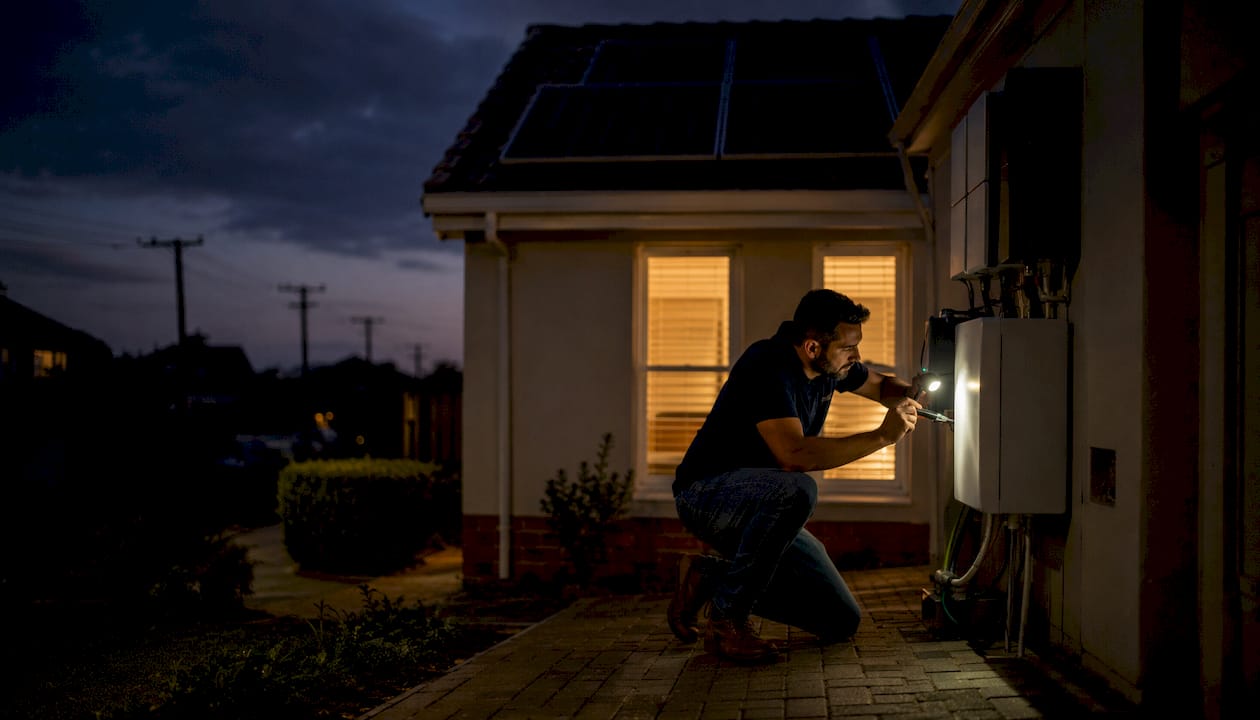 *
*
TL;DR:>
- Solar batteries can power homes during blackouts only if paired with a backup-capable inverter and properly configured for islanding. Standard grid-tied inverters shut down during outages due to safety rules, making hybrid or grid-forming inverters essential for backup. System components like batteries, inverters, and transfer switches must work together, and sizing for the worst load-shedding stages ensures reliable power.*
Yes, solar batteries can power your home during a blackout, but only if your system includes a battery bank and a backup-capable inverter (hybrid or grid-forming) configured for islanding operation. A standard grid-tied solar installation without a battery will shut down the moment the grid fails. Battery size, inverter type, and whether your panels can recharge the battery during a daytime outage all determine how long you stay powered. Systems built to SANS 10142 and installed by verified professionals, like those listed on Solarza, are the safest route to genuine blackout protection.
*Table of Contents
- What "blackout" and "load shedding" mean in South Africa
- Why ordinary grid-tied solar shuts down in a blackout
- What components does a backup-capable system actually need?
- How your panels, battery, and inverter work together during an outage
- What can you realistically run during load shedding?
- How long will your battery last? The kWh math
- Sizing and ballpark costs for South African homeowners
- Safety, SANS standards, permits, and choosing a qualified installer
- If your backup stops working during a blackout — quick checks
- Is a solar battery worth it for load shedding in South Africa?
- How to get a backup-capable system through Solarza
- Key takeaways
- Ready to get backup power that actually works?
- Useful sources
- FAQ
What "blackout" and "load shedding" mean in South Africa
A blackout is an unplanned, total loss of power, often caused by infrastructure failure. Load shedding is Eskom's controlled, rotational interruption of supply to prevent a total grid collapse. Both cut your power, but load shedding follows a schedule (in theory), while a blackout does not.
Load shedding runs through increasing stages, with longer outage durations at higher stages and multiple slots per day.
A few realities that shape how you should size a backup system:
- Evening peak hours (roughly 5 PM–10 PM) are the most common load-shedding windows, and your battery gets no solar recharge during those hours.
- Overlapping blocks at higher stages can mean your battery never fully recharges between outages.
- Schedule unpredictability means you cannot rely on a short outage to protect you; size for the worst realistic stage.
South Africa has seen periods of load-shedding suspension, but the underlying grid vulnerability has not been resolved. Sizing your system for Stage 4–6 conditions is the prudent baseline, not an overreaction. *
Why ordinary grid-tied solar shuts down in a blackout
Grid-tied inverters are legally required to stop generating power the moment the grid goes down. This is called anti-islanding protection, and it exists to prevent your system from back-feeding live electricity onto a line that a technician believes is dead. It is a safety rule, not a design flaw.
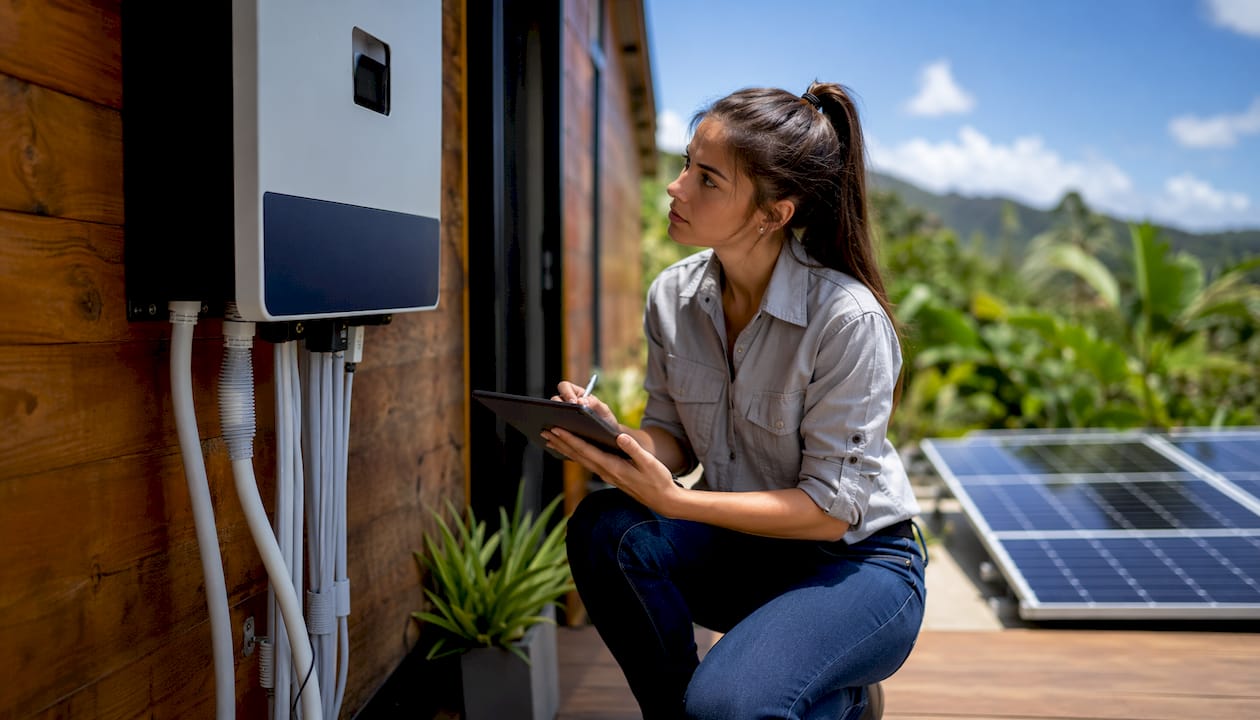
The practical result: your solar panels may be producing full power on a sunny afternoon, but if the grid fails, a standard grid-tied inverter cuts output immediately. You get nothing. The panels are still generating, but that energy has nowhere safe to go.
Not all inverters behave the same way:
- Grid-tied only: Shuts down completely during an outage. No backup whatsoever.
- Hybrid inverter: Can switch to islanding mode, powering a backup circuit from the battery while the grid is down, and can allow PV charging during the outage.
- Off-grid / grid-forming inverter: Operates entirely independently of the grid; suitable for remote properties or full whole-house backup.
Pro Tip: When reading an inverter spec sheet, look for the terms "blackout mode," "island mode," "grid-forming," or "EPS" (Emergency Power Supply). If none of those appear, the inverter cannot provide backup power. *
What components does a backup-capable system actually need?
A solar system that keeps your lights on during load shedding requires more than panels on the roof. Every element below plays a specific role:
- Solar array: Generates DC electricity during daylight; the energy source that recharges your battery when the grid is down.
- Battery bank (kWh): Stores energy for use at night or during outages. Lithium iron phosphate (LFP) chemistry is now the recommended standard for load-shedding resilience due to its long cycle life and depth-of-discharge performance.
- Hybrid or grid-forming inverter: Converts DC to AC, manages the switch between grid, solar, and battery, and creates the islanded microgrid your home runs on during an outage.
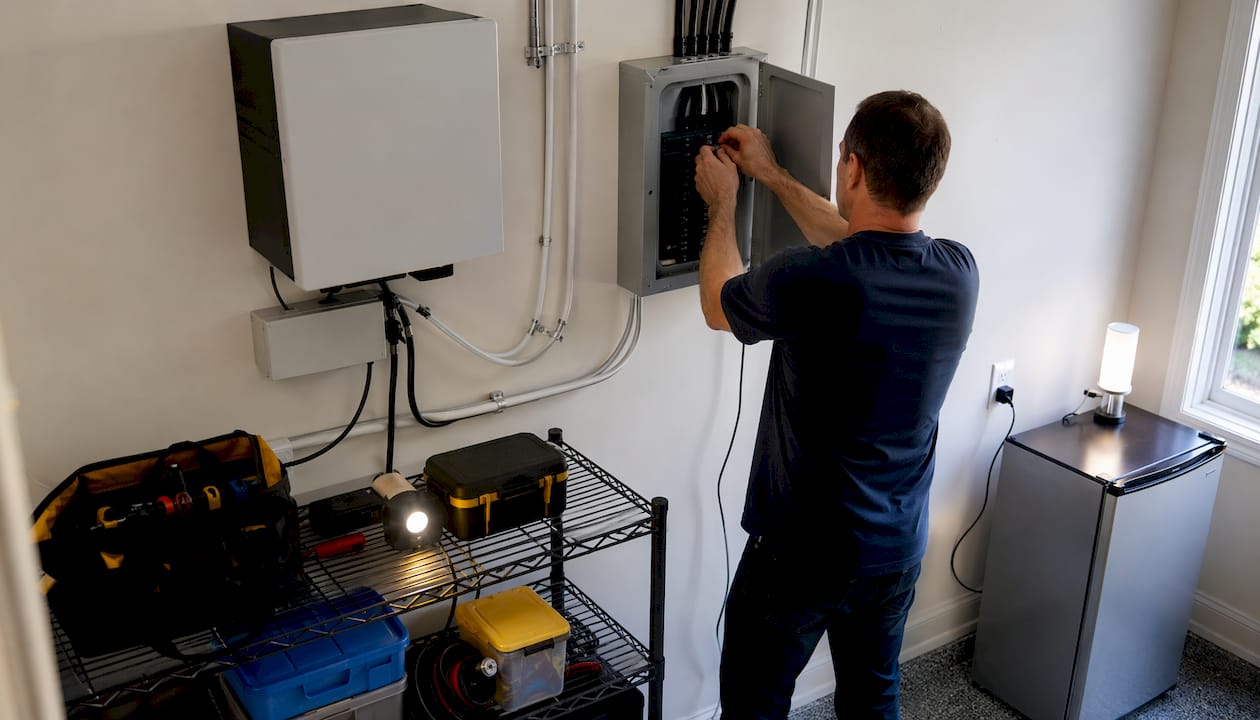
- Backup subpanel or transfer switch: Isolates your critical loads (fridge, lights, router) from non-essential circuits so the inverter is not overloaded during an outage.
- Battery management system (BMS): Monitors cell voltage, temperature, and state-of-charge to protect the battery from damage.
- Safety disconnects and cabling: DC isolators, AC breakers, and correctly rated wiring are non-negotiable for safe operation and COC compliance.
Not all inverters or batteries support a blackout mode. Some newer systems include it as a configurable option; older or budget units may not. Always confirm islanding capability and PV-charging-in-island mode before purchasing. Hybrid systems are the practical choice for most grid-connected South African homes because they allow self-consumption, battery backup, and grid access when the grid is available. *
How your panels, battery, and inverter work together during an outage
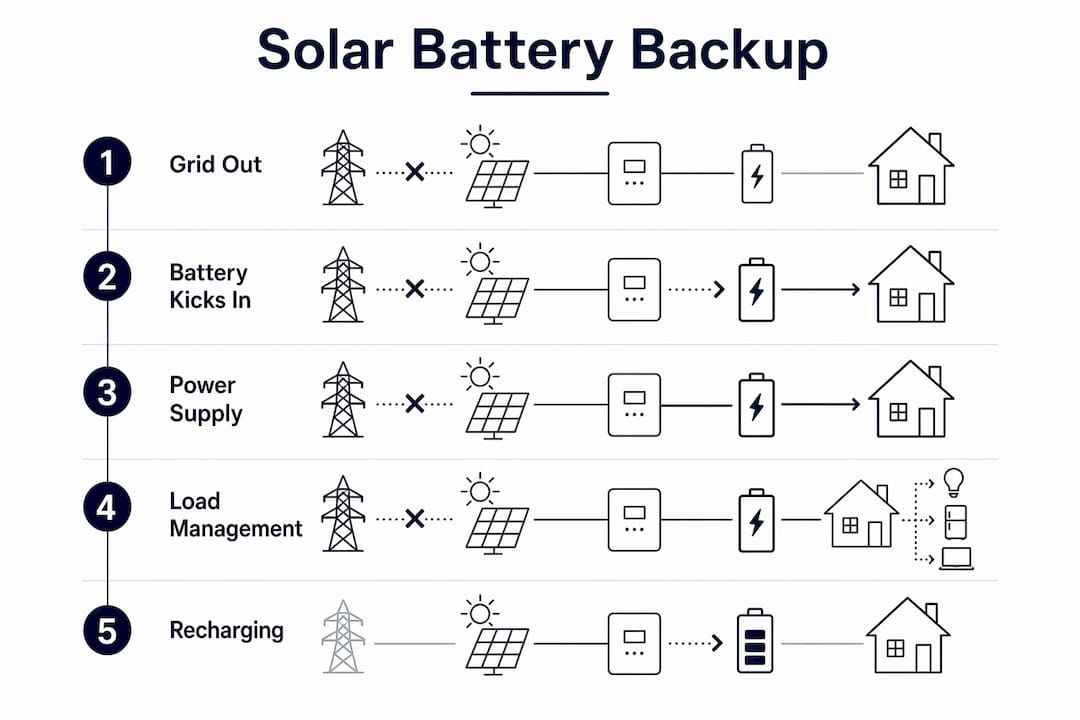
When the grid fails, a backup-capable inverter detects the loss of grid voltage within milliseconds and switches to island mode. Your home's critical loads now draw from the battery through the inverter. If it is daytime and your panels are generating, the inverter can simultaneously recharge the battery from solar while powering your home, extending your runtime well beyond what the battery alone could provide.
Here is how the energy flow differs between day and night:
- Daytime outage: Solar panels generate power. The inverter prioritises powering your loads first, then directs surplus generation into the battery. On a good solar day, a well-sized array can keep a battery topped up through multiple load-shedding blocks.
- Night-time outage: No solar input. The battery discharges at your household load rate until either the grid returns or the battery reaches its minimum state-of-charge cutoff.
- Cloudy day outage: Partial solar generation. The battery draws down more slowly than at night, but faster than on a clear day. Runtime is somewhere in between.
A hybrid battery system switches over with near-instant response, unlike a generator that takes 10–30 seconds to start. That switchover speed matters for sensitive electronics like computers and medical devices. *
What can you realistically run during load shedding?
The honest answer: it depends entirely on your battery size and inverter rating. A 5 kWh battery with a 3 kVA inverter will not run your geyser, stove, and pool pump simultaneously. Prioritising loads is where most homeowners go wrong.
A practical framework:
Critical (always power these first):- Refrigerator and freezer
- LED lighting
- Wi-Fi router and phone chargers
- Medical devices (CPAP, oxygen concentrators)
- Security system and electric fence energiser
- Laptop and desktop computers
- Television
- Small kitchen appliances (kettle, microwave — used briefly)
- Geyser (heat water before or after the outage window instead)
- Pool pump
- Washing machine and tumble dryer
- Air conditioner
How long will your battery last? The kWh math
The formula is straightforward:
Usable battery kWh ÷ average load (kW) = approximate hours of runtimeFactor in inverter efficiency (typically 80–88% round-trip) by using the conservative end. A 10 kWh nominal battery at 80% depth-of-discharge gives you roughly 8 kWh usable. At 80% inverter efficiency, plan on about 6.4 kWh of effective output.
 Worked example: A typical South African home running a fridge, LED lights, router, and phone chargers draws around 0.8–1.2 kW continuously. Call it 1 kW. With 8 kWh usable from a 10 kWh battery, that is approximately 8 hours of runtime before the battery hits its cutoff. Add daytime solar recharge and you can cover multiple back-to-back load-shedding blocks.
Backup duration depends on your usable battery size, ongoing power use, inverter efficiency, and actual appliance mix. Larger batteries support longer runtime. One critical point: size for Stage 4–6, not Stage 2. A battery that covers a 2-hour slot at Stage 2 will leave you in the dark when conditions worsen.
*Sizing and ballpark costs for South African homeowners
Getting the sizing right means answering three questions before you call an installer: How many hours of backup do you need? Which loads must stay on? And what is your budget?
Sizing checklist:- Calculate your essential load in kW (add up appliance wattages from the critical list above).
- Multiply by your target backup hours to get the kWh you need.
- Add 20–25% buffer for inverter losses and battery aging.
- Choose an inverter kVA rating that exceeds your peak simultaneous load, not just your average.
- Specify LFP chemistry for longevity; lead-acid is cheaper upfront but cycles far fewer times.
Ballpark installed costs for backup systems vary widely depending on battery size, inverter capacity, and panel wattage, influenced by brand, labour, certification, and local requirements. Beyond the bill savings, factor in reduced generator fuel costs and the non-financial value of uninterrupted work, refrigerated food, and functioning medical equipment during extended outages.
Note: Municipal rules and time-of-use tariffs affect the economics of any backup system. Include likely tariff escalations when modelling your return on investment.*
Safety, SANS standards, permits, and choosing a qualified installer
A solar battery backup system is a permanent electrical installation under South African law. That means it must comply with SANS 10142 (the wiring code of practice) and be signed off with a Certificate of Compliance (COC). Without a COC, your home insurance may be invalidated, and the installation could block a property sale.
What to verify before and after installation:- Installer holds a valid electrical contractor registration and can issue a COC on completion.
- Municipal approval or notification is obtained where your local authority requires it (rules vary by municipality).
- The inverter is approved for grid-connection in South Africa (check the manufacturer's local compliance documentation).
- Anti-islanding and transfer switch configuration are confirmed in writing.
- Written warranty documents cover both the inverter and the battery, including cycle-life specifications.
- Never attempt to modify grid-connection wiring yourself.
- Confirm the installer has set up proper isolation so the system cannot back-feed the grid during an outage.
- Ask specifically about the transfer switch setup and which circuits are on the backup panel.
If your backup stops working during a blackout — quick checks
Before calling an installer, run through these steps in order:
- Check the inverter display. Most hybrid inverters show a status screen or error code. Note the exact code before doing anything else.
- Check battery state-of-charge. If the battery is below its minimum threshold (often 10–20%), the inverter will shut down to protect the cells. This is normal behaviour, not a fault.
- Confirm the inverter is in backup or island mode. Some units require a manual mode switch or a setting change after firmware updates. Check the installer's configuration guide.
- Inspect the transfer switch or backup subpanel. A tripped breaker on the critical-loads panel is a common and easily fixed cause of backup failure.
- Check communication links. Some battery management systems communicate with the inverter via a CAN bus or RS485 cable. A loose connection can cause the inverter to refuse to discharge the battery.
- Look for a tripped safety disconnect. DC isolators and AC breakers can trip on overcurrent. Reset only if you understand what caused the trip.
Common root causes: undersized inverter for the connected load, incorrect backup wiring during installation, disabled blackout mode (often reset after a firmware update), failed BMS communication, or a battery that has degraded below usable capacity.
When you call an installer, have the inverter model number, firmware version, error codes, and battery state-of-charge reading ready. That information cuts diagnostic time significantly.
*Is a solar battery worth it for load shedding in South Africa?
For most South African homeowners experiencing regular Stage 4–6 load shedding, the answer is yes, with some nuance.
Where battery backup is clearly worth it:- Home office workers who lose income during outages.
- Households with medical equipment that cannot tolerate power interruptions.
- Families in areas with frequent Stage 4–6 schedules.
- Homeowners already paying for generator fuel, where the ongoing cost comparison favours solar.
- Renters or short-term residents who cannot recoup the capital cost.
- Homes in areas with genuinely infrequent, short outages (Stage 1–2 only).
- Households where a small UPS for the router and a gas stove covers 90% of their discomfort.
- Start with a critical-load sizing exercise, not a whole-house ambition.
- Prioritise a hybrid inverter with confirmed islanding capability over a cheaper grid-tied unit.
- Specify LFP batteries; the longer cycle life (typically 3,000–6,000 cycles) justifies the price premium over lead-acid for South African load-shedding frequency.
- Get at least three quotes and compare inverter blackout capability, usable kWh, and warranty terms, not just the total price.
How to get a backup-capable system through Solarza
Solarza connects South African homeowners with vetted, rated solar installers across all nine provinces. The process is designed to remove the guesswork from finding a qualified professional.
What to have ready when requesting a quote:- Your most recent electricity bill (shows monthly kWh consumption).
- A clear description of your backup goals: which loads, how many hours, which stages you want to survive.
- Roof photos or a rough sketch showing available panel space and orientation.
- Your municipality, since approval requirements vary.
- Does the inverter support blackout/island mode and PV charging during an outage?
- What is the usable kWh of the battery at 80% depth-of-discharge?
- What is the battery's cycle-life warranty and at what capacity retention?
- Will you issue a COC on completion, and do you handle municipal notification?
- Are you registered with your local municipality for grid-tied or hybrid installations?
- What is the installation timeline and what does the post-installation support look like?
Key takeaways
Solar batteries do work during a blackout, but only with the right inverter, correct configuration, and a battery sized for your real load and the worst realistic load-shedding stage.
| Point | Details |
|---|---|
| Backup requires the right inverter | Only hybrid or grid-forming inverters support island mode; standard grid-tied units shut down when the grid fails. |
| Battery size determines runtime | A 10 kWh battery at 80% DoD can provide multiple hours of power at a moderate essential load. |
| Daytime recharge extends backup | Panels can recharge the battery during a daytime outage, covering multiple load-shedding blocks in a single day. |
| Size for Stage 4–6, not Stage 2 | A battery sized for short outages often fails under higher-stage conditions with back-to-back blocks. |
| Solarza connects you to vetted installers | Use Solarza to compare quotes, verify COC credentials, and find installers across all nine provinces. |
The part most homeowners get wrong
Most of the questions I see about solar backup focus on one thing: "How many kWh do I need?" That is the right question, but it is usually asked too late, after someone has already chosen an inverter based on price.
The inverter is the decision that actually determines whether your system works in a blackout at all. A battery paired with a grid-tied inverter is, for backup purposes, an expensive paperweight. The inverter's islanding capability, its ability to charge from PV during an outage, and its continuous output rating relative to your peak load are the three specs that separate a system that works from one that does not.
The second mistake is sizing for today's load-shedding stage rather than the worst realistic scenario. Stage 6 is not a theoretical extreme anymore. A system that covers Stage 2 comfortably will leave you without power through the long evening blocks that Stage 4–6 brings. The cost difference between sizing for Stage 2 and sizing for Stage 4–6 is real, but so is the cost of a system that fails when you need it most.
Certified installers who understand both the technical configuration and the local compliance requirements are not a luxury. They are the difference between a system that switches over in milliseconds and one that trips a breaker and stays dark. Solarza's vetted installer network exists precisely to make that distinction easier to navigate.
*Ready to get backup power that actually works?
Cutting your electricity bill by up to 90% and staying powered through every load-shedding stage starts with one thing: a quote from an installer who knows what they are doing. Solarza connects South African homeowners with verified, rated installers across all nine provinces, so you compare real proposals with real credentials, not just prices.
When you request a quote through Solarza, bring your electricity bill, your backup goals, and the questions from the installer checklist above. Ask every installer about islanding capability, usable kWh, COC issuance, and cycle-life warranty. Those four questions will tell you more than the total price ever will.
Find vetted installers in your province or request a free quote today and get matched with a qualified installer who can design a system sized for South Africa's real load-shedding conditions.
*Useful sources
- SANS 10142 and COC requirements for solar installations (Electricians Near Me)
- Anti-islanding and grid-tied inverter shutdown explained (City of Cape Town)
- Daytime solar recharge during outages (Nedbank)
- Battery sizing for load-shedding stages (Lithium Batteries SA)
- Sizing sweet spot and payback guidance (SurgePV)
- Runtime estimates by battery size (Smartechs)
- Blackout mode and inverter spec-checking (BFO Solar)
- Hybrid systems for South African homes (VICSA)
- Solarza solar battery guide and prices
- Solarza inverter types and hybrid options
- Solarza solar calculator
FAQ
Can you use a solar battery during a blackout?
Yes, provided your system includes a battery and a hybrid or grid-forming inverter configured for island mode. A standard grid-tied solar system without a battery will shut down automatically when the grid fails.
Will my solar panels work during a blackout without a battery?
No. Grid-tied panels without a battery and a backup-capable inverter cut out immediately when the grid goes down, due to anti-islanding safety requirements. Panels only supply backup power when paired with a battery and the correct inverter.
How long will a solar battery last during a power outage?
Runtime depends on battery size and your load. A 10 kWh battery at 80% depth-of-discharge provides roughly 8 hours at a 1 kW essential load, or around 4 hours at 2 kW. Daytime solar recharge can extend this across multiple load-shedding blocks.
Can a solar battery last all night?
A 10 kWh battery running essential loads (fridge, lights, router) at around 1 kW can cover 8 hours, which is enough for most overnight outages. Larger 20 kWh systems can sustain essential loads for 16 hours or more at that draw rate.
How do I know if my inverter supports backup during load shedding?
Check the spec sheet for terms like "island mode," "blackout mode," "EPS," or "grid-forming." If none of those appear, the inverter cannot provide backup. Solarza's inverter guide explains the difference between grid-tied and hybrid units in plain language.