Two Year Solar COC and the 5 Documents You Need in South Africa

A solar COC (Certificate of Compliance) confirms your grid-tied solar installation meets SANS 10142-1 safety standards under the Electrical Installation Regulations. Only a Department of Employment and Labour (DoEL) registered Installation Electrician (IE) or Master Installation Electrician (MIE) may sign one, with narrow exceptions for Electrical Testers for Services and Products (ETSPs). It's valid for two years and voided by any later alteration. Before anyone touches your roof, confirm your installer's DoEL registration number and get a written commitment that a CoC and test report will be issued on completion.
*TL;DR:>
- Only registered Installation Electricians or Master Installation Electricians can legally issue a solar CoC, and their registration must be verified before installation begins.*
- A compliant CoC covers safety-critical components like DC cabling, isolator switches, earthing, inverter settings, labelling, and as-built drawings, and it remains valid for two years only if the installation remains unchanged.
- Adding batteries, swapping inverters, or extending the system after issuance immediately invalidates the existing CoC, making re-inspection necessary.
- The process includes pre-installation component verification, on-site commissioning tests, attaching a detailed test report, and submitting all documentation for SSEG registration with Eskom or the municipality.
- Insist on receiving the CoC, test report, inverter certificate, and as-built drawing before final payment, and ensure the installer provides these documents as part of the contract.
Table of Contents
- Who can legally issue a COC for solar in South Africa?
- What does a solar COC cover, and how long does it last?
- How do you get a valid COC for solar step by step?
- What standards govern solar installations in South Africa?
- How does SSEG registration with Eskom or your municipality work?
- What are the most common COC failures homeowners should catch?
- How much does a solar COC cost, and how long does it take?
- How Solarza connects you with installers who deliver a compliant COC
- Author perspective: practical priorities for owners and installers
- Get matched with installers who put COC compliance first
- Sources
- FAQ
Who can legally issue a COC for solar in South Africa?
Not every electrician who installs solar panels can sign the paperwork that makes the system legal. The Electrical Installation Regulations (EIR) restrict CoC issuance to specific registration categories, and getting this wrong is one of the most common (and expensive) mistakes South African homeowners make.
An Installation Electrician (IE) is the standard qualification allowed to design, install, and certify a full electrical installation, including a solar PV system integrated into your home's wiring. A Master Installation Electrician (MIE) holds a higher qualification and can supervise other electricians and sign off on more complex installations, including three-phase commercial systems. Both must be registered with the DoEL, and that registration is what makes their signature legally valid on a CoC.
An Electrical Tester for Services and Products (ETSP) occupies a much narrower lane. ETSPs may issue a CoC only in specific, limited circumstances, typically single-phase domestic work under general control, and they cannot certify the broader scope of work an IE or MIE can. If your installer describes themselves only as an ETSP, ask directly whether your system falls within their legal scope before signing a contract.
"General control" means an IE or MIE takes responsibility for work carried out under their supervision, even if a technician physically installed the panels. This is standard practice in larger installation companies, but it means the certifying electrician's registration, not the installer's sales rep, is what actually matters.
Before work starts, verify the following:
- Ask to see the installer's DoEL registration card or certificate, not just a business card or website badge.
- Confirm the registration number matches the name on any quote or contract you've been given.
- Request written confirmation that the CoC will carry a unique certificate number, traceable to that registered electrician.
- Check whether the person signing is an IE, MIE, or ETSP, and whether that category legally covers your installation type.
A quick verification call to the DoEL costs you nothing and can save you from an installation that's invalid the day it's switched on.
What does a solar COC cover, and how long does it last?
A solar CoC certifies the electrical safety of the entire installation, not just the panels on your roof. It covers DC cabling and its protection, isolator switches, earthing and bonding, inverter settings, labelling, and the as-built drawings that show exactly how the system was wired. A detailed test report must be attached to the certificate itself, confirming the specific measurements taken during commissioning.
The certificate is valid for a limited period from its date of issue and becomes invalid if the installation is altered. Adding a battery, swapping an inverter, or extending your panel array after the fact immediately invalidates the existing CoC, regardless of how much time is left on the original two-year window. This catches a lot of homeowners off guard when they add battery storage a year after their initial install, assuming the old paperwork still covers the upgraded system.
There's also an important distinction for anyone selling a property. A general electrical CoC, covering the home's wiring, plugs, and distribution board, is legally separate from the solar-specific compliance certificate. Conveyancers increasingly require the solar system to be explicitly listed on the CoC, or accompanied by its own dedicated solar CoC, before a property transfer can proceed cleanly.
| What's certified | Why it matters |
|---|---|
| DC cabling and protection | Prevents fire risk from unprotected high-voltage DC runs |
| Isolator switches | Allows safe shutdown during maintenance or emergencies |
| Earthing and bonding | Reduces shock risk and protects equipment during faults |
| Inverter settings | Confirms grid interface parameters match utility requirements |
| Labelling | Warns emergency responders and future electricians of solar circuits |
| As-built drawings | Documents actual wiring for future audits or fault-finding |
| Attached test report | Provides measured evidence, not just a signed opinion |
How do you get a valid COC for solar step by step?
Getting a compliant CoC isn't a single signature at the end of installation, it's a documented process that starts before the first panel goes up.
- Confirm component compliance before installation begins. Your inverter needs either NRS 097-2-1 type-test certification or inclusion on your local municipality's approved inverter list. Panels and mounting hardware should carry recognized compliance marks.
- Complete the physical installation according to SANS 10142-1. This covers cable sizing, DC isolator placement, earthing arrangements, and correct labelling at the distribution board and inverter.
- Carry out on-site commissioning tests. The certifying electrician measures insulation resistance, earth continuity, and inverter protection settings, then records results in a commissioning report. Templates like the SAPVIA PV GreenCard, AREP, or ECA SSEG formats are commonly used for this.
- Attach the test report to the CoC itself. A CoC issued without a physical inspection and accompanying test data is invalid and potentially fraudulent under the Occupational Health and Safety Act.
- Compile the as-built drawing. This should reflect exactly what was installed, not the original design if changes were made on-site.
- Submit for SSEG registration with Eskom or your local municipality where required, including the CoC, inverter certificate, and commissioning report as supporting documents.
Pro Tip: Ask your installer for the commissioning report and inverter test certificate as separate PDF files before you pay the final invoice. A vague promise that "it's all in the CoC" is a common way for corners to get cut on documentation you'll need later for insurance or resale.
Homeowners often assume the CoC is a formality issued automatically once panels are switched on. It isn't. It's a legal document that requires deliberate paperwork at every stage, and skipping a step now usually means paying for a second inspection later.
What standards govern solar installations in South Africa?
Three regulatory pillars determine whether your solar installation is legally compliant, and understanding what each one actually requires helps you ask sharper questions of any installer.
SANS 10142-1 is the core wiring standard for electrical installations in South Africa, and it governs how solar DC and AC circuits must be cabled, protected, and earthed. It sets requirements for cable ratings suited to outdoor UV exposure, correct isolator placement so a system can be safely de-energized, and bonding arrangements that prevent stray voltage during a fault. NRS 097 covers the technical interface between your inverter and the grid. It specifies how an inverter must behave during voltage fluctuations, frequency deviations, and grid outages, which matters enormously for safety when utility workers are repairing lines they assume are dead. Compliance can be demonstrated either through an independent NRS 097-2-1 type-test certificate or through inclusion on a municipal approved inverter list, which serves as accepted evidence without needing separate lab paperwork for every installation.The Electrical Installation Regulations (EIR) set out who may legally issue a CoC and what it must contain. Annexure 1 of the EIR specifies the test report requirements that must accompany the certificate, meaning a CoC without measured test data attached doesn't meet the regulation's own standard.
Practical implications worth flagging:
- A cheap inverter with no NRS 097 certificate and no municipal listing puts your entire registration at risk, regardless of how well it performs.
- SANS 10142-1 non-compliance is the most common reason a CoC gets refused at inspection, particularly around DC isolator placement and cable ratings.
- The EIR's Annexure 1 requirement means a one-page certificate with no attached data isn't a valid CoC, even if it's signed.
How does SSEG registration with Eskom or your municipality work?
Any grid-tied or hybrid solar system connected to your property's electrical supply typically needs to be registered as a Small-Scale Embedded Generation (SSEG) installation, whether Eskom or your local municipality is your electricity supplier. Off-grid systems with no connection back to the grid generally fall outside this requirement, since there's no reverse power flow to manage.
Registration exists because your inverter can, under fault conditions, feed power back into lines that utility staff expect to be dead. It's a safety measure, not bureaucratic box-ticking.
Documents typically required for SSEG registration include:
- The solar CoC itself, showing the system passed electrical safety inspection.
- The inverter's NRS 097 test certificate or confirmation it appears on the relevant municipal approved list.
- The commissioning or test report detailing measured values from installation.
- Proof of the installer's DoEL registration in some municipal applications.
Requirements vary between municipalities, and some are considerably slower or stricter than others, so it's worth checking your specific council's SSEG application process before assuming a standard timeline applies everywhere.
Since October 2025, Eskom simplified residential SSEG sign-off so that a DoEL-registered IE or MIE can complete it without requiring a separate ECSA professional engineer sign-off for most residential projects. Eskom has also offered temporary concessions, including fee waivers for small systems, running through 31 March 2026. Policies shift, so it's worth checking current terms directly with Eskom or your municipality rather than relying on last year's guide.
What are the most common COC failures homeowners should catch?
Inspectors see the same mistakes repeatedly, and most of them are visible to a homeowner who knows what to look for at handover, well before an official inspection flags them.
- Non-UV-rated DC cabling. Cable exposed to sunlight on the roof needs UV-resistant insulation. Standard indoor cable degrades and cracks within a year or two outdoors, and it's a top reason installations fail inspection.
- Missing DC isolator switches. There should be a clearly accessible isolator near the panels and another near the inverter. If you can't find a labelled switch to cut DC power independently of the AC mains, that's a red flag.
- Inadequate earthing or bonding. This one is harder to check visually, which is exactly why the test report matters more than a visual inspection alone.
- Missing or incorrect labelling. Distribution boards and inverters should carry warning labels identifying solar circuits, dual power sources, and isolation points.
- Incorrect inverter protection settings. These are configured during commissioning and should match your grid's voltage and frequency parameters, not factory defaults from another country's grid code.
- As-built drawings that don't match reality. If the installer changed cable routing or added an extra string during installation but never updated the drawing, that mismatch alone can hold up a CoC.
Pro Tip: At handover, physically locate every isolator switch and ask the installer to show you the earth bonding point before they leave. If they can't point to it confidently on the spot, that's worth flagging before final payment, not after.
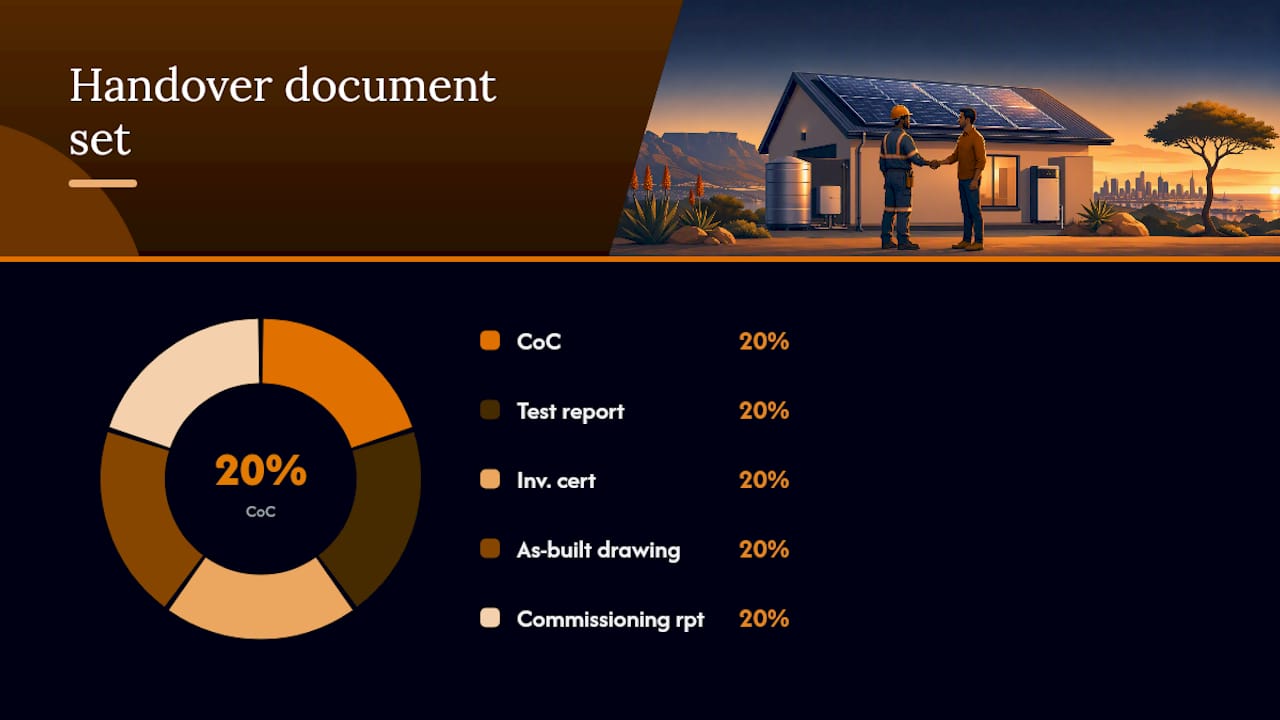
Demand this document set before signing off: the CoC, the attached test report, the inverter's compliance certificate, the as-built drawing, and the commissioning report. Five documents, not one signature.
How much does a solar COC cost, and how long does it take?
Costs vary by system complexity and region, but the fee elements are fairly consistent across the country: an inspection and testing fee for the certifying electrician's time, rectification labour if the inspection finds non-compliances that need fixing before sign-off, documentation costs for compiling the test report and as-built drawings, and municipal or Eskom registration fees where applicable.
Rectification is usually the biggest wildcard. A clean installation that passes first time costs far less than one where an inspector finds three or four issues requiring a follow-up visit.
Typical timing looks like this:
- Inspection and testing: usually completed in a single site visit for standard residential systems.
- Rectification, if needed: anywhere from a few days to a couple of weeks, depending on parts availability and scheduling.
- CoC issuance: generally same-day to a few days after a successful inspection, once paperwork is compiled.
- SSEG registration: this is often the slowest step, since it depends on municipal or Eskom processing capacity rather than your electrician's schedule.
Temporary fee assistance has been part of Eskom's recent SSEG compliance push, worth checking if you're registering a smaller residential system before that concession window closes.
The most avoidable delay is incomplete paperwork submitted for registration. Municipalities and Eskom will bounce back an application missing a test report or inverter certificate rather than chasing it down for you, so compile the full document set before you submit rather than after a rejection.
How Solarza connects you with installers who deliver a compliant COC
Solarza matches South African homeowners with vetted, rated solar installers across all nine provinces, and installer verification includes checking for the DoEL registration that makes a legally binding CoC possible. When you request quotes through the platform, you can specify that CoC issuance with an attached test report is a non-negotiable part of the job, not an afterthought tacked on after installation.
The solar calculator helps you scope system size accurately before you even speak to an installer, which matters because undersized or oversized quotes often lead to last-minute component swaps that complicate compliance paperwork. Getting matched with an installer who commits to full documentation upfront reduces your risk of a failed inspection and speeds up SSEG registration considerably compared with chasing missing paperwork after the fact.
Author perspective: practical priorities for owners and installers
If there's one thing worth insisting on before any panel goes up, it's this: get the DoEL registration number and a written promise of a CoC with attached test report in writing, before you sign a deposit, not after installation. Homeowners get seduced by price and installation speed, then discover months later that their "compliant" system has no test report backing it. Safety and paper trail come first; everything else is negotiable. If you're selling a property, insist your Offer to Purchase includes a clause requiring a current, solar-specific CoC from the seller within a fixed timeframe. It's a small clause that prevents you from inheriting someone else's undocumented wiring decisions.
— Kobus Kohvik
Get matched with installers who put COC compliance first
There are other ways to find a solar installer, word of mouth, a Google search, a flyer in your postbox, but none of them verify DoEL registration or CoC track record before connecting you. Solarza is built specifically to close that gap: every installer in the network is vetted and rated, so you're not gambling on a stranger's paperwork claims.

When you request a free solar quote, specify that your CoC and attached test report must be included as part of the deal, not billed as an extra afterward. You can also browse solar installers by province to shortlist companies local to you, or run your numbers through the solar calculator first so your quote requests are scoped accurately from the start. Ask every quoted installer directly: will you provide a signed CoC with attached test report, inverter certificate, and as-built drawing on completion? If the answer isn't an immediate yes, keep looking.
Sources
Verify any installer claim against primary sources rather than taking a sales pitch at face value. The Electrical Installation Regulations guidance on who may issue a CoC confirms registration categories and ETSP limits. Eskom's SSEG compliance campaign update covers current registration steps and concessions. Eskom's CoC and commissioning report management document details required test reports. For property transactions, the FAQ on electrical CoCs and solar panels clarifies conveyancing requirements.
FAQ
How much does it cost to get a solar COC certificate?
Costs depend on system size, region, and whether rectification is needed before sign-off, covering inspection fees, testing documentation, and any municipal registration charges. There's no single fixed national price, so request an itemized quote from your certifying electrician upfront.
Where can I get a COC certificate for solar?
Only a DoEL-registered Installation Electrician (IE) or Master Installation Electrician (MIE) can legally issue one, with ETSPs limited to narrow single-phase cases. Platforms like Solarza's installer directory help you find vetted, registered electricians near you.
How long is a solar COC valid?
A solar CoC is valid for two years from its issue date, and it becomes invalid immediately if the installation is altered, such as adding a battery or extending the panel array.
Do I need a separate COC if I already have one for my house?
Yes, in most cases. A general electrical CoC covers your home's wiring, but conveyancers increasingly require the solar system to be explicitly listed or covered by its own solar-specific CoC before a property sale can proceed.
Can any electrician issue a CoC for my solar system?
No. Only DoEL-registered IEs and MIEs have the full legal scope to certify most solar installations, while ETSPs may only sign off in limited single-phase circumstances. Always ask to see the registration certificate before work begins.