Stop Birds Nesting: Clip Mounted Proofing for SA Solar Panels
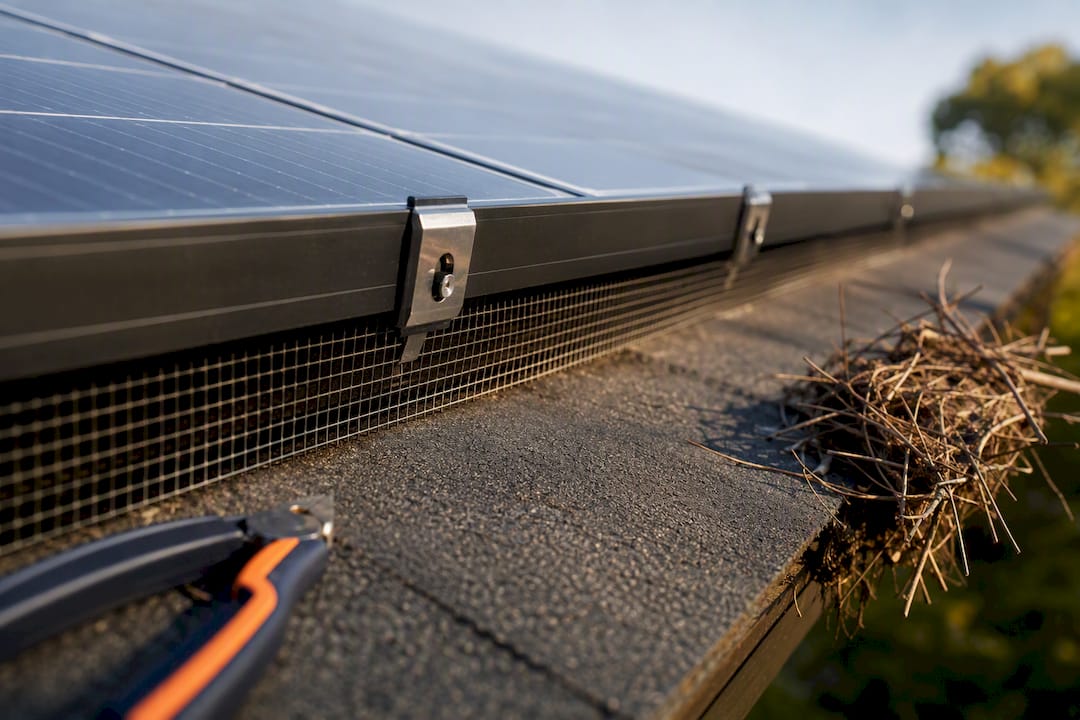
The most reliable way to stop birds nesting under solar panels is a professionally installed, clip-mounted perimeter mesh. Spikes and sonic deterrents help as backup measures but won't solve an active infestation on their own. Fit the mesh when panels go in if you can. If you're dealing with a retrofit or birds already living under your array, call a vetted installer rather than DIY it.
*TL;DR:>
- Proper bird-proofing requires full perimeter coverage with UV-stable, clip-mounted mesh to prevent birds from squeezing underneath panels.*
- DIY solutions like loose netting or sonic deterrents rarely last and do not offer long-term protection against persistent birds.
- Installing mesh during the initial panel setup is generally more cost-effective than retrofitting after nesting activity begins.
- Regular maintenance checks, especially after storms, are essential to identify and repair any damage or gaps in the proofing mesh.
- Always choose installers who use non-penetrating clips, offer clear warranties, and can provide references and proof of previous successful bird proofing projects.
Table of Contents
- What are the best bird proofing methods for solar panels?
- How does each bird proofing method actually work?
- How do you choose a bird proofing product or installer?
- What does bird proofing cost, and when should you install it?
- How do you maintain bird proofing over time?
- Why professional mesh beats every shortcut I've seen
- Get matched with a vetted installer for bird proofing
- Sources
- FAQ
What are the best bird proofing methods for solar panels?
Not every option on the market does the same job, and picking the wrong one wastes money without solving anything.
- Clip-mounted mesh (the gold standard): UV-stable PVC-coated mesh fitted around the panel perimeter with non-penetrating clips. This is what professional installers use, and it's the only method that reliably stops birds getting underneath in the first place.
- Perimeter skirting: A rigid alternative to mesh for exposed edges, often paired with clips on larger commercial arrays.
- Spike strips: Useful on ridges, gutters, and flat landing zones near the array, but they don't stop birds squeezing under the panel edge itself.
- Brush strips: A softer deterrent for ledges and parapets. Good supplement, weak as a standalone fix.
- Roof netting: Makes sense for large or ground-mounted commercial arrays where full mesh wrapping every panel edge isn't practical, though it costs more and needs regular tension checks.
- Ultrasonic and visual deterrents: Cheap and easy to install, but birds get used to them fast.
If you're comparing suppliers, Sustainable.co.za's solar bird proofing mesh kit is a common DIY route for standard pitched roofs. The EagleEye / Bird Skip range covers both electronic deterrents and mesh clamps for homeowners who want off-the-shelf options. BirdBlocker publishes South African case studies if you want to see before-and-after results before committing. For anyone who'd rather skip the trial and error, You can find a vetted installer who fits mesh properly the first time. This works especially well when bundling proofing with a new install or a maintenance visit.
How does each bird proofing method actually work?
Clip-mounted mesh works through pure physical exclusion. Birds can't land, can't perch, and can't squeeze through, so there's nothing for them to get used to over time. That's the core advantage over anything electronic: physical exclusion delivers high long-term effectiveness with low habituation risk, while a speaker or flashing light loses its scare factor within days. Installers use purpose-built metal clips that grip the panel frame without drilling or adhesives, which matters more than it sounds. Drilling into a frame or gluing brackets on can void your panel warranty, and a bad seal invites moisture problems you didn't have before.
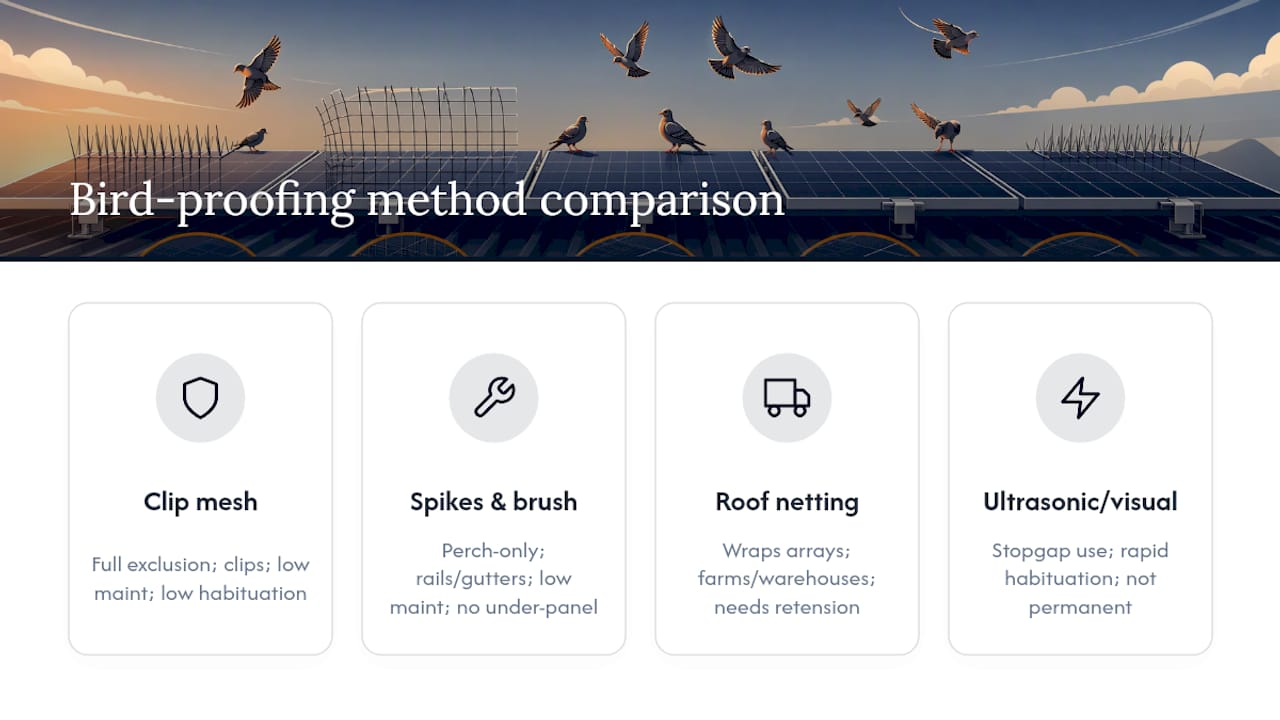
Spikes and brush strips solve a different problem. They stop birds perching on ridges, gutter lines, and flat mounting rails near the array, but they do nothing for the gap underneath the panel itself. Pair them with mesh; don't expect them to replace it.
Roof netting earns its cost on big installations, ground-mount farms, or warehouse roofs where wrapping every individual panel edge in mesh becomes impractical. The trade-off is maintenance. Netting sags, stretches, and needs periodic retensioning in a way that clipped mesh doesn't.
Ultrasonic and visual deterrents belong at the bottom of the list for anything permanent. Field reports consistently show rapid habituation once birds realise the noise or flash carries no real threat. Use them as a stopgap while you wait for a proper mesh installation, not as the plan itself.
How do you choose a bird proofing product or installer?
A few checks separate a job that lasts years from one that fails within a season.
- Full perimeter coverage. Every edge, every corner, no exceptions. A single gap is where birds get in.
- Non-penetrating clips, not screws or adhesive, so the panel frame and warranty stay intact.
- UV-stable mesh that won't go brittle and crack after a couple of South African summers.
- A ventilation gap maintained behind the panels, since sealing airflow too tightly can affect panel temperature and output.
- Clear warranty language on both materials and labour, in writing, not a verbal promise.
Before you sign off on a quote, ask whether proofing can be bundled into the installation cost, whether scaffold or access charges are extra, how they handle an active nest if one turns up mid-job, and whether they can show references or real before-and-after photos. Pro Tip: If a quote mentions drilling into the panel frame, adhesive-only fixing, or has no warranty on the labour, walk away. Those are the three biggest red flags in this industry.
What does bird proofing cost, and when should you install it?
Fitting mesh during the original panel installation is almost always cheaper than doing it later, because the installer already has access, scaffolding, and safety equipment on site for the panel job itself. A retrofit means paying for that access all over again, on its own.
Price mostly comes down to how many linear metres of panel edge need covering, not how many panels you have. A long, narrow array actually costs more to proof than a compact one with the same output, because you're paying for perimeter length, not panel count. Beyond that, expect the price to move with:
- Roof pitch and access difficulty (single storey versus a steep double storey roof)
- Whether scaffolding or a lift is required
- Whether birds have already nested and material needs removing
- Mesh quality and clip type used
If birds are already nesting, most professional installers wait until the nest is vacated, or follow the relevant wildlife protection guidance, before touching it. Removing an active nest carelessly can be both illegal and pointless if the birds simply come back to rebuild.
How do you maintain bird proofing over time?
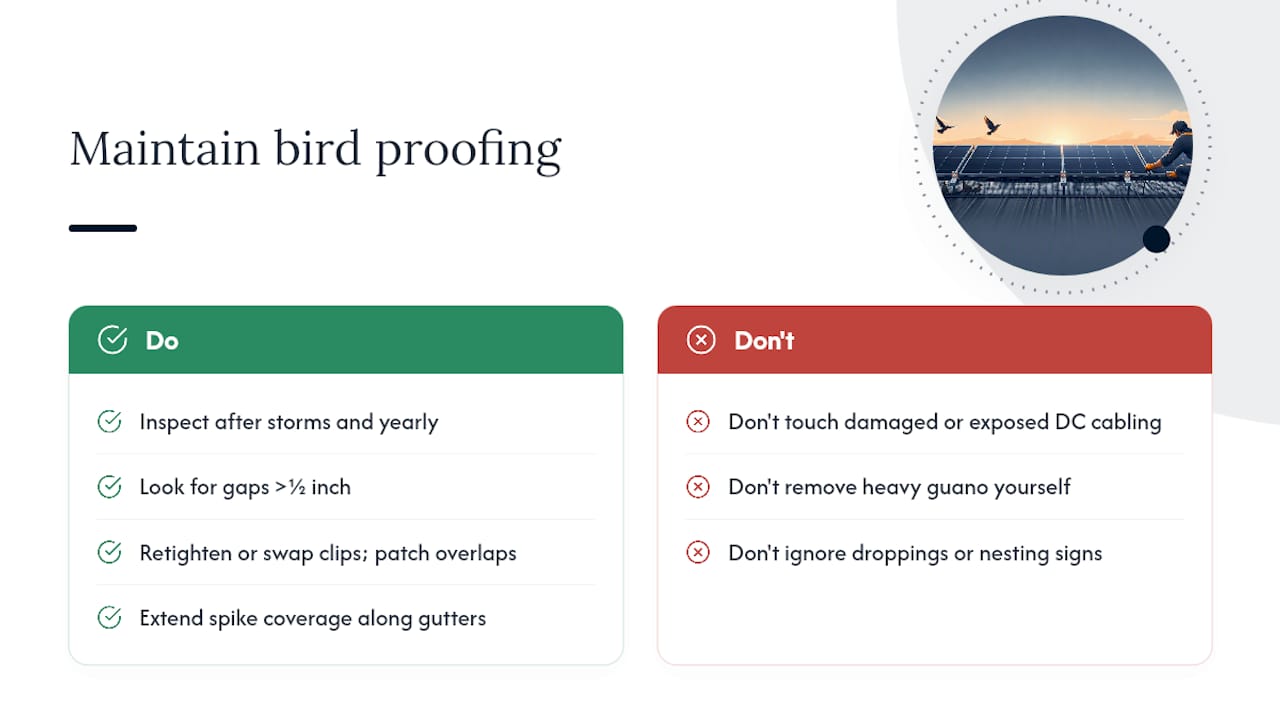
Check the mesh after major storms and at least once a year. Look for gaps wider than half an inch, clips that have worked loose, torn sections, or cabling that's sagging under old nesting debris. Most fixes are simple: retighten or swap a clip, patch an overlap, extend spike coverage along the gutter line where birds have found a new landing spot.
If you find damaged or exposed DC cabling, or guano built up enough that it needs safe removal, stop and call a professional. That's an electrical and health risk, not a weekend job. And if your panels have gone a full year with zero signs of bird activity, you probably don't need proofing at all yet, though it's worth keeping an eye on droppings, noise, and any nesting material appearing at the edges.
Why professional mesh beats every shortcut I've seen
Homeowners keep reaching for the cheapest fix first: a sonic gadget, a fake owl, maybe some loose netting from a hardware store. None of it holds up against a determined pigeon over a full season. Clip-mounted mesh, fitted properly, is the one method that actually solves the problem instead of postponing it.
That's why Solarza exists in this conversation at all. Getting matched with a vetted installer who fits mesh correctly, and can bundle it into a wider maintenance visit, removes most of the guesswork homeowners face when they're staring down conflicting product claims online.
— Kobus Kohvik
Get matched with a vetted installer for bird proofing
If your panels are already showing droppings, nesting debris, or sagging cables, the fastest path forward is getting a proper quote rather than guessing at a DIY fix.
This platform connects you directly to vetted installers who fit mesh correctly the first time, without requiring you to vet suppliers or compare product claims yourself. Request a free quote and mention bird proofing specifically. If you're due for a maintenance visit anyway, ask whether it can be bundled with mesh installation, since sharing access and scaffolding is usually where the real savings sit. Whichever installer you're matched with, ask for a written labour warranty and before-and-after photos as standard. You can also browse installers by city if you'd rather compare a few options before committing, or check installer services to see what a bundled maintenance and proofing visit typically includes.
Sources
- Bird proofing | Fumipro
- Solar Panel Bird Deterrent Products: What Works and What Doesn't | PV Protector
- Why choose BirdBlocker for Bird Proofing in South Africa | BirdBlocker
FAQ
Is bird proofing necessary for solar panels?
It's necessary once you see pigeons roosting, droppings building up, or nesting material at the panel edges. If a year has passed with no signs of activity, proofing usually isn't urgent yet.
How can I protect my solar panels from birds?
Clip-mounted perimeter mesh fitted by a professional is the most effective long-term protection, since it physically blocks birds from getting underneath the panels at all.
How much does it cost to pigeon proof solar panels?
Cost depends mainly on the linear metres of panel edge needing coverage, roof access difficulty, and whether active nests need removing first. Fitting mesh during the original installation is cheaper than a separate retrofit.
How do I protect solar panels from birds without drilling into the frame?
Look for installers using non-penetrating metal clips that grip the panel frame rather than screws or adhesive. This avoids voiding your panel warranty while still holding the mesh securely in place.
Recommended
- Photovoltaic Module Testing in South Africa - Solar Installer in Summerstrand, Eastern Cape
- Solar Structures Africa - Solar Installer in Framesby, Eastern Cape
- Top-Quality Solar Panels for Homes and Businesses - Solar Installer in Nahoon, Western Cape
- Residential Solar Installation Solar Installers in South Africa | Compare Quotes