Best value solar panels 2026: South Africa buyer's guide
 *
*
TL;DR:>
- N-type TOPCon 550W panels from brands like JA Solar and LONGi offer the best value for South African homeowners in 2026 due to high efficiency and strong warranties. They provide superior heat tolerance, lower degradation, and shorter payback periods compared to alternative technologies. Buyers should verify warranty details, local stock availability, and ensure they select panels that match their energy needs and space constraints.*
For most South African homeowners, the best value solar panels in 2026 are N-type TOPCon 550W-class modules. They deliver more lifetime kilowatt-hours per rand than any other mainstream option, with lower degradation, better heat tolerance, and warranties that hold up under local conditions. Here is your shortlist:
- Best overall value: JA Solar or LONGi 550W TOPCon — competitive ZAR per watt, strong 25-year performance warranties, widely stocked by South African distributors.
- Best budget option: Trina Solar or Jinko Solar 450–550W TOPCon — slightly lower price per panel, still N-type, good availability.
- Best for limited roof space: SunPower back-contact or HJT modules — premium price, but maximum watts per square metre where every panel counts.
- Best mid-tier reliability: Canadian Solar 500–550W TOPCon — consistent temperature-coefficient profiles suited to SA heat.
Typical 2026 pricing generally spans a moderate range per 550W panel, varying by brand and distributor. Get verified quotes via Solarza before committing to any single supplier. *
Table of Contents
- What are the top-rated solar panels for South Africa in 2026?
- Side-by-side comparison: which panel brand suits your home?
- What does a solar system actually cost in South Africa in 2026?
- How to choose the best-value panel for your home
- What do solar panel warranties actually cover?
- Why N-type TOPCon is the right technology choice for 2026
- Where to buy panels and how to get verified quotes in South Africa
- Key takeaways
- The tariff clock is already running
- Solarza helps you get the right panels at the right price
- Useful sources
- FAQ
What are the top-rated solar panels for South Africa in 2026?
Five brands dominate the South African market for value-conscious buyers, and the differences between them are narrower than the marketing suggests. What separates them is warranty depth, local stock reliability, and how their temperature coefficients hold up on a hot Gauteng or Western Cape roof.
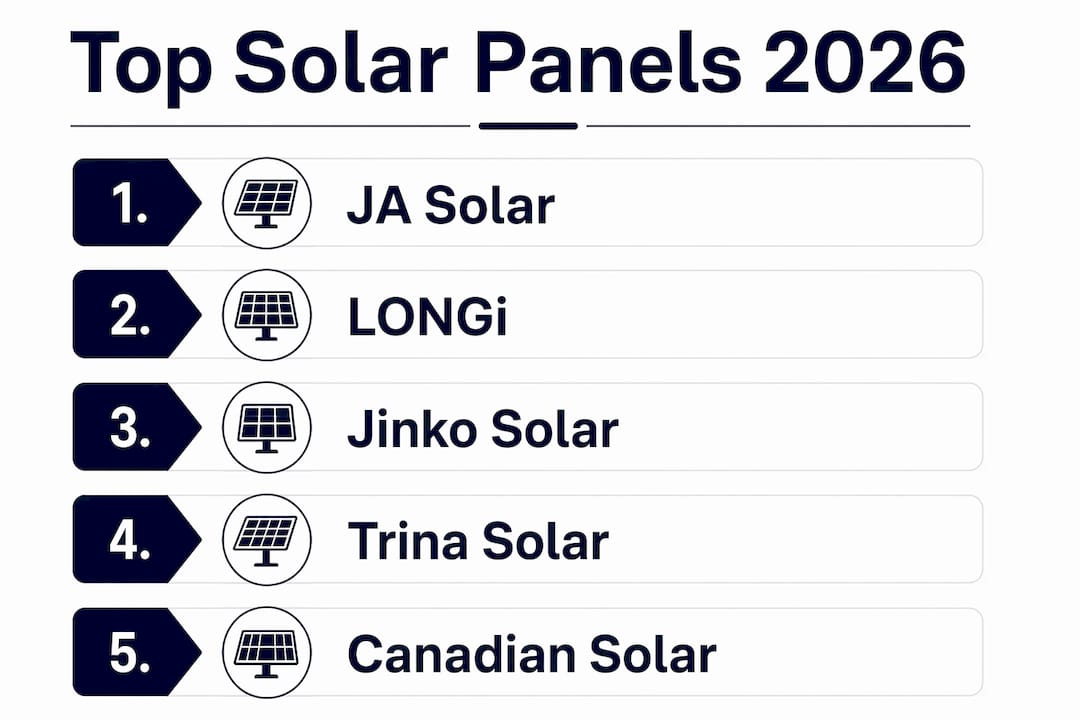 JA Solar sits at the top of the value list for most buyers. Its 550W TOPCon modules are widely available through South African distributors, carry a 25-year performance guarantee, and typically land at a competitive price per watt. If you want a panel you can actually get delivered within two weeks, JA Solar is the safest bet.
 LONGi (also written Longi Solar) is the world's largest solar manufacturer by volume, and that scale translates directly into supply-chain consistency. Its 550W-class Hi-MO series modules offer strong efficiency figures and a 30-year performance warranty on select product lines, which is genuinely unusual at this price point.
Jinko Solar is the pick if your priority is keeping the total panel cost down on a larger system. Its TOPCon modules are competitively priced per watt, and the 500–550W range keeps balance-of-system (BOS) costs low by reducing the number of panels needed.
Trina Solar offers good value across its 450–550W range and is well-distributed locally. It suits buyers who want a standardised product line with predictable pricing rather than chasing the absolute lowest rand-per-watt figure.
Canadian Solar rounds out the shortlist with mid-tier TOPCon modules that consistently hit the best-value band. Its temperature-coefficient profiles are well-suited to South African conditions, which matters more than most buyers realise.
*
LONGi (also written Longi Solar) is the world's largest solar manufacturer by volume, and that scale translates directly into supply-chain consistency. Its 550W-class Hi-MO series modules offer strong efficiency figures and a 30-year performance warranty on select product lines, which is genuinely unusual at this price point.
Jinko Solar is the pick if your priority is keeping the total panel cost down on a larger system. Its TOPCon modules are competitively priced per watt, and the 500–550W range keeps balance-of-system (BOS) costs low by reducing the number of panels needed.
Trina Solar offers good value across its 450–550W range and is well-distributed locally. It suits buyers who want a standardised product line with predictable pricing rather than chasing the absolute lowest rand-per-watt figure.
Canadian Solar rounds out the shortlist with mid-tier TOPCon modules that consistently hit the best-value band. Its temperature-coefficient profiles are well-suited to South African conditions, which matters more than most buyers realise.
*
Side-by-side comparison: which panel brand suits your home?
Solarza connects you to verified installers who stock all five of these brands. The table below compares them on the dimensions that actually affect your long-term return.
| Brand | Best for | Typical wattages | Efficiency / type | Price per panel (ZAR est.) | Warranty | Degradation | SA availability | Technology |
|---|---|---|---|---|---|---|---|---|
| JA Solar | Best overall value | 500W | 21–22% / N-type | R2,800–R3,800 | 12 yr product / 25 yr performance | ~0.4%/yr | Wide — major distributors | TOPCon |
| LONGi | Best value per watt + long warranty | 500W | 21–23% / N-type | R2,900–R4,000 | 12 yr product / 25–30 yr performance | ~0.4%/yr | Wide — major distributors | TOPCon |
| Jinko Solar | High-wattage, lower BOS cost | 500W | 21–22% / N-type | R2,600–R3,800 | 12 yr product / 25 yr performance | ~0.4%/yr | Wide — major distributors | TOPCon |
| Canadian Solar | Reliable mid-tier, SA heat profile | 450–550W | 22% / N-type | R2,500–R3,600 | 12 yr product / 25 yr performance | ~0.4%/yr | Good — multiple distributors | TOPCon |
| Trina Solar | Competitive pricing, standard lines | 450–550W | 22% / N-type | R2,200–R2,800 | 10 yr product / 25 yr performance | ~0.4%/yr | Good — multiple distributors | TOPCon |
| SunPower | Roof-space-constrained installs | 400–450W | 22–24% / back-contact | R5,500–R6,500 | 25 yr product / 25 yr performance | ~0.4%/yr | Limited — specialist importers | Back-contact |
- SunPower's 25-year product warranty is the best in the table, but its price premium is only justified when roof space genuinely limits your system size.
- Trina Solar's 10-year product warranty is shorter than the others — confirm this in writing before signing.
- All five mainstream brands now ship N-type TOPCon as their primary residential module. PERC makes up less than 10% of new shipments globally in 2026, so any installer quoting PERC modules deserves a direct question about why.
What does a solar system actually cost in South Africa in 2026?
Per-panel prices only tell part of the story. The installed cost includes inverter, mounting, cabling, labour, and VAT — and those components often add up to more than the panels themselves.
Panel price reference by wattage (2026 estimates)
| Panel wattage | Typical price per panel (ZAR) | Approx. price per watt |
|---|---|---|
| 400–450W (mid-range) | R2,200–R2,800 | R5.50–R6.20/W |
| 500W (high-watt) | R2,800–R3,600 | R5.40–R6.00/W |
| 550W (best value) | R3,000–R4,000 | R5.00–R5.80/W |
Installed system cost examples (ballpark estimates, 2026)
These are illustrative estimates based on observed 2026 market pricing. Your actual quote will vary by location, roof type, and installer.
| System size | Panels (est.) | Panels cost | Inverter | Mounting + BOS | Labour + VAT | Total estimate |
|---|---|---|---|---|---|---|
| 5kW | 10 × 550W | R30,000–R35,000 | R18,000–R22,000 | R8,000–R10,000 | R12,000–R15,000 | R68,000–R92,000 |
| 7.5kW | 14–15 × 550W | R45,000–R60,000 | R22,000–R35,000 | R10,000–R15,000 | R15,000–R22,000 | R92,000–R132,000 |
| 10kW | 18–20 × 550W | R60,000–R80,000 | R28,000–R45,000 | R12,000–R15,000 | R18,000–R26,000 | R118,000–R169,000 |
Eskom tariff increases through the mid-2020s continue to shorten payback windows. NERSA multi-year determinations extend to 2028, which means modelling your payback on today's flat tariff understates the return.
Pro Tip: Watch for quotes that omit export meters, municipal SSEG (Small-Scale Embedded Generation) application fees, and any roof preparation work. These can add R5,000–R15,000 to the total. Always ask for a fully itemised quote. For a complete picture of system sizing and costs, Solarza's guide breaks down each component. *How to choose the best-value panel for your home
The right panel depends on your roof, your budget, and how long you plan to stay in the property. Here is a practical checklist.
Selection criteria
- Technology first: Specify N-type TOPCon. Avoid P-type PERC unless the price difference is substantial and you have confirmed the degradation assumptions in the installer's savings model.
- Wattage: 550W panels reduce the number of panels needed, cutting labour and mounting costs per watt. Use them unless your roof sections are too small.
- Efficiency vs temperature coefficient: A panel rated at 22% efficiency but with a poor temperature coefficient loses more output on a hot day than a 21% panel with a better coefficient. Ask for the Pmax temperature coefficient (look for better than -0.35%/°C).
- Degradation rate: TOPCon panels typically degrade at around 0.4% per year versus 0.55% for PERC. Over 25 years, that gap translates to 5–10% more lifetime energy.
- Warranty depth: Confirm both the product warranty (manufacturing defects) and the performance warranty (minimum output after 25 years). A 25-year performance guarantee at 80% or better is the current standard.
- Local stock: A panel that takes 8 weeks to import delays your installation and your savings. Confirm the distributor holds local stock.
Questions to ask your installer
- What cell technology is this panel — N-type TOPCon or P-type PERC?
- What annual degradation rate did you use in your savings model?
- Can you provide the panel's datasheet and confirm the batch serial numbers before installation?
- Who is the authorised South African distributor for this brand, and how do I lodge a warranty claim locally?
- Does your quote include the SSEG application fee, export meter, and any roof preparation?
- What is your current lead time from deposit to installation?
Red flags on quotes
- Warranty described vaguely as "25 years" without specifying product vs performance coverage.
- No line items for BOS components — cabling, mounting rails, DC isolators.
- Generation estimates that assume 100% of rated panel output with no temperature or shading derating.
- A quote that lists panels only by wattage, with no brand name or model number.
What do solar panel warranties actually cover?
"25-year warranty" is one of the most misused phrases in solar marketing. There are two entirely separate warranties, and conflating them is how buyers end up disappointed.
Product warranty covers manufacturing defects, delamination, frame failure, and junction box faults. Standard product warranties run 10–12 years for mainstream brands, and 25 years for SunPower. If a panel physically fails within this period, the manufacturer replaces it. Performance warranty guarantees a minimum power output after a set number of years — typically 80–90% of rated output after 25 years. This is the warranty that protects your long-term energy yield. A 25-year performance warranty at 80% means the manufacturer will replace or compensate you if the panel drops below 80% of its nameplate wattage within that period.How to verify warranty claims in South Africa
- Request the written warranty certificate as a separate document, not just a reference in the datasheet.
- Confirm the installer is an authorised distributor or reseller for the brand. Panels sold through grey-market channels may void the manufacturer warranty.
- Check whether the warranty is transferable if you sell the property — this directly affects resale value.
- Clarify the claims process: does the manufacturer handle it directly, or does it go through the local distributor? Who bears the cost of removal and reinstallation?
Why N-type TOPCon is the right technology choice for 2026
N-type TOPCon is not a premium upgrade anymore. It is the market default. TOPCon accounted for 78% of new module shipments in 2026, with PERC falling below 10%. The price gap between TOPCon and PERC has narrowed to the point where choosing PERC to save money rarely makes sense.
Here is why TOPCon wins on the numbers that matter for South African homeowners:
- Higher efficiency: TOPCon mass-production efficiency reaches approximately 25.7% at cell level, versus around 23.5% for PERC. In panel terms, that means more watts per square metre.
- Lower degradation: TOPCon panels degrade at roughly 0.4% per year versus 0.55% for PERC, delivering 5–10% more lifetime energy over a 25-year system life.
- Better heat tolerance: South African summers push roof temperatures well above 25°C, the standard test condition. TOPCon's temperature coefficient is typically better than -0.35%/°C, meaning it loses less output on hot days than older PERC panels.
- Lower light-induced degradation (LID): N-type cells are inherently less susceptible to LID, which causes a measurable first-year output drop in P-type PERC panels.
When HJT or back-contact panels are worth considering
HJT (heterojunction) modules reach approximately 25.9% mass-production efficiency and carry a roughly 15% module price premium over TOPCon. That premium pays off only when roof space is genuinely the binding constraint — a small north-facing section that limits you to 6 panels, for example. SunPower's back-contact modules fall into the same category: outstanding output per square metre, but at a price that only makes sense when space is the problem.
Bifacial TOPCon panels can add a few percentage points of yield on light-coloured or reflective roof surfaces, but the gain is modest on typical tiled South African roofs. Worth asking about, but not worth paying a large premium for.
*Where to buy panels and how to get verified quotes in South Africa
There are four main procurement routes, and they are not equal.
Branded distributors supply panels directly to installers and occasionally to large commercial buyers. You get genuine product with full warranty backing, but you cannot buy a single panel without going through a trade account. Authorised retailers sell to the public and typically stock the mainstream brands. Pricing is transparent, but you are responsible for sourcing your own installer separately, which creates coordination risk. Installer-supplied panels are the most common residential route. Your installer buys the panels and includes them in the system quote. The advantage is a single point of accountability. The risk is that you cannot easily compare panel prices across quotes unless you ask each installer to itemise panel cost separately. Marketplace matching via Solarza is the fastest route to comparable quotes from verified installers. Solarza's platform covers all nine provinces, with city-by-city installer listings and a free quote request process. Installers on the platform are vetted and rated, which removes the guesswork of finding someone reliable.What to expect after accepting a quote
Typical lead times in South Africa in 2026 run 2–4 weeks from deposit to installation, depending on panel availability and municipal SSEG application processing times. The installation itself takes 1–2 days for a standard residential system. After installation, your installer submits the SSEG application to the municipality, which can take a further 4–8 weeks before your export meter is active. Budget for that timeline when planning your first bill reduction.
For homeowners also considering battery storage, Solarza's solar battery guide covers lithium and deep-cycle options alongside panel packages. Pairing a battery with your panel system changes the payback calculation, but it also means you are covered during load shedding from day one.
*Key takeaways
N-type TOPCon 550W-class panels from JA Solar, LONGi, Jinko Solar, Canadian Solar, or Trina Solar represent the best value solar panels for South African homeowners in 2026, often achieving payback within a few years when tariff escalation is modelled correctly.
| Point | Details |
|---|---|
| Choose N-type TOPCon | TOPCon makes up 78% of 2026 shipments and delivers 5–10% more lifetime energy than PERC at similar prices. |
| 550W panels cut system cost | Higher wattage per panel reduces mounting, cabling, and labour costs per watt installed. |
| Verify both warranty types | Confirm product warranty (10–12 years) and performance warranty (25 years at 80%+) in writing before signing. |
| Model escalating tariffs | Eskom tariff increases through 2028 shorten payback windows — use escalating rates, not today's flat tariff. |
| Use Solarza for verified quotes | Solarza matches homeowners to vetted installers across all nine provinces with free quote requests and a solar calculator. |
The tariff clock is already running
There is a version of the solar buying decision that most guides skip: the cost of waiting. Every month you delay, you pay Eskom's current tariff on every kilowatt-hour you consume. With NERSA determinations locking in further increases through 2028, that baseline keeps rising.
The technology question is largely settled. TOPCon is mature, widely available, and priced competitively. The brands at the top of this list — JA Solar, LONGi, Jinko, Canadian Solar, Trina — are all credible choices. The difference between them is smaller than the difference between getting a well-structured quote from a verified installer and signing the first quote that lands in your inbox.
What I see buyers underestimate is the warranty verification step. A 25-year performance warranty from a brand with no authorised South African distributor is not a 25-year warranty in any practical sense. The paperwork matters as much as the panel spec.
The other thing worth saying plainly: a financed solar system can cost less per month than your current Eskom bill from day one, depending on your consumption profile. That changes the framing from "can I afford solar?" to "can I afford not to act?" The numbers, when modelled honestly with escalating tariffs, increasingly answer that question in one direction.
*Solarza helps you get the right panels at the right price
Picking the right panel brand is only half the job. The other half is finding an installer who stocks that brand locally, quotes transparently, and handles the SSEG paperwork without you chasing them for weeks.
Solarza connects South African homeowners with verified, rated installers across all nine provinces. Submit one free quote request and receive comparable quotes from installers who have been vetted on service quality and panel sourcing. The platform's solar calculator gives you a personalised savings estimate before you speak to anyone, so you walk into every quote conversation knowing your numbers.
You can also browse installers by city or filter by the panel brand you want, which means you are not stuck with whoever happens to cold-call you. For homeowners who want to reduce their electricity bills and cut load-shedding exposure, this is the practical next step. Request your free quote today and get matched to a verified installer near you.
*Useful sources
- Best Solar Panels South Africa 2026 — EnergyBee
- Solar Panel Prices South Africa 2026 — EnergyBee
- PERC vs TOPCon vs HJT Solar Cells 2026 — Earth Energy Log
- Solar Panel Technology in 2026 — Solar Power Nation
- South Africa Has Crossed a Solar Inflection Point — One Energy
- How Much Does a Solar System Save You in South Africa? — Sun Profit
- Eskom Tariff Hikes and Solar ROI — Reslink Energy
- 2026 Comparison: SunPower vs Canadian Solar vs JA Solar — SaSolarExperts
- Solar Panels South Africa 2026 — Solarza
- Solar Calculator South Africa — Solarza
- 5 Smart Ways to Reduce Your Utility Bills — EchoPM
FAQ
What are the most efficient solar panels available in South Africa in 2026?
SunPower's back-contact modules lead on efficiency at 22–24%, but N-type TOPCon panels from JA Solar, LONGi, and Jinko Solar reach 21–23% at a fraction of the price, making them the practical efficiency leaders for most residential buyers.
What is the best solar panel to buy in South Africa right now?
For most homeowners, a 550W N-type TOPCon panel from JA Solar or LONGi offers the best combination of price per watt, warranty depth, and local availability in 2026.
What is the new solar panel technology to know about in 2026?
N-type TOPCon is now the dominant technology, accounting for 78% of new module shipments in 2026. HJT (heterojunction) is the next step up in efficiency but carries a roughly 15% price premium over TOPCon.
Is solar cheaper than Eskom in South Africa?
Yes, over the system lifetime. One documented example shows an installed system reducing monthly grid spend from approximately R4,600–R4,900 to around R140 per month. With Eskom tariff increases locked in through 2028, the cost advantage of solar versus grid power continues to widen.
How long does it take to install a solar system in South Africa?
Most residential installations take 1–2 days on-site, with a total lead time of 2–4 weeks from deposit to completion. Municipal SSEG approval for grid-tied systems can add a further 4–8 weeks before your export meter is active.