Best portable solar panels 2026: South Africa camping & off-grid picks
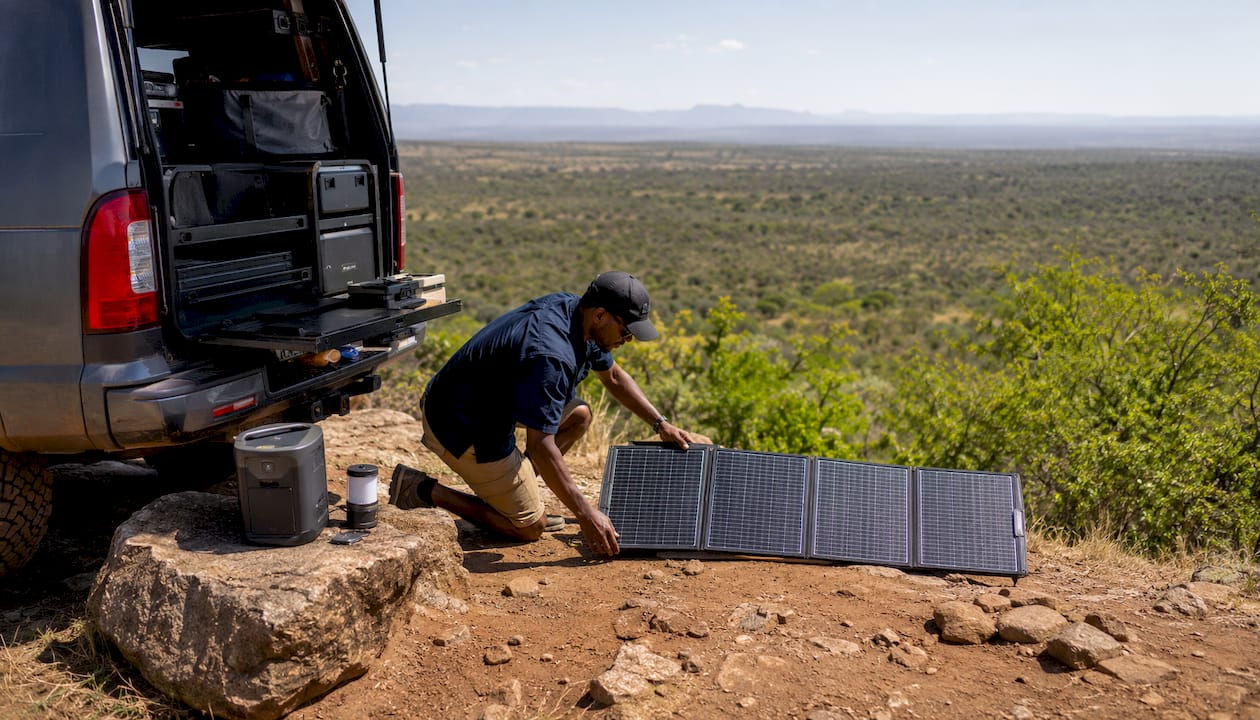
For most South African campers and overlanders, the EcoFlow 220W lightweight portable solar panel is the single best portable panel to buy right now. It combines bifacial TOPCon efficiency (a high conversion efficiency), IP68 waterproofing, a built-in XT60 connector, and a multi-year warranty — all in a package that pairs directly with EcoFlow's own power stations.
If that doesn't fit your use case, here are the specialist picks:
- Best for backpacking and ultralight camping: FocusOutdoor 150W HPBC ETFE (under 2.7 kg, MC4, flexible mount)
- Best for overlanding and long trips: Renogy foldable portable panels or the Flexopower Kalahari 400W Hi-Volt ETFE (for MPPT-based setups)
- Best for emergency/load-shedding backup: EcoFlow DELTA 2 paired with the 220W panel, or Bluetti AC200P with companion Bluetti panels
- Best plug-and-play bundle for car campers: Jackery SolarSaga panels with the Jackery Explorer 1000 Plus
When to pick which:
- Camping on foot or motorbike: go lightweight and flexible (under 200W, ETFE, under 3 kg)
- Car camping or caravan: foldable rigid panels 200–400W with MPPT compatibility
- Cabin or extended off-grid stay: 300–400W panel plus a 1,000 Wh+ LiFePO4 station
- Load-shedding emergency backup: any 200W+ panel paired with a 500–1,000 Wh LiFePO4 power station
*
Table of Contents
- Best portable solar panels 2026: quick comparison for South Africa
- Short reviews: which panel suits your setup?
- How to choose the right portable solar panel for South African conditions
- Will a 400W panel run a fridge? Sizing for South African conditions
- Key takeaways
- The part most buyers skip — and regret
- Solarza connects you with verified local solar suppliers
- FAQ
Best portable solar panels 2026: quick comparison for South Africa
The table below covers the top picks available in South Africa. Real-world daily energy uses the standard South African estimate of approximately 5 effective sun-hours per day.
| Panel / Bundle | Rated W | Est. Wh/day (SA) | Weight / folded size | IP / coating | Connectors | Cell tech | Approx. ZAR price band | Warranty | Best use-case |
|---|---|---|---|---|---|---|---|---|---|
| SolarZA marketplace | Various | Various | Various | Various | Various | Various | ZAR pricing tools | Local service | All buyers needing local quotes & warranty |
| EcoFlow 220W portable panel | 220W | estimated daily output in South African conditions | Lightweight / compact fold | IP68 / ETFE | XT60 built-in | TOPCon N-type bifacial | R6,000–R8,000 | multi-year warranty | Camping, emergency backup |
| Jackery SolarSaga panels + Explorer 1000 Plus | 100–200W | estimated daily output for typical South African solar conditions | Foldable / portable | IP68 | Jackery DC | Bifacial IBC/mono | R8,000+ (bundle) | multi-year warranty | Car camping, RV |
| Bluetti portable panels + AC200P | 150–200W | estimated daily output typical for South Africa | Foldable / mid-size | IP65–IP67 | MC4 / DC7909 | Mono PERC | R12,000+ (bundle) | multi-year warranty | Long off-grid stays, cabin |
| Renogy foldable portable panels | 100–200W | estimated daily output for typical South African solar conditions | Foldable / carry case | IP67 | MC4 / Anderson | Mono PERC | R3,000–R7,000 | multi-year warranty | Overlanding, caravan |
| Goal Zero Nomad series | 50–200W | estimated daily output consistent with South African sun exposure | Rugged fold / modular | IP67 | Anderson / USB-C | Mono | R5,000–R9,000 | multi-year warranty | Backcountry, modular arrays |
| FocusOutdoor 300W HPBC ETFE | 300W | estimated daily production in South African conditions | approx. 5 kg / flexible | — / ETFE | MC4 | HPBC mono | R5,000–R8,000 | Manufacturer | Hot-climate, flexible mount |
| FocusOutdoor 150W HPBC ETFE | 150W | estimated daily output in South Africa | ~2.64 kg / flexible | — / ETFE | MC4 | HPBC mono | R3,000–R4,000 | Manufacturer | Backpacking, coastal, marine |
| FlexoSun 260W TOPCon | 260W | approx. 1,000 Wh | Foldable | IP67 / — | MC4 / Anderson | TOPCon shingled | R5,000–R7,000 | multi-year warranty | Camping, overlanding |
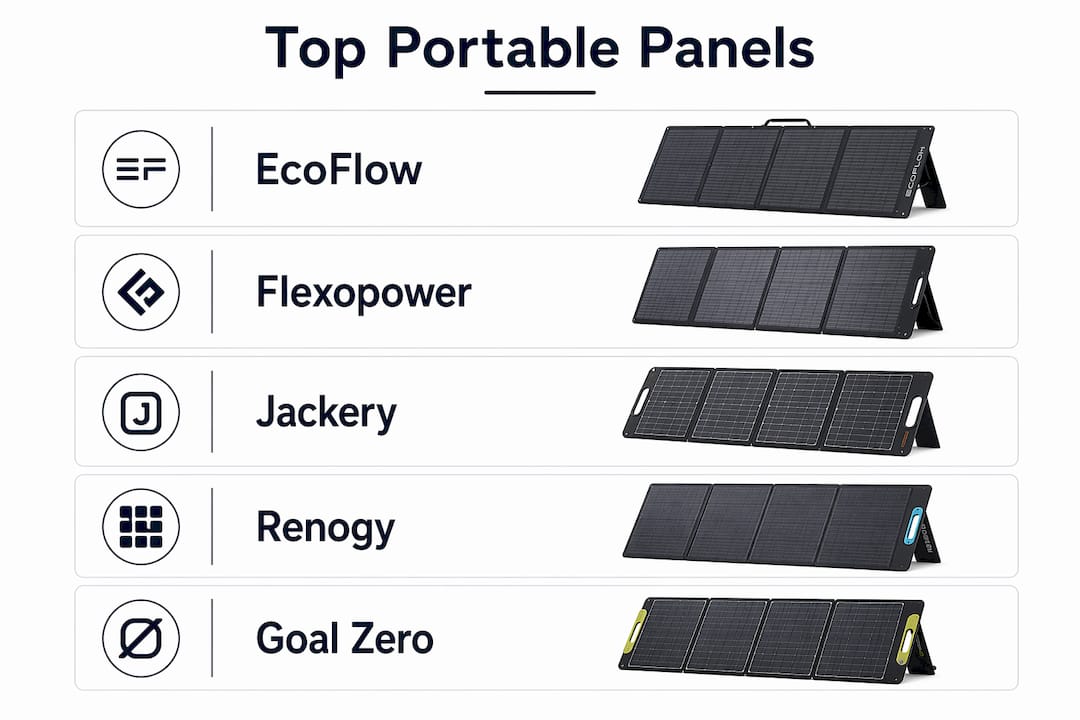 Availability note: EcoFlow panels and power stations are sold through EcoFlow ZA directly and select South African retailers. Jackery, Bluetti, Renogy, and Goal Zero are available through online retailers including Takealot, Outdoor Warehouse, and specialist overlanding stores. Use Solarza's panel directory to compare ZAR pricing and find local warranty service.
*
Availability note: EcoFlow panels and power stations are sold through EcoFlow ZA directly and select South African retailers. Jackery, Bluetti, Renogy, and Goal Zero are available through online retailers including Takealot, Outdoor Warehouse, and specialist overlanding stores. Use Solarza's panel directory to compare ZAR pricing and find local warranty service.
*
Short reviews: which panel suits your setup?
EcoFlow a 220W rating lightweight portable panel
The standout spec here is IP68 — fully dust-tight and submersion-rated, which matters when you're camping near rivers or caught in a Highveld thunderstorm. The bifacial TOPCon design captures light from both sides, and the built-in XT60 cable means zero adapter hunting if you own an EcoFlow DELTA 2 or RIVER 2 Pro. EcoFlow claims a high conversion efficiency efficiency and backs it with a multi-year warranty, which is now the emerging standard for higher-tier portable panels sold in South Africa.
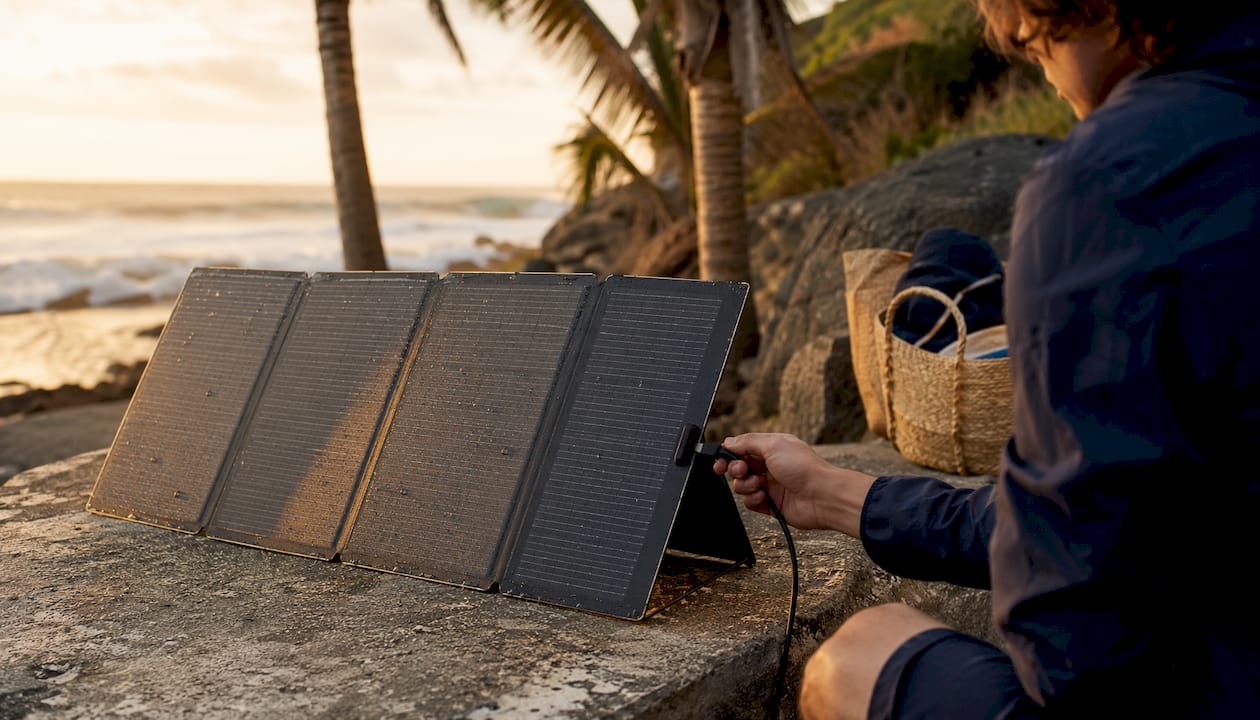
Paired with the EcoFlow DELTA 2, you get a capable emergency backup system: the DELTA 2 handles large AC loads and recharges fast when multiple panels are stacked. For lighter weekend use, the EcoFlow RIVER 2 Pro is the more portable pairing.
Practical note: The XT60 connector is only directly compatible with EcoFlow stations. If you own a different brand of power station, budget for an MC4-to-XT60 adapter.Jackery SolarSaga panels and Explorer 1000 Plus
Jackery's ecosystem is genuinely plug-and-play. The SolarSaga panels fold flat, set up in under a minute, and connect directly to the Explorer 1000 Plus without any adapter. The Explorer 1000 Plus handles mid-to-large loads — a portable fridge, lighting, and phone charging simultaneously — making it a practical choice for car campers and RV users who don't want to think about compatibility.
The SolarSaga 100 Light uses IBC cells, which deliver high efficiency in a compact panel. Warranty terms are similar to what is standard for quality portable panels in South Africa, so consider this for long-term use.
Bluetti portable panels and AC200P
The Bluetti AC200P is a workhorse station: large battery capacity and multiple output types make it popular for cabin use and longer off-grid stays. Companion Bluetti panels connect via MC4 or the proprietary DC7909 port. The trade-off is weight — this is not a backpacker setup. If you need to run a chest freezer, a CPAP machine, and lights through a three-day Karoo trip, the AC200P earns its bulk.
Renogy foldable portable panels
Renogy panels are widely stocked by South African overlanding retailers and distributors, which makes warranty claims and replacements more straightforward than grey-import alternatives. The foldable design with carry case suits caravan and bakkie setups. Most Renogy portable panels use MC4 or Anderson connectors, compatible with a broad range of MPPT controllers and power stations. Warranty coverage is in line with the multi-year standard expected for quality panels in 2026.
Goal Zero Nomad series
Goal Zero's Nomad panels are built for backcountry punishment. The modular design lets you chain panels together for more output, and the rugged housing handles the kind of treatment that would crack a cheaper panel. They pair naturally with Goal Zero's own Yeti power stations, though the Anderson connector is widely adaptable. Pricing in South Africa sits at the higher end for the wattage delivered. Warranty is consistent with what is typically offered for high-quality portable panels in the local market.
FocusOutdoor 300W and 150W HPBC ETFE
These panels use HPBC monocrystalline cells with ETFE coating and claim module efficiency above 26%, which is among the highest available in portable flexible panels. The ETFE surface resists UV degradation and coastal salt spray far better than PET-coated alternatives. The the 150W version weighs just 2.64 kg, making it the lightest credible option for backpackers who need a flexible panel that conforms to a tent or pack surface. Both use MC4 connectors and are available through MYSO in South Africa.
FlexoSun 260W TOPCon
The FlexoSun 260W uses TOPCon shingled cells with IP67 protection and a multi-year warranty. Flexopower is a South African company (Johannesburg and Stellenbosch), so local warranty service is a genuine advantage. At roughly 260W with IP67 and a fold design, it sits between the lightweight EcoFlow and the heavy-duty Kalahari 400W in the Flexopower range.
Anker SOLIX C800 Plus
The Anker SOLIX C800 Plus is a modern portable power station with a strong feature set and compatibility with common portable panels via standard connectors. It suits buyers who want a compact but capable station and aren't locked into a single panel ecosystem. Pair it with any MC4-output panel in the panels within 100–200W range for a flexible camping or emergency setup.
Pro Tip: If you already own a power station, check its maximum solar input wattage and voltage range before buying a panel. A 400W panel pushing 43V open-circuit into a station rated for 12V input will trigger the protection circuit and deliver nothing. *How to choose the right portable solar panel for South African conditions
South Africa's combination of high UV, dust, coastal salt air, and extreme temperature swings is genuinely hard on panels. Here's what to check before you buy.
Must-have specs checklist
- IP67 or IP68 ingress protection. IP65 is the bare minimum; IP67 handles full immersion briefly; IP68 is the top standard. Anything lower is a risk in dusty Karoo or coastal KZN conditions.
- ETFE coating, not PET. ETFE outperforms PET in UV resistance, scratch resistance, and long-term field performance. PET panels yellow and degrade faster under South Africa's high UV index.
- TOPCon or HPBC cell technology. Next-generation cells deliver 25–26%+ efficiency and handle high temperatures better than older mono PERC or polycrystalline panels. In a hot car boot or on a sun-baked bakkie roof, temperature coefficient matters.
- Connector compatibility. Verify that the panel's output connector (MC4, Anderson SB50, XT60, USB-C) matches your power station's input. Common panel outputs include MC4, Anderson, and XT60; some panels include adapters, many don't.
- multi-year warranty with local service. A warranty backed by a South African distributor or manufacturer is worth far more than a 2-year warranty on a grey import with no local support channel.
- Realistic ZAR price range. Expect to pay R3,000–R5,000 for a quality a 150W rating panel, R5,000–R9,000 for 200–260W, and R8,000–R15,000+ for 300–400W with premium specs. Prices significantly below these bands usually signal PET coating, older cell tech, or no local warranty.
- Expected lifespan and degradation. Quality portable panels degrade at roughly 0.5–0.7% per year under normal use. A multi-year warranty and ETFE coating are the best proxies for long-term durability when you can't inspect the lamination yourself.
Questions to ask sellers
- What is the panel's Vmp (maximum power voltage) and Voc (open-circuit voltage)? Does it match your power station's input range?
- Is the IP rating certified to IEC 60529, or is it a manufacturer claim?
- Are replacement connectors and cables available locally?
- Who handles warranty claims in South Africa, and what is the turnaround time?
Red flags when buying in South Africa
- No local warranty contact or distributor address listed
- IP rating stated without a certification standard reference
- PET coating described as "durable" without mentioning ETFE
- Panel voltage (Voc) exceeds your power station's maximum solar input voltage
- Price well below market for the stated wattage and cell tech
Will a 400W panel run a fridge? Sizing for South African conditions
South Africa averages approximately 5 effective sun-hours per day across most of the country, though the Northern Cape and Karoo regularly exceed that. The working rule is simple: watts × 5 sun-hours = estimated Wh per day.
A 400W panel therefore produces roughly 2,000 Wh per day under good conditions. A typical camping fridge draws 30–50 Wh per hour, which adds up to typical daily energy consumption range over 24 hours. So yes, a 400W panel can run a camping fridge — but only if you pair it with adequate battery storage to cover night hours and cloudy periods.
| Load | Typical draw | Hours/day | Daily Wh needed |
|---|---|---|---|
| Smartphone charging (×2) | 10–15W | 2 | 30–50 Wh |
| LED camp lighting | 10–15 W | 5 | 50–100 Wh |
| Portable camping fridge | 30–50W | 24 | typical daily energy consumption range |
| Small laptop | 45–60 W | 4 | 180–250 Wh |
| CPAP machine | 30–60W | 8 | 240–400 Wh |
How these picks were evaluated
Every panel on this list was assessed against a consistent set of criteria: real-world Wh/day output relative to rated wattage, IP ingress protection rating and coating type (ETFE vs PET), cell technology and stated efficiency, connector compatibility with common South African power stations, warranty terms and local service availability, and approximate ZAR pricing from South African retailers and distributors.
Wh/day estimates use the 5 effective sun-hours standard applicable across most of South Africa. Packability and weight were checked against manufacturer specifications. Connector compatibility was verified against the input specs of the EcoFlow DELTA 2, RIVER 2 Pro, Jackery Explorer 1000 Plus, Bluetti AC200P, and Anker SOLIX C800 Plus. Local availability was confirmed through South African retailer and distributor listings, and warranty terms were taken from official manufacturer pages.
Local warranty is the most underrated buying criterion. A panel shipped from overseas with no South African distributor leaves you with no practical recourse if cells delaminate or connectors fail after six months in the Karoo. Verify the warranty contact before you buy, not after.
South African buyers should also check that warranty and service channels exist locally — a common post-purchase regret for buyers in remote provinces is discovering their panel has no in-country support.
*Key takeaways
The EcoFlow a 220W rating with IP68 and TOPCon cells is the strongest single pick for most South African buyers, but the right panel depends on your load, travel style, and whether you have local warranty backup.
| Point | Details |
|---|---|
| Match panel to use-case | Lightweight flexible panels suit backpacking; foldable rigid 200–400W panels suit overlanding and cabins. |
| Size with 5 sun-hours | Multiply rated watts by 5 to estimate daily Wh; a 400W panel yields ~2,000 Wh/day under good SA conditions. |
| Prioritise ETFE and IP67/IP68 | ETFE coating and IP67+ protection are non-negotiable for South Africa's UV, dust, and coastal conditions. |
| Buffer with LiFePO4 storage | Pair any panel with a 500–1,000 Wh LiFePO4 power station to cover night loads and peak surge demands. |
| Solarza for local sourcing | Use Solarza to compare panel brands, request ZAR quotes, and find verified installers with local warranty support. |
The part most buyers skip — and regret
South African buyers spend hours comparing wattage and efficiency figures, then buy from the cheapest online listing without checking whether the warranty is backed locally. That is the single most common mistake in this market.
A TOPCon panel with 25% efficiency and IP68 is genuinely impressive. But if the connector corrodes after a winter trip to the coast and the only warranty contact is a Shenzhen email address, the specs are irrelevant. The practical hierarchy for South African conditions is: local warranty first, then ETFE coating and IP rating, then cell tech and efficiency.
The other thing worth saying plainly: portable panels degrade. Even quality ETFE-coated panels lose roughly 0.5–0.7% of output per year. After ten years, a 220W panel is delivering closer to 205W under the same conditions. That is manageable — but it means the 400W panel you buy today for a fridge load may not cover the same load in year eight without a battery buffer. Size the battery generously from the start.
One field tip that experienced overlanders use but rarely write down: run your panel cable long enough to keep the power station in the shade of the vehicle while the panel faces full sun. Ambient temperatures inside a closed bakkie or caravan can exceed 50°C on a summer day in Limpopo. LiFePO4 stations handle heat better than lithium-ion, but keeping them cool extends cycle life noticeably.
*Solarza connects you with verified local solar suppliers
Choosing the right panel is only half the job. Getting it installed, warranted, and serviced by someone who actually answers the phone in South Africa is the other half — and that is where most buyers hit a wall.
Solarza's marketplace covers all nine provinces, connecting you with verified solar installers and suppliers who stock the brands covered in this guide. You can compare panel options in ZAR, use the solar cost calculator to size your system, and request a free quote from local installers who handle warranty claims and after-sales service in your area. Whether you need a portable panel for camping or a full backup system for load shedding, find verified installers by city and get a quote today.
*Useful sources for South African buyers
- EcoFlow a 220W rating Portable Solar Panel — EcoFlow ZA: Official spec page for IP68 rating, TOPCon efficiency claim, XT60 connector, and multi-year warranty. Verify current ZAR pricing here.
- FlexoSun 260W TOPCon IP67 — Flexopower ZA: South African manufacturer page; check IP67 certification, TOPCon cell specs, and local warranty terms.
- FocusOutdoor a 300W rating HPBC ETFE — MYSO: Local retailer listing with ETFE coating details, HPBC efficiency specs, and MC4 connector confirmation.
- FocusOutdoor a 150W rating HPBC ETFE — MYSO: Lightweight flexible panel specs; confirm weight and connector type for your setup.
- Portable battery solar system sizing guide — Greensurface: Explains the 400W/5-sun-hour/2,000 Wh/day calculation and fridge load examples.
- Why LiFePO4 beats lithium-ion for camping — Toddra: Practical breakdown of battery chemistry for portable power stations; useful for sizing battery buffers.
- Solar-powered camping setups: real examples 2026 — Toddra: Real campsite panel and battery combination examples for South African conditions.
- Solarza panel directory and ZAR pricing: Compare panel brands, check local pricing, and access the solar calculator for system sizing.
- Solarza installer directory by province: Find verified local installers for warranty service and panel supply across all nine provinces.
FAQ
What is the best brand of portable solar panels in South Africa?
EcoFlow leads for most buyers in 2026, thanks to IP68 protection, TOPCon efficiency, and a multi-year warranty backed by a local South African presence. Flexopower is the strongest locally manufactured option, with Renogy and Jackery widely available through South African retailers.
Will a 400W solar panel run a camping fridge?
Yes, with adequate battery storage. A 400W panel produces roughly 2,000 Wh per day in South African conditions (5 effective sun-hours), and a camping fridge draws typical daily energy consumption range over 24 hours — so you need a 500–1,000 Wh LiFePO4 battery to cover overnight and cloudy-day loads.
What is the best solar panel brand for 2026 overall?
For portable panels specifically, EcoFlow and Flexopower lead on efficiency and durability for South African conditions. For residential and larger systems, Solarza's brand comparison guide covers the full range of panels available locally with ZAR pricing.
What connector types do portable solar panels use?
The most common connectors are MC4 (industry standard, widely compatible), Anderson SB50 (popular in overlanding setups), XT60 (used by EcoFlow panels), and USB-C/PD for smaller panels. Always verify that your panel's output connector matches your power station's solar input before buying.
How long do portable solar panels last in South African conditions?
Quality ETFE-coated panels with IP67 or IP68 protection typically last 10–15 years with normal use, degrading at roughly 0.5–0.7% per year. PET-coated panels degrade faster under South Africa's high UV index and coastal salt exposure, often showing yellowing and efficiency loss within 3–5 years.