Best bifacial solar panels 2026: South Africa ROI guide
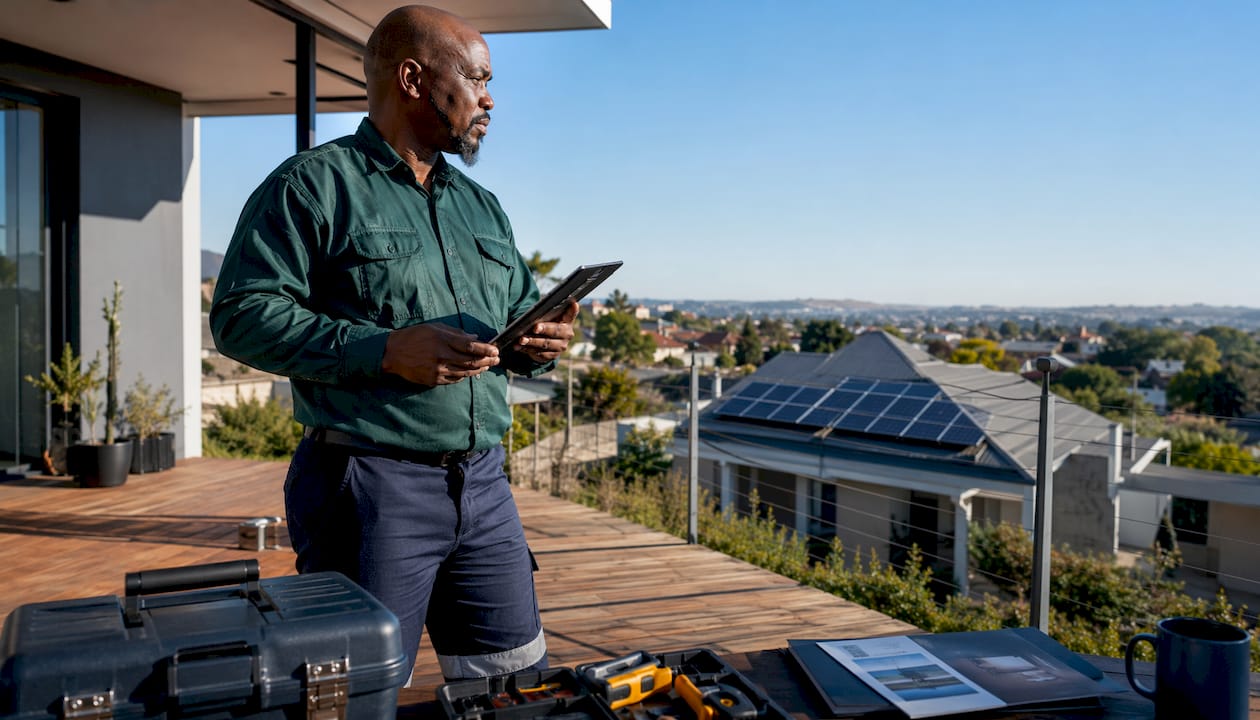
For most South African homeowners in 2026, bifacial panels are worth the premium only when your installation type can actually capture rear-side light. On a ground mount, elevated carport, or white flat roof, they are the clear choice. On a standard dark-tiled pitched roof with minimal clearance, a larger monofacial array often pays back faster.
Quick shortlist by installation type:- Ground-mounted or carport arrays: N-type bifacial (Longi Hi-MO 7, Jinko Tiger Neo, Risen Hyper-ion) — significant rear-side gains are realistic here
- Elevated flat roof with reflective surface: Bifacial N-type TOPCon or HJT — achievable gains with light-coloured membrane or gravel
- Standard pitched tiled roof (dark tiles, close-mounted): Monofacial or bifacial with modest expectations — realistic rear-side gains are low, making the premium harder to justify
- Northern Cape / Karoo ground arrays with single-axis trackers: Bifacial is the strongest ROI case in South Africa, full stop
Table of Contents
- How do bifacial solar panels generate extra energy?
- How much extra energy can bifacial panels produce in South Africa?
- When does bifacial make financial sense for your property?
- Top bifacial models available in South Africa in 2026
- Cost premium and ROI: a worked South Africa example
- How to choose bifacial modules and what to ask your installer
- Key takeaways
- Why the bifacial conversation in South Africa needs a reset
- Get vetted installers and site-specific quotes through Solarza
- Sources and further reading
- FAQ
How do bifacial solar panels generate extra energy?
A bifacial panel captures sunlight from both its front face and its rear face. The front works exactly like any standard module. The rear collects light that bounces off the surface beneath and around the array, a property called albedo. That reflected light hits the rear cells and generates additional current on top of what the front produces.
The bifaciality factor is the key spec here. It expresses how efficiently the rear side converts light relative to the front, stated as a percentage. A panel with an 80% bifaciality factor means its rear cells are 80% as productive as the front cells under the same irradiance. The Longi Hi-MO 7 Edge, for example, carries a bifaciality factor of 80% ±5%. Risen's HJT Hyper-ion series claims above 85%, which is among the highest available locally.
Most premium bifacial panels in 2026 use N-type cell technology (TOPCon or HJT) rather than older PERC. N-type cells have lower light-induced degradation, better low-light response, and tighter temperature coefficients. They are almost always paired with dual-glass construction (a glass backsheet instead of a polymer film), which protects the rear cells from moisture ingress and mechanical stress while allowing light transmission. Dual-glass also improves resistance to potential-induced degradation (PID), a real concern in South Africa's humid coastal regions.
 Temperature coefficient matters more in South Africa than most marketing materials admit. Panels lose output as they heat up, and South African rooftops regularly exceed 60°C in summer. A coefficient of -0.28%/°C versus -0.35%/°C sounds like a rounding error, but across a summer in Gauteng it translates to a measurable kWh difference every single day.
Pro Tip: Ask your installer to provide a site-specific rear-side irradiance model that states the assumed roof colour, clearance height, and row spacing. Without those three inputs, any bifacial gain estimate is a guess.
*
Temperature coefficient matters more in South Africa than most marketing materials admit. Panels lose output as they heat up, and South African rooftops regularly exceed 60°C in summer. A coefficient of -0.28%/°C versus -0.35%/°C sounds like a rounding error, but across a summer in Gauteng it translates to a measurable kWh difference every single day.
Pro Tip: Ask your installer to provide a site-specific rear-side irradiance model that states the assumed roof colour, clearance height, and row spacing. Without those three inputs, any bifacial gain estimate is a guess.
*
How much extra energy can bifacial panels produce in South Africa?
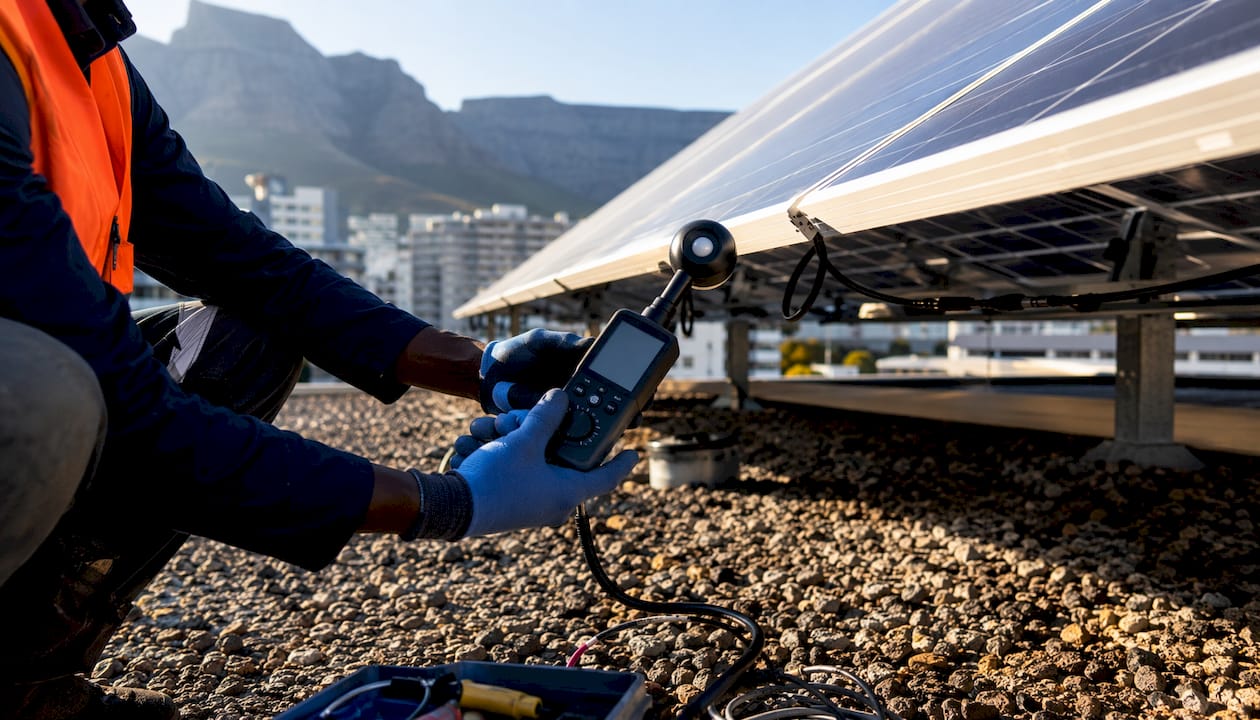
The honest answer: real-world rear-side energy gains for bifacial panels in South Africa range from roughly 5% to 30% depending almost entirely on the installation type and the surface beneath the panels. Most residential rooftops are at the low end (2–8%), while ground mounts, carports, and highly reflective surfaces can see higher gains.
Expected rear-side gain by installation type
| Installation type | Typical rear-side gain (SA conditions) | Notes |
|---|---|---|
| Standard pitched tiled roof, dark tiles, close-mounted | 2–8% | Minimal clearance, low albedo, residential rooftops commonly achieve 2–8% |
| Pitched roof with 300mm+ clearance, light tiles | 5–8% | Modest improvement from tile colour |
| Elevated flat roof, white membrane or light gravel | 8–15% | Albedo 40–70%; good bifacial case |
| Ground-mounted on grass, fixed tilt | 10–15% | Grass albedo 15–25%; height and row spacing critical |
| Ground-mounted on white concrete or light gravel | 25–30% | White concrete albedo 70–80%; strongest SA case |
| Single-axis tracker, high-albedo surface | 25–30% | Optimal; suited to Northern Cape utility/farm arrays |
South Africa context: three quick scenarios
A Gauteng homeowner with dark terracotta tiles and panels mounted flush to the roof is looking at 2–4% rear-side gain at best. The bifacial premium is hard to justify there unless the panel price difference is negligible.
A Western Cape carport installation with 1m panel height over light concrete is a different story. Albedo in the 60–70% range, good clearance, and consistent irradiance push rear-side gains toward 15–20%. The premium pays back.
A Northern Cape ground array on white-painted concrete with single-axis tracking is the strongest case in the country. Gains above 25% are achievable, and the long-term LCOE improvement is substantial.
What moves the gain from low to high
- Surface albedo: white concrete (70–80%) versus dark asphalt (5–10%) is the single biggest variable
- Panel clearance: more height above the surface means more reflected light reaches the rear cells
- Row spacing: tighter rows shade each other's rear faces; 6–8m row spacing is a common benchmark for ground arrays
- Tilt angle: a slightly steeper tilt than you would use for monofacial (roughly 2–15 degrees more) improves rear capture
- Shading: any rear-side shading from mounting frames, cables, or adjacent rows cuts gain disproportionately
When does bifacial make financial sense for your property?
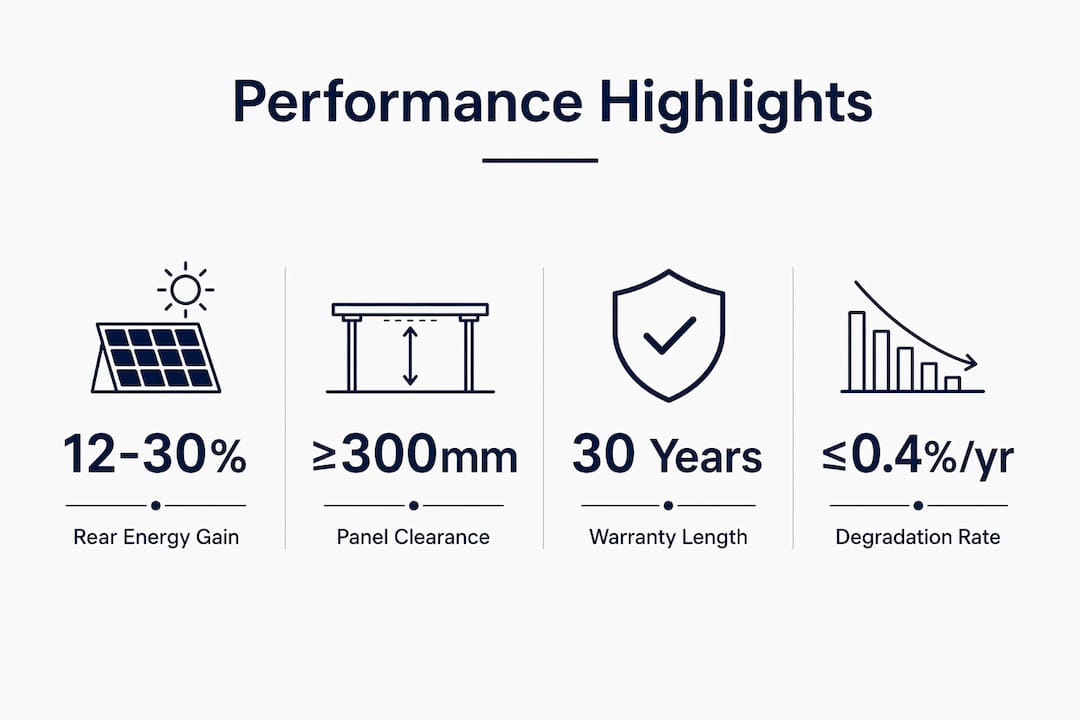
The clearest rule: bifacial usually pays when panel clearance exceeds roughly 300mm and the surface beneath has an albedo above 25%. Below those thresholds, the rear-side gain is too small to recover the price premium within a typical 5–10 year payback target.

Site checklist before you commit
Work through these before accepting any bifacial proposal:
- Roof or ground surface colour and finish. Light-coloured tiles, white membrane, pale gravel, or painted concrete all support bifacial gains. Dark tiles, black rubber membrane, or bare soil do not.
- Clearance height. Measure the gap between the panel's rear face and the mounting surface. Under 150mm, rear-side gain is negligible.
- Orientation and tilt. North-facing at 20–35° tilt is optimal in South Africa. East/west split arrays reduce rear-side capture.
- Row spacing for ground mounts. Confirm the installer's proposed row distance and ask how it was calculated.
- Self-consumption rate. Higher self-consumption (above 60%) means more of the extra bifacial yield is valued at the full avoided Eskom tariff rather than fed back at a lower export rate.
- Budget flexibility. If the bifacial premium means buying fewer panels overall, run the numbers on a larger monofacial array first.
Decision flow
Choose bifacial when you have a ground mount, elevated carport, or flat roof with a reflective surface, clearance above 300mm, and a budget that does not require sacrificing array size. Choose monofacial when you have a standard pitched tiled roof with dark tiles and close-mounted racking, or when your budget is tight and adding one or two extra monofacial panels would deliver more kWh for the same spend. Invest in more array area instead when your roof is large enough to accommodate additional panels and your self-consumption is high. Financial analysis consistently shows that a larger, lower-cost monofacial array often returns a higher short-term ROI than a smaller premium bifacial array on dark residential roofs.Bifacial rarely makes sense on a standard Johannesburg or Cape Town tiled roof where panels sit 50–100mm above dark terracotta. The rear-side gain simply does not cover the premium within a homeowner's payback window.
*Top bifacial models available in South Africa in 2026
Prefer N-type TOPCon or HJT dual-glass bifacials for the highest yield and durability in 2026. These are the five model families to evaluate, all confirmed available through South African solar panel suppliers and installer networks.
The five models to compare
- Longi Hi-MO 7 Edge (620W): The benchmark N-type TOPCon bifacial in South Africa. Efficiency up to 23.0%, temperature coefficient -0.280%/°C, bifaciality 80% ±5%, dual-glass, 12-year product warranty and 30-year linear performance warranty. Strong installer support network nationally.
- Jinko Tiger Neo (570–590W, 72HL4-BDV): N-type dual-glass bifacial with IP68 junction box, 12-year product and 30-year linear performance warranty. High power density in a large-format module. Well-suited to ground mounts and commercial flat roofs.
- Risen Hyper-ion HJT (590W): The standout for temperature performance. Temperature coefficient of approximately -0.22%/°C is the lowest of the five, meaning it loses less output on hot South African afternoons. Efficiency around 22.6%, bifaciality above 85%, 30-year linear warranty. Best suited to high-irradiance sites where afternoon temperatures are consistently high.
- Canadian Solar bifacial models (TOPBiHiKu7 series): Widely stocked by South African distributors. Efficiency in the 21–22% range, dual-glass construction, competitive pricing. A practical choice when local availability and installer familiarity matter as much as peak specs.
- JA Solar bifacial models (DeepBlue series): Ranked among SA's top performers in local yield assessments. Efficiency 21–22.5%, N-type TOPCon cells, dual-glass, 30-year linear warranty. Strong track record with South African installers.
Comparison table
| Model | Efficiency (%) | Rated power (W) | Temp coefficient (%/°C) | Bifaciality factor | Construction | Warranty (product/performance) | Best installation type | Expected SA payback (years) |
|---|---|---|---|---|---|---|---|---|
| Longi Hi-MO 7 Edge | 23.0 | 620 | -0.280 | 80% ±5% | Dual-glass, N-type TOPCon | 12 yr / 30 yr | Ground, carport, flat roof | 6–8 |
| Jinko Tiger Neo | ~22 | 570–590 | ~-0.28 | ~80% | Dual-glass, N-type | 12 yr / 30 yr | Ground, commercial flat roof | 6–8 |
| Risen Hyper-ion HJT | ~22.6 | 590 | -0.22 | 85%+ | Dual-glass, HJT | 30 yr linear | High-irradiance ground/carport | 6–8 |
| Canadian Solar TOPBiHiKu7 | 21–22 | 570–590 | ~-0.28 | ~80% | Dual-glass, N-type TOPCon | 12 yr / 30 yr | Ground, flat roof, carport | 7–10 |
| JA Solar DeepBlue | 21–22.5 | 570–590 | ~-0.28 | ~80% | Dual-glass, N-type TOPCon | 12 yr / 30 yr | Ground, flat roof, carport | 7–10 |
Cost premium and ROI: a worked South Africa example
The bifacial premium in 2026 runs somewhat higher than a comparable monofacial system at the system level. For most South African homeowners, that premium shortens payback when the installation type supports meaningful rear-side gain, and lengthens it when it does not.
Worked calculation: 5 kW vs 10 kW system
The table below uses conservative assumptions: Eskom residential tariff of R3.50/kWh (a reasonable 2026 baseline for most metros), 65% self-consumption, and a bifacial rear-side gain of 12% (achievable on an elevated flat roof or carport with moderate albedo).
| Scenario | System size | Capital cost (ZAR) | Annual kWh (monofacial baseline) | Bifacial annual kWh (+12%) | Annual saving (ZAR, 65% self-consumption) | Simple payback (years) |
|---|---|---|---|---|---|---|
| Monofacial 5 kW | 5 kW | — | — | — | — | — |
| Bifacial 5 kW | 5 kW | — | — | — | — | — |
| Monofacial 10 kW | 10 kW | — | — | — | — | — |
| Bifacial 10 kW | 10 kW | — | — | — | — | — |
At 12% rear-side gain, the bifacial premium pays back in roughly the same time as the monofacial system, with meaningfully more kWh generated over the panel's 30-year life. The long-term LCOE advantage is real, particularly given low first-year degradation and modest annual degradation on premium N-type bifacial modules.
Sensitivity: what changes the numbers
- Higher albedo (white concrete vs grass): rear-side gain rises from 12% to 20–25%, improving bifacial payback by 0.3–0.5 years
- Lower self-consumption (below 40%): avoided kWh value drops; both systems take longer to pay back, and the bifacial premium becomes harder to recover
- Bifacial premium above 10%: the payback advantage narrows; at 15% premium with only 5% rear-side gain, monofacial wins on payback
- Dark tiled roof, minimal clearance: rear-side gain drops to 2–4%; the bifacial premium adds cost with almost no yield benefit
How to choose bifacial modules and what to ask your installer
The single most important ask: request a site-specific rear-side gain model with stated assumptions. Any installer who quotes a bifacial system without specifying the assumed albedo, clearance height, and row spacing is working from a marketing brochure, not your roof.
Checklist of questions and measurements to demand
- What bifaciality factor did you use in the yield model? The answer should match the manufacturer's datasheet (typically 78–85% for premium N-type modules). A round number like "80%" is fine; no number at all is a red flag.
- What albedo value did you assume for my surface? They should be able to state a figure (e.g., 25% for grass, 70% for white concrete) and explain how they measured or estimated it.
- What is the proposed clearance height between the panel rear and the mounting surface? Under 150mm, rear-side gain is negligible. Ask for the exact figure.
- What is the row spacing for ground or flat-roof arrays? Confirm it matches the modelled shading assumptions.
- Is the backsheet dual-glass or polymer film? For bifacial, dual-glass is strongly preferred. Polymer backsheets can degrade and reduce rear-side transmission over time.
- What are the warranty terms, and what does the performance warranty actually cover? A 30-year linear performance warranty should specify the annual degradation rate (look for ≤0.4%/year after year one) and the end-of-warranty output floor (typically 87–88% of rated power).
- What is the temperature coefficient for Pmax? For South African conditions, anything worse than -0.35%/°C deserves scrutiny. The Risen HJT at -0.22%/°C sets the current benchmark.
- What is the first-year degradation rate? Premium N-type bifacial modules typically specify ≤1% in year one. Older PERC bifacials may be higher.
Red flags to watch for
- A blanket "30% bifacial gain" claim with no site-specific data attached. That figure requires white concrete, high clearance, and often single-axis tracking.
- A proposal that uses bifacial panels on a dark close-mounted tiled roof without acknowledging the limited rear-side gain.
- Missing or vague warranty documentation. Always request the product warranty PDF and the performance warranty PDF separately.
- No temperature coefficient listed on the proposal. This is a standard datasheet spec; its absence suggests the installer has not reviewed the datasheet.
Certifications to request
Ask for IEC 61215 (module qualification), IEC 61730 (safety), and TÜV or UL certification documentation. For dual-glass bifacial modules, confirm the IEC 61730 rating covers the specific glass-glass construction. These are not optional extras; they are the baseline for any bankable installation.
*Key takeaways
N-type bifacial panels deliver their strongest South Africa ROI on ground mounts, carports, and reflective flat roofs — not on standard dark-tiled pitched roofs where rear-side gains drop to 2–5%.
| Point | Details |
|---|---|
| Rear-side gain range | Realistic gains run 5–30% depending on surface albedo, clearance, and mounting type. |
| Best installation types | Ground mounts, elevated carports, and white flat roofs capture the most rear-side light in South Africa. |
| Temperature coefficient matters | Risen HJT at -0.22%/°C and Longi Hi-MO 7 at -0.280%/°C outperform older PERC modules in sustained heat. |
| Bifacial premium is 5–8% | The system-level premium pays back when rear-side gain exceeds roughly 10%; below that, a larger monofacial array often wins on payback. |
| Use Solarza for installer matching | Solarza connects you with vetted installers across all nine provinces who can provide site-specific yield models and local stock confirmation. |
Why the bifacial conversation in South Africa needs a reset
The marketing around bifacial panels has outrun the reality for most residential buyers. Walk into any solar expo in Johannesburg or Cape Town and you will hear "up to 30% more energy" repeated as though it applies to every installation. It does not. That figure belongs to optimised ground arrays in the Northern Cape, not to a north-facing roof in Pretoria with terracotta tiles and 80mm of clearance.
What actually matters for a South African homeowner is simpler than the spec sheets suggest. Three things drive whether bifacial pays: what is under the panels, how far above it they sit, and whether your self-consumption is high enough to value every extra kWh at the full avoided Eskom rate. Get those three right and the premium is justified. Get them wrong and you have paid more for a panel that performs almost identically to a monofacial module on your specific roof.
The other thing the industry undersells is the long-term warranty story. A 30-year linear performance warranty with ≤0.4% annual degradation is genuinely meaningful for an energy investor thinking in decades, not just payback years. The LCOE advantage of premium N-type bifacial over a 25–30 year horizon is real, even when the short-term payback difference is modest. That is the argument worth making, and it is the one most sales conversations skip entirely.
My recommendation: before you decide on bifacial versus monofacial, ask your installer to model both scenarios side by side with your actual roof specs. If they cannot or will not do that, find an installer who can.
*Get vetted installers and site-specific quotes through Solarza
Choosing between bifacial and monofacial is the kind of decision that turns on your specific roof, your surface colour, and your self-consumption pattern. Generic advice only gets you so far. What closes the gap is a quote from an installer who has actually modelled your site.

Solarza connects South African homeowners with verified solar installers across all nine provinces. You can compare installers by city, filter by brand and service type, and receive tailored quotes that include site-specific yield estimates. Every installer in the Solarza directory is vetted and rated, so you are not starting from scratch with an unknown contractor. The solar savings calculator lets you test bifacial versus monofacial scenarios with your own consumption figures before you speak to anyone. Request your quotes today and get a clear, numbers-backed answer for your property.
*Sources and further reading
The claims and modelling assumptions in this article draw on manufacturer product datasheets (Longi, Jinko, Risen), South African yield ranking analyses, independent bifacial performance guides, and local supplier listings. For your own due diligence, the following are the most authoritative sources to consult:
- NREL bifacial PV performance documentation at docs.nrel.gov covers bifacial gain modelling methodology and albedo data used in utility-scale analysis.
- Green Building Africa publishes a detailed bifacial module challenges and advantages review covering installation cost premiums, tracker economics, and LCOE considerations relevant to South African conditions.
- Local supplier product pages for Longi Hi-MO 7 Edge, Jinko Tiger Neo, and Risen Hyper-ion carry the datasheets with warranty PDFs, temperature coefficients, and bifaciality factor specifications.
- Solarza's solar panels comparison page and brands directory provide current local pricing context and installer availability by brand.
For dual-glass construction methods and carport mounting considerations, EvoEnergy's technical resources on solar panel installations and carport mounting systems provide useful background on structural and yield considerations. *
FAQ
Who makes the best bifacial solar panels in 2026?
Longi, Jinko, Risen, Canadian Solar, and JA Solar are the leading bifacial manufacturers available in South Africa in 2026, with N-type TOPCon and HJT models from all five ranked among SA's top performers by yield, warranty, and installer feedback.
What is the best solar panel brand in South Africa right now?
Longi Hi-MO 7 is the most widely cited benchmark for efficiency and warranty strength, but Risen's Hyper-ion HJT series leads on temperature coefficient, which matters most in high-irradiance South African conditions.
How long do bifacial solar panels last?
Premium N-type bifacial panels carry 30-year linear performance warranties with first-year degradation of ≤1% and annual degradation of approximately 0.3–0.4% thereafter, meaning they typically retain above 87% of rated output at the end of the warranty period.
Are bifacial panels worth the extra cost on a typical South African roof?
On a standard dark-tiled pitched roof with close-mounted racking, the rear-side gain is typically only 2–5%, making the 5–8% system cost premium difficult to recover within a 5–10 year payback window. Ground mounts, carports, and reflective flat roofs are where bifacial panels consistently justify the premium.
How do I find a qualified bifacial installer in South Africa?
Solarza's directory of vetted installers by province lets you filter by location, brand, and service type, and request site-specific quotes that include rear-side gain modelling assumptions.