48V LiFePO4 for 5kW Inverters in South Africa: 5.12–10.2 kWh Options
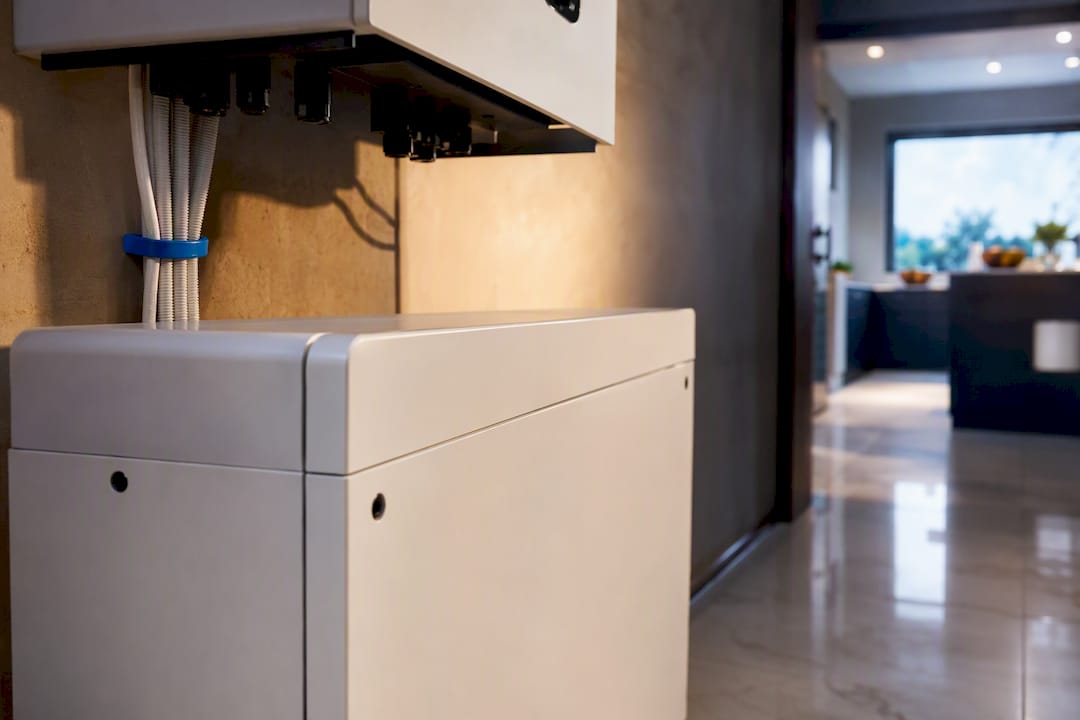
For a 5kW inverter, a 48V LiFePO4 battery bank is the standard choice, and it works for nearly every home setup. Most South African installs land between 5 and 13.5 kWh of usable capacity, depending on what you want to keep running and for how long. The sections below walk through the market's actual modules, the math to size your own bank, and the checks that stop a mismatched battery from tripping your inverter.
*TL;DR:>
- Most homes with a 5kW inverter choose a 48V LiFePO4 battery bank between 5 and 10.2 kWh of usable capacity, depending on backup duration needs.*
- A single 5.12 kWh module typically provides around four hours of essential load backup, while two modules can deliver eight or more hours.
- Compatibility requires verifying inverter support for the battery's communication protocol and ensuring proper wiring, sizing, and ventilation.
- LiFePO4 batteries offer superior discharges, longer cycle life, and safety advantages over lead‑acid, making them the preferred choice for most residential systems.
- Accurate sizing and professional installation help prevent mismatches that can lead to trip faults or warranty issues.
Table of Contents
- What's the best battery for a 5kW inverter?
- How do you calculate the battery size you actually need?
- LiFePO4 vs lead‑acid: which chemistry actually fits a 5kW system?
- Getting compatibility and installation right
- What will a 5kW battery setup cost?
- Getting matched with the right installer for your setup
- An installer checklist worth pinning to your fridge
- Get matched with a vetted installer through Solarza
- Where to verify specs before you buy
- Sources
- FAQ
What's the best battery for a 5kW inverter?
Deye, Dyness, SunSynk, and Shoto offer 48V LiFePO4 modules commonly ranging around 5 kWh, which is a typical building block for 5kW hybrid systems. Local kit vendors routinely bundle 5kW hybrid inverters with 5.12 to 5.32 kWh battery modules, which is why you'll see the same handful of names on nearly every quote.
Here's what separates them once you look past the spec sheet:
- Deye SE-F5 Plus (5.12 kWh) is the go-to for anyone starting with a single module and planning to add more later. It's the module most commonly paired with Deye's own 5kW hybrid kits, so compatibility and firmware support are rarely an issue.
- Dyness 5.12 kWh shows up in retail combos across the country and stacks cleanly in 5.12 kWh increments, which makes budgeting for future expansion straightforward.
- SunSynk 5.32 kWh module gives you a touch more headroom per unit. If you're trying to hit a runtime target with fewer physical batteries, that extra 0.2 kWh adds up over two or three modules.
- Shoto 48V modules tend to be the budget play. They're widely used as OEM stock in wholesale kit builds, so you'll find them under other brand names too.
Before you commit to any module, confirm two things with your installer: that it's on your inverter's supported battery list, and that its BMS communicates over the protocol your inverter expects (usually CAN or RS485). A battery with the right voltage but the wrong protocol simply won't talk to the inverter.
How do you calculate the battery size you actually need?
The math is simpler than it looks once you break it into three steps.
- Work out your load in watt-hours. Multiply the wattage of what you want to run by the hours you want it running: Wh = W × hours.
- Convert to battery Ah. Divide by voltage and depth of discharge: Battery Ah = Wh ÷ (Voltage × DoD). Lead‑acid uses a DoD around 0.5; lithium supports roughly 0.8.
- Add a loss allowance. Battery kWh needed = (Load kW × Hours) ÷ (DoD × 0.90), where the 0.90 factor covers inverter and system losses. Some installers push that further to a 1.05 to 1.25 safety multiplier on top.
Worked example, essential loads only: lights, router, and a fridge draw roughly 400W combined. Over 4 hours that's 1,600 Wh. At 48V with 0.8 DoD, gross Ah works out to about 42 Ah, or roughly 2 kWh gross. A single 5.12 kWh module covers that with room to spare. Worked example, longer backup: the same household wants 8 to 12 hours of cover, including a bit more load. That pushes gross requirement toward 8 to 10 kWh, which typically means two 5.12 kWh modules rather than one. Pro Tip: Size for continuous discharge first, then check kWh. A battery with plenty of capacity but a low C-rating can still trip your inverter the moment a kettle and a pump switch on together.
LiFePO4 vs lead‑acid: which chemistry actually fits a 5kW system?
LiFePO4 wins for nearly every residential 5kW pairing, and the reasons go beyond marketing.
- LiFePO4 delivers 80 to 90% usable depth of discharge, thousands of cycles, and a strong safety record, which is why it's the prevailing recommendation for hybrid solar setups.
- Lead‑acid costs less upfront but only gives you around 50% usable capacity and a shorter service life, so you end up buying more battery to get the same usable kWh. It still makes sense on very tight budgets or legacy systems.
- NMC and other lithium chemistries offer higher energy density, which matters for electric vehicles or portable equipment. For a wall-mounted home battery, that density advantage rarely justifies the added thermal management complexity.
Getting compatibility and installation right
A battery that's the right size on paper can still fail in practice if the wiring or communication setup is wrong. Run through this before signing off on any install:
- Confirm the inverter's voltage class (48V) matches the battery, and check the inverter's supported battery list for your exact model.
- Verify the communication protocol, usually CAN or RS485, and confirm firmware on both sides supports it.
- Check the battery's continuous discharge rating against your inverter's continuous kW demand; underspecified continuous current is a common cause of nuisance trips when a fridge compressor or borehole pump kicks in.
- Get cabling sized correctly, fuse each battery bank, fit a battery isolator, and keep the install ventilated within the manufacturer's temperature range.
- Use a certified installer. Self-installed banks are a common source of warranty disputes down the line.
Red flag: if a quote doesn't mention checking your inverter's supported battery list, ask why. It's a five-minute check that prevents a very expensive mismatch.
What will a 5kW battery setup cost?
Two example builds show how capacity and price scale together.
| Build | Configuration | Usable capacity | Typical use case |
|---|---|---|---|
| Build A | 5kW inverter + one 5.12 kWh module | 5.12 kWh | Essential loads for 3 to 4 hours |
| Build B | 5kW inverter + two 5.12 kWh modules | ~10.2 kWh usable | Extended backup, 8+ hours on moderate loads |
What actually drives the price difference between builds isn't just the second battery. Extra cabling runs, a second battery cabinet or rack, higher C-rating modules for heavier continuous loads, and additional installation labour all add up. Ask your installer for a line-item quote so you can see exactly what you're paying for beyond the battery itself.
Getting matched with the right installer for your setup
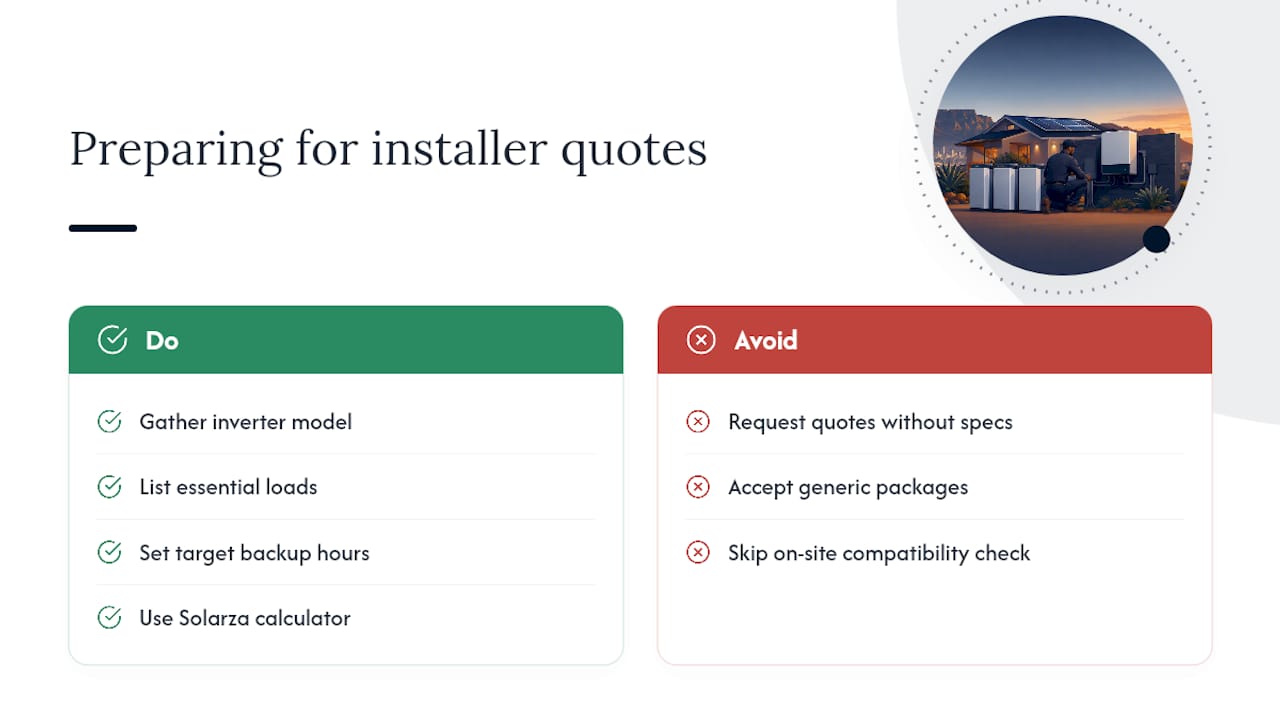
Before requesting quotes, gather three things: your inverter model, a list of essential loads, and your target backup hours. Solarza's solar calculator helps you turn that into an estimated kWh range, and the battery buyer's guide lets you check specs against what's actually available near you.
Once you know roughly what you need, You can find installers in your area who can quote against your actual inverter model, not a generic package. That means fewer surprises when the installer arrives and checks compatibility in person.
An installer checklist worth pinning to your fridge
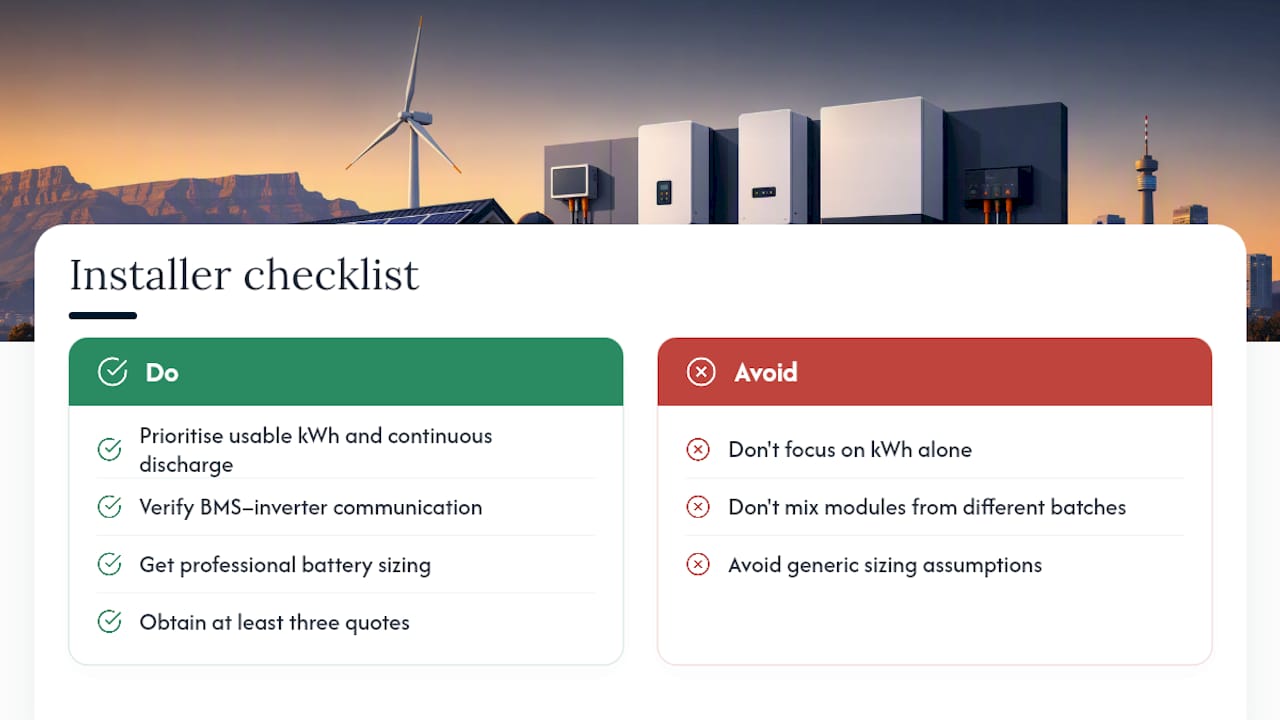
The mistakes we see repeatedly aren't exotic. Homeowners undersize continuous discharge because they focus on kWh alone, skip checking BMS communication with the inverter, or mix battery modules from different production batches and end up with balancing issues.
Usable kWh and continuous discharge matter more than the number printed on the box. Get professional sizing, and get at least three quotes before you commit. Battery bank sizing varies enough by household that a generic answer rarely fits your actual usage.
— Kobus Kohvik
Get matched with a vetted installer through Solarza
Rather than chasing quotes from multiple suppliers one by one, you can submit your inverter model and load list once, and get matched with installers who know how to size a 48V LiFePO4 bank correctly for your situation.

Start by running your numbers through the solar calculator to get a realistic usable kWh target. Then check the 48V battery guide to confirm which modules suit your inverter class. Once you have that groundwork, request a free quote and you can be matched with installers who can size and install the system properly, without needing to vet each one yourself.
Where to verify specs before you buy
- Use an inverter sizing calculator to double-check your own Ah and kWh math.
- Always confirm module specs against the manufacturer's current warranty and supported-battery documentation before ordering.
Sources
- Inverter Sizing Calculator — kVA & Battery | SA Property Tools
- Lithium Batteries Buying Guide | South Africa | SP-Energy
- How many batteries do I need for a 5kW inverter? | BBrief
FAQ
What size battery do I need for a 5kW inverter?
Most homes pair a 5kW inverter with 5.12 to 10.2 kWh of usable LiFePO4 capacity, depending on whether you're covering essential loads only or a full evening's backup.
How many batteries are needed for a 5kW inverter?
It depends on your load and target runtime, but one 5.12 kWh module typically covers essential loads for a few hours, while two modules suit 8 or more hours of moderate use. Sizing varies by household, so confirm with an installer.
What size lithium battery do I need for a 5kVA inverter?
Calculate it as Battery kWh = (Load kW × Hours) ÷ (DoD × 0.90), using roughly 0.8 DoD for lithium. For most homes that lands between one and two 5.12 kWh modules.
Why is 48V preferred over 12V or 24V for a 5kW system?
A 48V bank cuts current draw dramatically compared to lower voltages, which means smaller cables, less heat, and fewer connector failures. It's the practical standard for any system above roughly 2 kVA.
Can I mix different battery brands on the same 5kW inverter?
It's not recommended. Mixing brands or even production batches of the same brand can cause BMS balancing issues, and it risks voiding the warranty on both units.