Solar Savings Calculator: South Africa Guide for 2026
 *
*
TL;DR:>
- A solar savings calculator estimates potential electricity bill reductions based on consumption, rates, sun hours, and system size.*
- Homeowners should use it as a planning tool, supplementing results with professional site assessments and multiple quotes.
A solar savings calculator is defined as a tool that estimates your potential electricity bill reduction by analyzing your monthly consumption, local energy rate, peak sun hours, and system size. For South African homeowners facing relentless load shedding and rising Eskom tariffs, this estimate is the starting point for every serious solar decision. The Solarza solar calculator applies these inputs to show you the gap between what you pay now and what you could pay after installation. Standard 2026 calculators assume 3% annual electricity inflation and 0.5% panel degradation for Tier 1 systems. That inflation assumption alone reveals why doing nothing is a financial decision, not a neutral one.
What inputs does a solar savings calculator need?

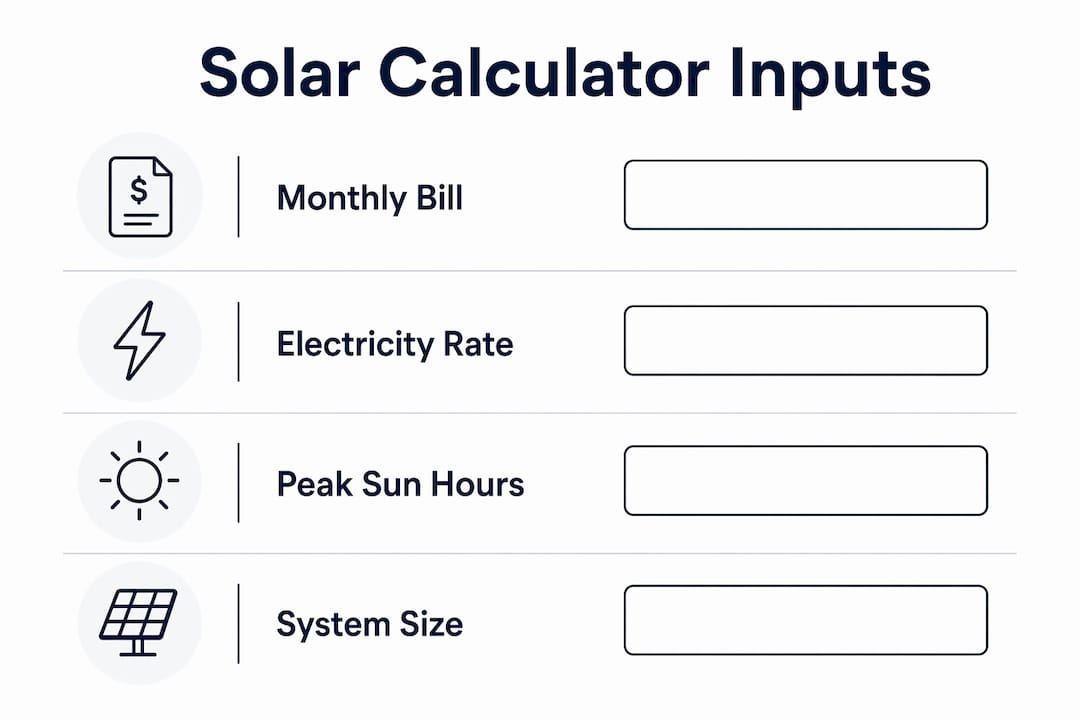
A solar return on investment calculator is only as accurate as the data you feed it. Four inputs drive every meaningful estimate: your average monthly electricity bill, your electricity rate per kilowatt-hour, your local peak sun hours, and your intended system size in kilowatts.
Your monthly electricity bill is the easiest to find. Pull the last three months of Eskom or municipal utility statements and average the totals. Use only the electricity consumption portion, not the full bill amount. Many homeowners accidentally include water or refuse charges, which inflates the baseline and skews every output figure. Your electricity rate appears on the same statement, usually expressed as cents per kilowatt-hour. Rates vary by municipality in South Africa. Cape Town, Johannesburg, and Durban each apply different tariff structures, so confirm your exact rate rather than using a national average. Peak sun hours measure the daily hours when sunlight intensity reaches 1,000 watts per square meter. South Africa averages 4.5–6 peak sun hours per day depending on province, with the Northern Cape and North West receiving the highest irradiance. The Western Cape and KwaZulu-Natal sit at the lower end of that range. Using the wrong figure for your province will produce a meaningfully different production estimate. System size is typically expressed in kilowatts. A standard residential installation in South Africa runs between 3 kW and 10 kW. If you have not yet received installer quotes, use your monthly consumption in kilowatt-hours divided by your monthly peak sun hours as a rough sizing guide. Solarza's system size calculator automates this step for South African conditions.| Input | Typical South Africa Range | How to find it |
|---|---|---|
| Monthly electricity bill | R800–R4,000+ | Utility statement (electricity portion only) |
| Electricity rate | R2.00–R3.50/kWh | Utility statement or municipal tariff schedule |
| Peak sun hours | 4.5–6 hours/day | Province-specific irradiance maps |
| System size | 3 kW–10 kW | Installer quote or sizing calculator |
 Pro Tip: Never use the national default peak sun hours figure if your calculator offers one. Gauteng and the Northern Cape differ by more than a full hour per day, and that gap compounds across 25 years of projected savings.
How do you use a solar savings calculator step by step?
The solar ROI calculation process follows a clear sequence. Understanding each step prevents misreading the output.
- Enter your monthly electricity bill. Use the electricity-only figure from your utility statement.
- Input your electricity rate. Enter the rate in rand per kilowatt-hour.
- Set your peak sun hours. Use your province's average, not a national default.
- Enter your system size. Use your installer's quoted capacity or your sizing estimate.
- Set the rate inflation assumption. Standard models use 3%–5% annual increases. South Africa's historical tariff increases justify using the higher end.
- Review the output figures. The calculator returns estimated annual savings, payback period, and lifetime savings over 25–30 years.
The payback period is the most watched output. It equals your net system cost divided by your first-year savings. A 6 kW system producing roughly 8,760 kWh annually at 80% efficiency gives you a concrete first-year savings figure to divide against. Lifetime savings across a 25-year system life can reach substantial totals, especially when electricity rate inflation compounds over time.
The carbon offset figure appears in most calculators as a secondary output. For South African homeowners, this number carries real weight given Eskom's coal-heavy generation mix. Every kilowatt-hour you generate locally displaces a meaningful volume of grid-sourced emissions.
Pro Tip: Run three scenarios: one with 3% annual rate inflation, one with 5%, and one with the actual average Eskom tariff increase from the last five years. The spread between those three outputs shows you the realistic range of your long-term savings, not just a single optimistic number.What are the common pitfalls of solar savings calculators?
Solar savings calculators use fixed efficiency inputs and simplified assumptions. Real-world outcomes vary because of factors no online tool can fully model from your postcode alone.
Roof orientation and tilt matter more than most homeowners expect. A north-facing roof at 30 degrees in South Africa captures significantly more energy than an east or west-facing surface. Shading from trees, chimneys, or neighboring buildings cuts production further. Calculators cannot account for these variables without a physical site assessment.
Most basic tools also omit inverter replacement costs. Inverters typically require replacement every 12–15 years, and that cost reduces your actual lifetime ROI. Panel degradation runs at 0.3%–0.8% annually for quality systems. A calculator that ignores degradation overstates savings in years 15–25.
Net metering and export credit policies add another layer of complexity. Local utility buy-back policies directly affect how much of your exported energy translates to bill reduction. South African municipalities apply different rules, and some do not offer feed-in credits at all. If your calculator assumes full credit for every kilowatt-hour exported, the output will be optimistic.
Watch for these warning signs when reviewing calculator results:
- The tool does not ask for your roof orientation or shading conditions.
- Lifetime savings figures assume zero maintenance or inverter replacement costs.
- The export credit assumption is not stated or is set to 100%.
- The electricity rate inflation assumption is below 3% for South Africa.
- The payback period is under four years without a clear explanation of incentives applied.
Treat calculator results as a planning screen, not a design tool. They tell you whether solar is worth investigating further. They do not replace a professional site assessment and multiple installer quotes.
How to maximize accuracy when using a solar power savings calculator
Accuracy improves when you move from generic defaults to inputs specific to your property and province. The difference between a basic and an advanced approach is not technical skill. It is the quality of the data you bring to the tool.
Basic vs. advanced input approaches
| Approach | Inputs used | Estimate quality |
|---|---|---|
| Basic | National averages, estimated bill | Directional only; ±30% variance |
| Intermediate | Actual bill, municipal rate, province sun hours | Reasonable planning estimate; ±15% variance |
| Advanced | All intermediate inputs plus roof orientation, shading, battery size, financing type | High-quality estimate; ±5–10% variance |
Verify your electricity rate tier with your municipality before entering it. Many urban South African homeowners pay a stepped tariff, where the rate increases above a consumption threshold. If your calculator uses a single flat rate and you are a high consumer, your savings estimate will be understated.
Lifetime solar savings depend on rising electricity costs, panel degradation, maintenance, and inflation all working together. Modeling each variable separately, then combining them, gives you a more honest picture than a single blended output.
Pro Tip: Document at least three scenarios in a spreadsheet: a small system with cash purchase, a larger system with financing, and a battery-integrated system. Comparing these side by side shows you the real trade-off between upfront cost and long-term savings, which no single calculator output can capture.Key Takeaways
A solar savings calculator gives South African homeowners a reliable planning baseline, but accurate results require province-specific inputs, honest assumptions about rate inflation, and a follow-up professional assessment.
| Point | Details |
|---|---|
| Four core inputs drive every estimate | Monthly bill, electricity rate, peak sun hours, and system size determine all output figures. |
| Rate inflation assumptions matter | Use 3%–5% annual increases to reflect South Africa's historical Eskom tariff trajectory. |
| Calculators have real limits | Roof orientation, shading, and inverter replacement costs require a site assessment to quantify. |
| Battery storage changes the math | Self-consumption during load shedding adds savings that basic solar panel calculators do not capture. |
| Use results as a starting point | Combine calculator outputs with multiple professional quotes before committing to any system. |
Why I think most homeowners misread their calculator results
The most common mistake I see is treating the payback period as a fixed promise. A calculator tells you that your system pays back in seven years. The homeowner signs a contract expecting exactly that. Then the inverter needs replacing in year 12, the municipality changes its export credit policy in year nine, and the actual payback lands closer to ten years. That is still a good outcome. But the gap between expectation and reality creates frustration that could have been avoided.
The primary purpose of a solar savings calculator is to establish the cost of doing nothing: paying rising grid rates for 25 years versus investing in generation capacity now. That framing is more useful than any single payback figure. When you see your projected grid spend over 25 years sitting next to your projected solar spend, the decision becomes obvious for most South African properties.
Battery storage is where I see the biggest gap between calculator outputs and real-world value. Most homeowners run a basic solar ROI calculator that ignores batteries entirely. But in South Africa, where load shedding has reshaped how families use electricity, the value of stored energy during an outage is real and measurable. A calculator that excludes battery savings will consistently understate the total return for a South African property.
My practical advice: use the calculator to qualify the investment, then use installer quotes to price it. Walk into every quote conversation with your calculator output in hand. Ask the installer to explain any gap between their projected savings and yours. That conversation reveals more about the quality of the installer than any review ever will.
— Kobus Kohvik
Ready to move from estimate to installation?
Solarza connects South African homeowners with verified, rated solar installers across all nine provinces. Once your solar savings estimate points toward a viable investment, the next step is getting real quotes from professionals who know your local conditions, tariff structures, and load shedding patterns.

Use the Solarza solar cost calculator to refine your estimate with South Africa-specific inputs, then find installers in your city to request tailored quotes. Solarza's platform lets you compare offers from vetted installers by province, services offered, and brand, so your calculator estimate becomes a real installation plan. Solarza reports that homeowners can reduce electricity bills by up to 90% after installation.
FAQ
What does a solar savings calculator actually calculate?
A solar savings calculator estimates how much you could reduce your electricity bill by generating your own power. It compares your projected solar production against your current consumption and electricity rate to produce annual and lifetime savings figures.
How accurate is a solar panel savings calculator?
Basic calculators carry a variance of roughly ±30% because they rely on national averages. Using province-specific peak sun hours, your actual electricity rate, and your roof orientation improves accuracy to within ±5–10%.
Does a solar savings calculator include battery storage?
Most basic tools do not include battery storage by default. For South African homeowners, adding battery inputs is worth the extra step because battery-integrated models capture self-consumption savings during load shedding that a panel-only calculation misses.
What is a realistic solar payback period in South Africa?
Payback periods vary by system size, financing method, and local electricity rates. A cash-purchased system on a north-facing roof with good sun exposure typically pays back faster than a financed system on a shaded or east-facing roof.
Should I use a solar ROI calculator before getting installer quotes?
Yes. Running a solar return on investment calculation first gives you a benchmark to evaluate installer quotes against. It also helps you ask better questions about system size, degradation assumptions, and export credit policies during the quoting process.