Solar Panel Finance South Africa: 2026 Options Guide
 *
*
TL;DR:>
- Solar panel financing in South Africa offers structured payment options like loans, PPAs, and rent-to-own to make solar adoption affordable. Tax incentives and regulations influence choices by reducing costs and guiding compliance, especially for businesses. Long-term ownership usually provides the greatest financial benefit, while PPAs suit those prioritizing cash flow and minimal upfront costs.*
Solar panel finance in South Africa is defined as any structured payment method that lets homeowners and businesses install solar systems without paying the full cost upfront. Load shedding and rising Eskom tariffs have pushed solar adoption from a luxury to a practical necessity. The good news is that solar power financing options in South Africa now cover everything from bank loans and hire purchase agreements to Power Purchase Agreements (PPAs) and rent-to-own models. The right choice depends on your capital, credit profile, and how long you plan to stay in the property. This guide breaks down every major option so you can make a clear, informed decision.
1. What are the main solar panel finance options in South Africa?
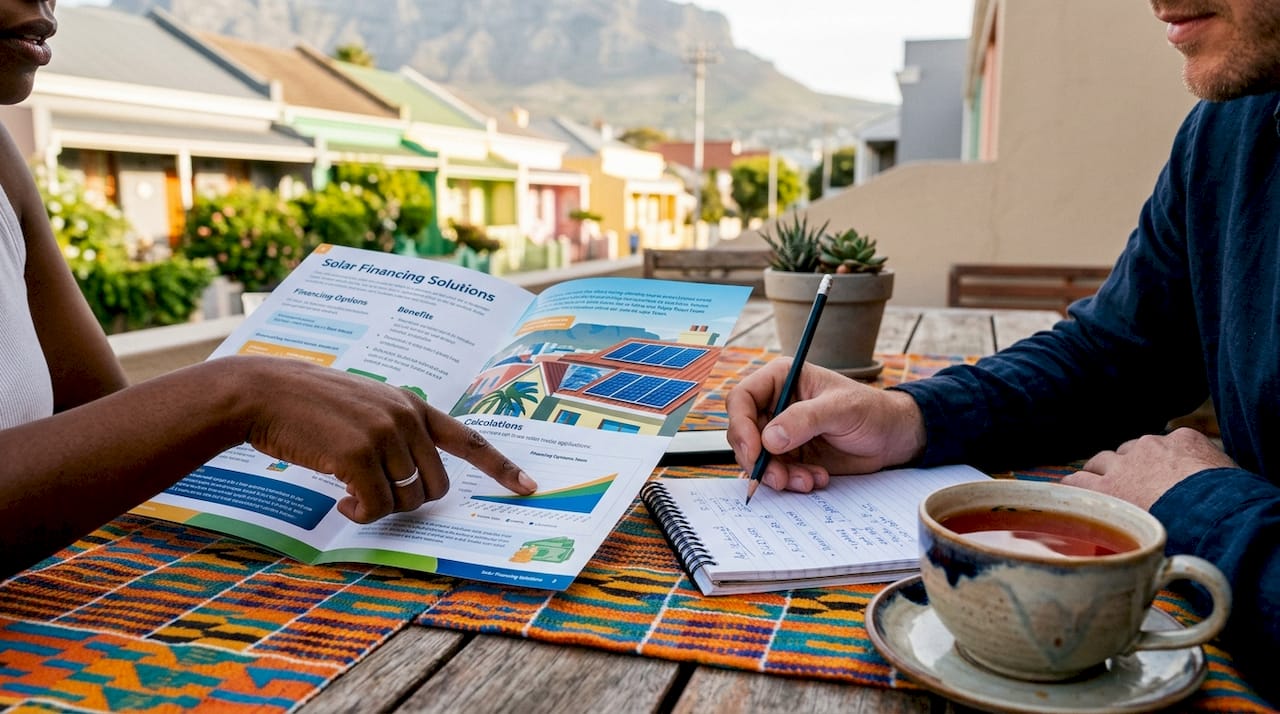 Solar financing has shifted the conversation from "Can I afford solar?" to "Which payment model fits my situation?" That shift matters because it opens the door for far more South Africans to go solar.
The six core financing categories are:
- Cash purchase: You own the system outright from day one. No interest, no contracts, and maximum long-term savings. The downside is a large upfront outlay, typically R80,000 to R250,000 for a residential system.
- Asset finance (hire purchase or instalment sale): A bank or lender funds the system. You repay over 3–7 years with fixed monthly installments. South African solar asset finance is priced at prime plus 2–5%, and a 10–30% deposit is standard.
- Operating lease or rental: The provider owns the system and charges a monthly rental fee. You get solar energy without ownership, which suits renters or homeowners who prefer predictable costs.
- Rent-to-own: Similar to a lease, but ownership transfers to you at the end of the contract. This model combines low upfront costs with eventual full ownership.
- Power Purchase Agreement (PPA): You pay only for the electricity the system generates, often at 10–30% below current grid tariffs. The provider owns and maintains the system throughout the contract.
- Green bonds and sustainability loans: Products like the Nedbank Green Savings Bond and Standard Bank sustainability-linked loans offer concessional rates for renewable energy projects.
Pro Tip: Compare the total cost of ownership across the full contract term, not just the monthly payment. A lower monthly PPA rate can cost more over 15 years than a hire purchase agreement paid off in 5.
2. How tax incentives and South African regulations shape your financing decision
Tax incentives directly reduce the net cost of solar, which changes which financing model makes the most financial sense.
The Section 12B tax allowance provides 125% accelerated depreciation on solar assets used for trade. A R1,500,000 installation can generate a tax saving of over R500,000 at the 27% corporate tax rate. That saving in year one dramatically improves the return on a cash purchase or asset finance deal for businesses.
On the regulatory side, SSEG registration is required for any grid-connected solar system over 1kW. Eskom registration costs are suspended until march 2026, but the process still takes 2–6 weeks. Municipal feed-in tariffs vary by city, and some municipalities allow you to sell surplus power back to the grid, which improves the financial case for larger systems.
NERSA (the National Energy Regulator of South Africa) governs the broader licensing framework. Understanding your municipality's feed-in tariff before signing any finance agreement is critical because it affects your monthly savings calculation.
Pro Tip: If you run a business, claim Section 12B in the same tax year the system is commissioned. Delaying the claim means losing the accelerated depreciation benefit.3. What are the benefits and risks of rent-to-own and PPA models?
Rent-to-own and PPAs are the most popular solar finance options for South Africans who cannot or prefer not to deploy large amounts of capital upfront.
Rent-to-own benefits:- Zero or low upfront cost
- Fixed monthly payments that are predictable
- Ownership transfers at contract end, building long-term asset value
- Maintenance is typically covered by the provider during the contract
- PPA contracts transfer performance risk to the provider entirely
- You pay only for energy generated, not for system downtime
- Tariffs are often 10–30% below Eskom rates from day one
- PPA terms typically run 10–20 years, with an option to buy the system at residual value
- Total cost over a 15 or 20-year PPA can exceed the purchase price of the system
- Early exit clauses in PPA contracts can be expensive
- You do not benefit from rising property value linked to system ownership under a PPA
- Maintenance and performance risk stays with the provider under both models, which is an advantage, but it also means less control over system decisions
4. How to evaluate your financial situation before choosing a solar finance option
The best solar financing option for you is determined by four factors: capital availability, credit profile, energy usage, and tax position.
Start with capital. If you have R100,000 or more available and no better investment opportunity, a cash purchase delivers the highest lifetime return. If that capital is tied up or earns a higher return elsewhere, asset finance or a PPA preserves liquidity while still cutting your electricity bill.
Next, check your credit profile. Asset finance and hire purchase agreements require a credit check. A strong credit score unlocks better interest rates, which reduces the total cost of borrowing. A weaker credit profile may push you toward a PPA or rental model, which typically has no credit requirement because the provider owns the asset.
Energy usage determines system size, which determines financing amount. Use a solar savings calculator to estimate your monthly consumption and match it to a system size before approaching any lender. Oversizing a financed system increases monthly payments without proportional savings.
Finally, assess your tax position. Businesses that pay corporate tax benefit most from Section 12B. Residential homeowners do not qualify for Section 12B but may benefit from the personal income tax rebate introduced in 2023 for rooftop solar panels.
Pro Tip: Model your cash flow over the full system lifetime, not just year one. A 25-year solar panel lifespan means the financing decision you make today affects your energy costs well into the 2040s.5. How commercial and industrial solar financing differs from residential
Commercial and industrial solar financing operates on a different scale and with different tools than residential options.
Instalment sales for businesses allow Section 12B tax depreciation claims and off-balance-sheet financing for systems over 300kW. That structure preserves credit facilities, which matters for businesses that need borrowing capacity for operations or expansion.For large commercial systems, the core decision is between EPC (Engineering, Procurement, and Construction) ownership and a PPA. Ownership maximizes savings but carries maintenance risk and requires capital. A PPA preserves capital and transfers technical risk to the provider, but reduces long-term savings potential.
ESG (Environmental, Social, and Governance) reporting requirements are increasingly driving commercial solar decisions. Green bonds and sustainability-linked loans from institutions like the Development Bank of Southern Africa and Nedbank offer concessional rates aligned with ESG targets. These products are not available to residential buyers, making them a distinct advantage for qualifying businesses.
Adding battery storage and wheeling options to a commercial system complicates the financing structure but delivers greater energy management control. Businesses should work with a qualified financial advisor and a vetted installer to model the full cost-benefit picture before committing to any structure.
6. How to compare solar panel payment options side by side
Comparing solar finance options requires looking at four variables: upfront cost, monthly payment, total cost over the contract term, and who owns the system.
| Finance model | Upfront cost | Ownership | Best for |
|---|---|---|---|
| Cash purchase | High | Immediate | Capital-rich buyers seeking max savings |
| Asset finance | Low (10–30% deposit) | At contract end | Buyers with good credit and stable income |
| Rent-to-own | Zero to low | At contract end | Buyers wanting ownership without large deposits |
| PPA | Zero | Provider | Businesses and homeowners prioritizing cash flow |
| Operating lease | Zero | Provider (always) | Renters or short-term occupants |
| Green bond/sustainability loan | Varies | Immediate | Businesses with ESG targets |
When comparing quotes, always ask for the total cost of the agreement, not just the monthly installment. A lower monthly payment stretched over 20 years can cost significantly more than a higher payment over 5 years.
7. Where to find verified solar installers and financing partners in South Africa
Finding a reputable installer is as important as choosing the right finance model. A poorly installed system underperforms, which erodes the financial case for any financing structure.
Solarza connects homeowners with verified solar installers across all nine provinces. Each installer on the platform is vetted and rated, which reduces the risk of poor workmanship that can void warranties and undermine your financing returns. You can search by city, province, or service type to find the right match for your system size and budget.
Before requesting quotes, use the Solarza solar panel price guide to understand current market pricing for panels, inverters, and batteries. That context helps you evaluate whether a financed quote is priced fairly or inflated.
Pro Tip: Always get at least three quotes before signing a finance agreement. Installer pricing varies significantly, and a lower system cost means a smaller loan, lower monthly payments, and faster payback.Key Takeaways
The best solar finance option in South Africa depends on your capital availability, credit profile, and whether you prioritize ownership, cash flow, or tax efficiency.
| Point | Details |
|---|---|
| Cash purchase delivers the highest return | Buyers with available capital save the most over the system's 25-year lifespan. |
| Section 12B cuts business costs significantly | A R1,500,000 system can generate over R500,000 in tax savings at the 27% corporate rate. |
| PPAs suit cash-flow-sensitive buyers | PPA tariffs run 10–30% below Eskom rates with zero upfront cost and no maintenance risk. |
| SSEG registration is mandatory | Grid-connected systems over 1kW require registration, which takes 2–6 weeks to complete. |
| Always model total contract cost | Monthly payment comparisons mislead. Total cost over the full term is the only fair comparison. |
South Africa's solar finance market is maturing faster than most people realize
I have watched the South African solar finance market shift from a niche product for wealthy homeowners to a mainstream financial decision that rivals a car loan in accessibility. That shift is real, but it comes with a trap most buyers fall into.
The trap is fixating on the monthly payment. A PPA at R1,200 per month sounds better than a hire purchase at R2,800 per month. But over 20 years, that PPA can cost R288,000 with nothing to show for it at the end. The hire purchase, paid off in 5 years, leaves you with a fully owned asset generating free electricity for another 20 years.
My honest view is that ownership, through cash or asset finance, is almost always the better long-term decision for homeowners who plan to stay in their property. PPAs make sense for businesses protecting credit lines or homeowners in rented properties. The zero-upfront pitch is compelling, but the math rarely favors it over a full system lifetime.
The other thing I see consistently underestimated is installer quality. A poorly installed system on a great finance deal is still a bad deal. Vet your installer as carefully as you vet your finance terms. Check ratings, ask for references, and confirm that the installer is registered with the South African Photovoltaic Industry Association (SAPVIA).
— Kobus Kohvik
Solarza makes solar financing simpler for South African homeowners
Getting the right solar finance deal starts with knowing your system cost and finding an installer you can trust.
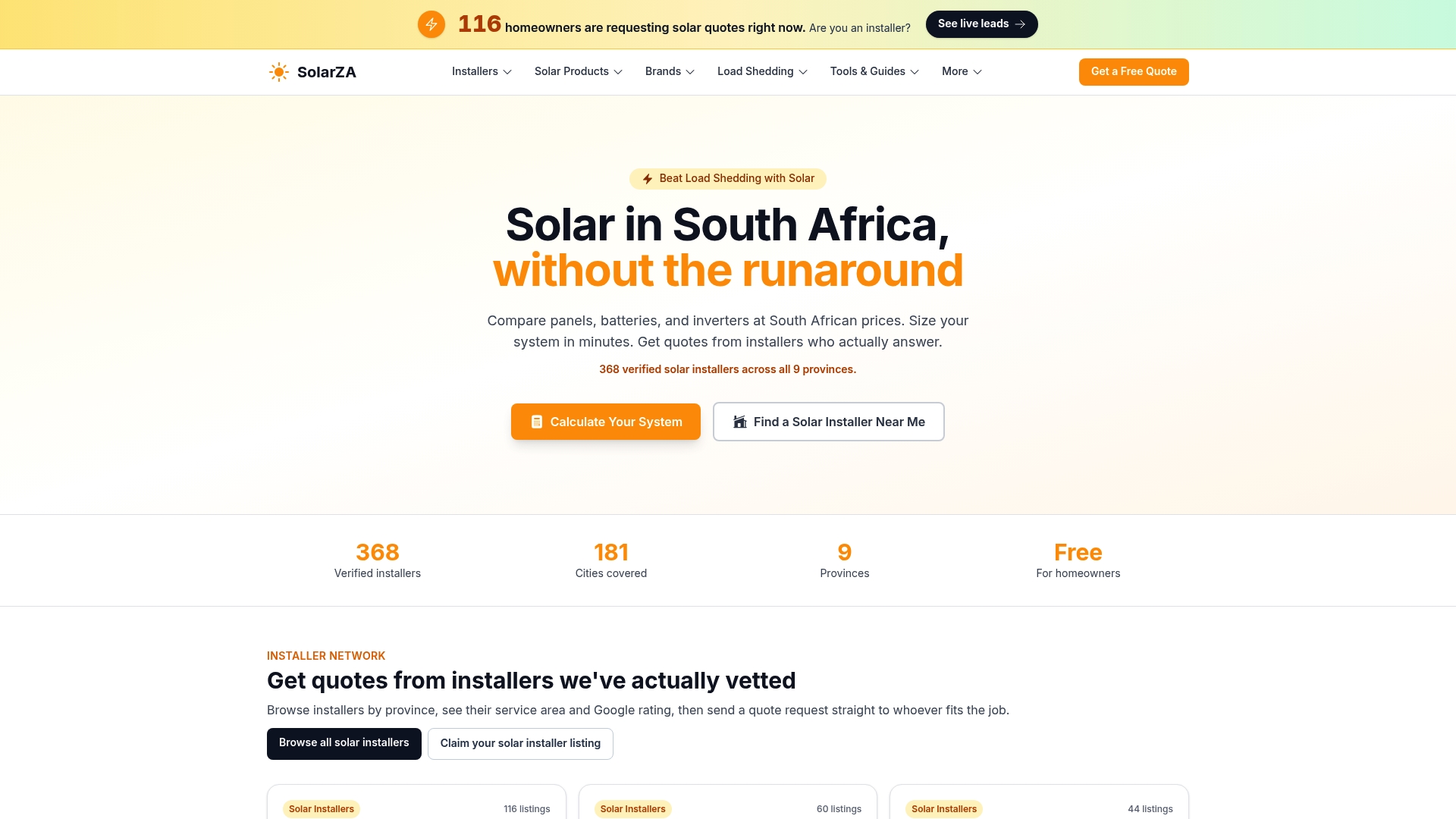
Solarza gives you both. The platform connects you with vetted, rated solar installers across all nine provinces, so you are never guessing about quality. Use the free solar quote tool to get tailored pricing from local installers, then compare your options with confidence. Solarza also lists solar installers by province so you can find qualified professionals in your area quickly. Whether you are financing a residential rooftop system or a large commercial installation, Solarza gives you the information and connections to make a sound decision.
FAQ
Can you finance solar panels in South Africa?
Yes. South African homeowners and businesses can finance solar panels through asset finance, hire purchase, PPAs, rent-to-own agreements, and green loans from major banks.
What is the best way to finance solar panels in South Africa?
Cash purchase delivers the highest lifetime return, but asset finance is the best balance of ownership and affordability for buyers with a good credit profile and a 10–30% deposit.
Is financing solar panels worth it in South Africa?
Yes, particularly given rising Eskom tariffs and frequent load shedding. PPA tariffs run 10–30% below grid rates, and financed systems often generate positive cash flow from the first month.
What is Section 12B and how does it affect solar financing?
Section 12B is a South African tax allowance that provides 125% accelerated depreciation on solar assets used for trade, generating significant tax savings for businesses in the year of commissioning.
How long does SSEG registration take in South Africa?
SSEG registration for grid-connected solar systems over 1kW takes 2–6 weeks, depending on your municipality's processes and workload.