Solar Calculator South Africa: Estimate Your System in 2026
 *
*
TL;DR:>
- A South African solar calculator estimates system size, cost, and savings based on consumption and sunlight conditions. It helps homeowners plan for energy independence amid rising tariffs and load shedding. Accurate data and professional follow-up are essential for effective solar investment decisions.*
A solar calculator for South Africa is a tool that estimates the optimal solar system size, installation cost, and potential savings based on your electricity usage and local sunlight conditions. South African homeowners face a specific combination of pressures: Eskom tariffs rising at roughly 12.7% per year and ongoing load shedding that makes energy independence a financial priority, not just a lifestyle choice. The right solar energy calculator gives you a credible starting point before you spend a cent on a site visit or installer quote. Solarza's solar calculator tool is built specifically for South African conditions, factoring in local sun hours, tariff structures, and system costs.
What data do you need to use a solar calculator in South Africa?
Accurate inputs produce accurate estimates. Feed a solar panel sizing tool the wrong numbers and the output is useless, regardless of how well the tool is built.
The four inputs that matter most are:
- Monthly kWh consumption. Find this on your Eskom or municipal electricity bill. Look for the line labeled "units used" or "kWh." A typical South African household uses 600–900 kWh per month.
- Electricity tariff (R/kWh). Your current rate determines how much each kilowatt-hour costs you. Eskom's residential tariff varies by municipality, so use your actual bill figure.
- Location or peak sun hours. South Africa receives strong solar irradiance, but the exact figure varies by region. The KZN coast averages 5.0 peak sun hours daily, while the Highveld averages about 5.7 hours. That difference changes the number of panels you need for the same energy output.
- Appliance load for backup sizing. List the appliances you want to run during load shedding, along with their wattage and hours of use. This determines your battery bank size, not your panel array.
Pro Tip: Pull three months of electricity bills and average the kWh figures. A single month can be misleading if you ran a pool pump or air conditioner more than usual.
Reading your bill correctly is the single biggest source of input error. The "amount due" in rands is not the same as your consumption in kWh. Always use the kWh figure, not the rand amount, when entering data into any solar system cost estimator.
How does the solar calculator determine system size and components?
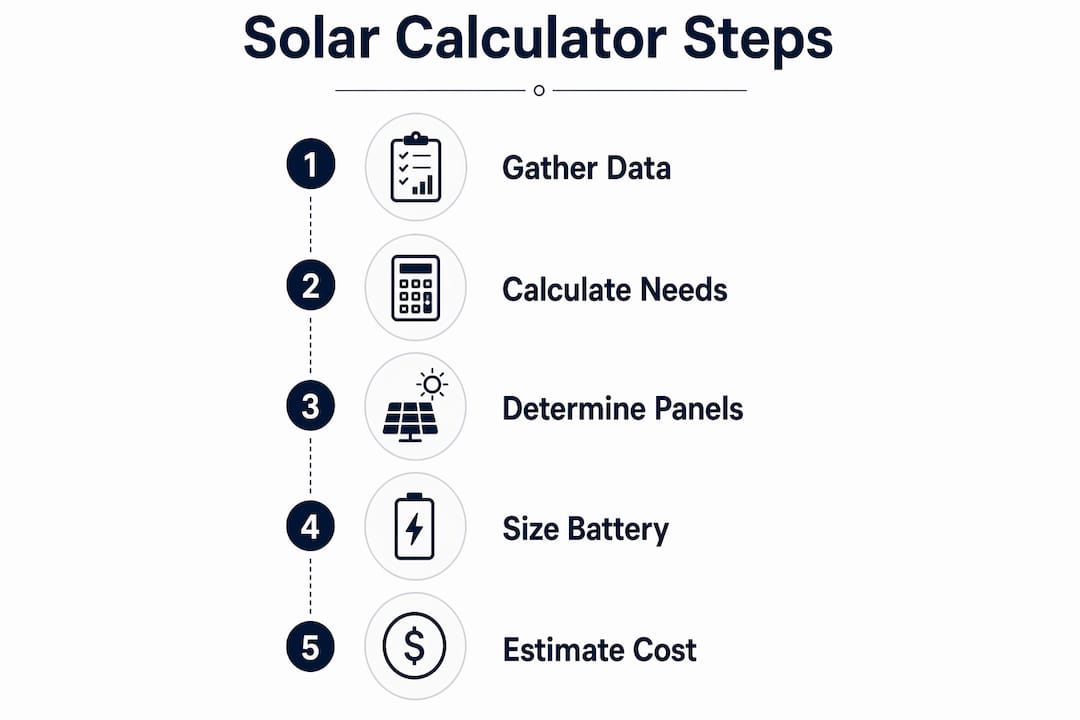
The calculation moves through three layers: daily energy needs, panel array size, and battery plus inverter sizing. Each layer feeds the next.

From monthly usage to daily energy needs
Divide your monthly kWh by 30 to get your daily consumption. A household using 750 kWh per month needs 25 kWh per day. That number is the foundation for every other calculation.
From daily needs to panel array size
The calculator divides your daily energy need by the peak sun hours for your location, then adjusts for real-world losses. Real-world system efficiency sits at 75–80% of theoretical output, accounting for shading, inverter losses, panel degradation, and cable voltage drops. That means a system sized for 25 kWh per day must actually be designed to produce closer to 31–33 kWh to deliver the target after losses.
The steps look like this:
- Calculate daily energy need (monthly kWh ÷ 30).
- Adjust for efficiency losses (divide by 0.77 as a midpoint estimate).
- Divide the adjusted figure by your location's peak sun hours to get the required kilowatt-peak (kWp) rating.
- Divide the kWp figure by the wattage of your chosen panel (e.g., 550W) to get the panel count.
Sizing the battery bank and inverter
Battery sizing depends on how many hours of backup you need and the depth of discharge your battery chemistry allows. LiFePO4 batteries should not be discharged below 20% state of charge to maintain a 10–15 year lifespan. That means only 80% of the nominal capacity is usable. A 10 kWh battery bank delivers 8 kWh of real backup.
Inverter capacity is determined by peak simultaneous load, not daily consumption. If you run a 2,000W oven, a 1,500W kettle, and a 500W TV at the same time, your inverter must handle at least 4,000W continuously.
Pro Tip: Size your inverter at 20% above your calculated peak load. This buffer protects the unit from thermal stress during surge currents when motors start.Typical households consuming 600–900 kWh per month need 5–8 kW solar systems with 10–15 panels. System costs in early 2026 range from R120,000 to R280,000 depending on configuration.
Understanding the cost and savings estimates from solar calculators
A solar energy calculator does not just size your system. It also projects the financial return, and that projection is where most South African homeowners find the most value.
The key financial factors the calculator weighs are:
- Upfront system cost. For a mid-range home using 750 kWh per month, a hybrid system with battery backup typically falls in the R150,000–R200,000 range in 2026.
- Tariff escalation. A R2,000 monthly electricity bill grows to roughly R6,500 in 10 years at the current 12.7% annual increase rate. That escalation is what makes the payback math compelling.
- Payback period. Most residential installations in South Africa pay back in 5–8 years as of April 2026. Systems without batteries pay back faster because the upfront cost is lower.
- Financing impact. Solar financing in South Africa is typically available at prime rate plus about 2%. A R87,000 system financed over 5 years at 12.25% interest carries monthly repayments of around R1,900. For many homeowners, that figure is already lower than their current electricity bill.
The distinction between daytime savings and full backup savings matters here. A grid-tied system without batteries saves money only when the sun shines. A hybrid system with batteries saves money around the clock and provides load shedding protection. The calculator should let you toggle between these scenarios so you can compare the payback difference directly.
The main financial driver for solar ROI in South Africa is electricity bill reduction, not load shedding backup. Backup is a real benefit, but the numbers that justify the investment come from offsetting tariff increases year after year.
Common mistakes and limitations when using solar calculators
A solar calculator online gives you a ballpark figure, not a final quote. Understanding where the estimate can go wrong helps you use the output correctly.
The most common errors are:
- Ignoring shading. A single shaded panel on a string can reduce output for the entire string, not just that one panel. Calculators cannot account for your specific roof's shadow patterns.
- Using nominal battery capacity instead of usable capacity. A 15 kWh battery bank with a 20% depth-of-discharge limit delivers 12 kWh of usable energy. Calculators that use nominal figures will overestimate your backup time.
- Misreading the payback period. Homeowners who add a large battery bank for load shedding comfort often extend their payback period significantly. The calculator is accurate, but the goal shifts from bill reduction to backup, and the math changes accordingly.
- Applying the wrong peak sun hours. Using a national average instead of your specific region's figure introduces meaningful error. A Durban home and a Johannesburg home with identical consumption need different panel arrays.
- Treating the estimate as a final design. Solar calculators serve as quick estimation tools, not exact quotations. Roof orientation, panel tilt angle, and local shading all require a physical site assessment to quantify accurately.
The output from any solar calculator for home use is a starting point for a conversation with an installer, not a purchase order.
How to use a solar calculator online for your South African home
Getting useful results from a solar calculator takes about 10 minutes if you have your electricity bill in hand. Here is the process:
- Gather your bill. Find your most recent Eskom or municipal statement and note the kWh consumed and the rand-per-kWh tariff.
- Open the calculator. Solarza's cost estimator tool is built for South African conditions and includes location-based sun hour data.
- Enter your monthly kWh and tariff. Use the actual kWh figure from your bill, not the rand amount.
- Select your location. Choose your province or city so the tool applies the correct peak sun hours for your area.
- Choose your backup preference. Indicate whether you want a grid-tied system, a hybrid system with battery backup, or an off-grid setup. This choice drives the battery sizing output.
- Review the results. The calculator will return a recommended system size in kWp, a panel count, a battery bank size, an estimated cost range, and a projected payback period.
- Use the output to request quotes. Take the recommended system specifications to at least two or three verified solar installers in your area. Compare their quotes against the calculator's estimate to spot outliers.
Pro Tip: Run the calculator twice: once with battery backup and once without. The difference in payback period often surprises homeowners and helps clarify whether backup is worth the extra upfront cost for your situation.
A standard residential installation takes 1–2 days from site assessment through testing. Knowing this helps you plan around work schedules and minimizes disruption.
Key Takeaways
A solar calculator gives South African homeowners a reliable estimate of system size, cost, and savings, but accurate inputs and realistic expectations are what make the output useful.
| Point | Details |
|---|---|
| Accurate inputs are critical | Use your actual kWh figure from your electricity bill, not the rand amount. |
| Location changes system size | KZN and Highveld homes need different panel arrays for identical energy output due to sun hour variation. |
| Battery capacity is not all usable | LiFePO4 batteries deliver only 80% of nominal capacity; size your bank on usable kWh. |
| Tariff escalation drives ROI | A R2,000 monthly bill grows to roughly R6,500 in 10 years at 12.7% annual increases. |
| Calculators are starting points | Always follow up with a professional site assessment before committing to a system design. |
Why I think most homeowners use solar calculators the wrong way
Most people open a solar calculator looking for permission to buy. They want a number that confirms the decision they have already made emotionally. That is not a criticism. Load shedding is genuinely disruptive, and the frustration is real. But it leads to a specific mistake: sizing the system around backup comfort rather than bill reduction.
I have seen homeowners add R60,000 worth of extra battery capacity to cover a 4-hour load shedding slot, pushing their payback from 6 years to nearly 10. The backup is real and valuable, but the financial case weakens considerably. The tariff escalation math is what makes solar a genuinely strong investment in South Africa. Focus the calculator on that first.
The second mistake is trusting a single calculator run. Run it with your actual three-month average consumption, not your highest bill. Then run it again with your lowest bill. The range between those two outputs tells you something honest about your system's real-world performance window.
On battery chemistry: LiFePO4 is the right choice for South African conditions. The temperature tolerance, cycle life, and depth-of-discharge characteristics suit our climate and usage patterns better than older lead-acid alternatives. The upfront cost is higher, but the 10–15 year lifespan makes the per-cycle cost lower over time.
Finally, do not dismiss financing because it feels like debt. A monthly loan repayment that is lower than your current electricity bill is not debt. It is a hedge against an asset that keeps appreciating in value as Eskom tariffs climb.
— Kobus Kohvik
Solarza connects your calculator results to real installer quotes
Running a solar calculator online is step one. Getting a verified installer to confirm and refine that estimate is step two.

Solarza connects South African homeowners with vetted, rated solar installers across all nine provinces. Whether your calculator output points to a 5 kW grid-tied system or a 10 kW hybrid setup with battery backup, Solarza's installer directory by city matches you with qualified professionals who can turn that estimate into a firm quote. The platform also covers solar panel pricing, battery options, and inverter comparisons so you arrive at your installer conversation already informed. Homeowners who install through Solarza's network report electricity bill reductions of up to 90%.
FAQ
What is a solar calculator for South Africa?
A solar calculator for South Africa is an online tool that estimates the solar system size, cost, and savings you need based on your electricity consumption and local sun hours. It accounts for South African tariff rates and geographic irradiance variation to produce location-specific results.
How accurate are solar calculator estimates?
Solar calculators provide reliable ballpark figures but do not replace a professional site assessment. Shading, roof orientation, and appliance variability all affect final system design in ways a calculator cannot fully capture.
How many solar panels does a typical South African home need?
A household consuming 600–900 kWh per month typically needs 10–15 panels in a 5–8 kW system. The exact count depends on panel wattage and your location's peak sun hours.
What is the payback period for solar in South Africa?
Most residential solar systems in South Africa pay back in 5–8 years as of 2026, driven primarily by Eskom tariff increases of 12.7% per year rather than load shedding savings alone.
Can I finance a solar system in South Africa?
Solar financing is widely available at prime rate plus approximately 2%. A well-sized system can carry monthly repayments that are lower than your current electricity bill, making the switch cash-flow positive from the first month.